
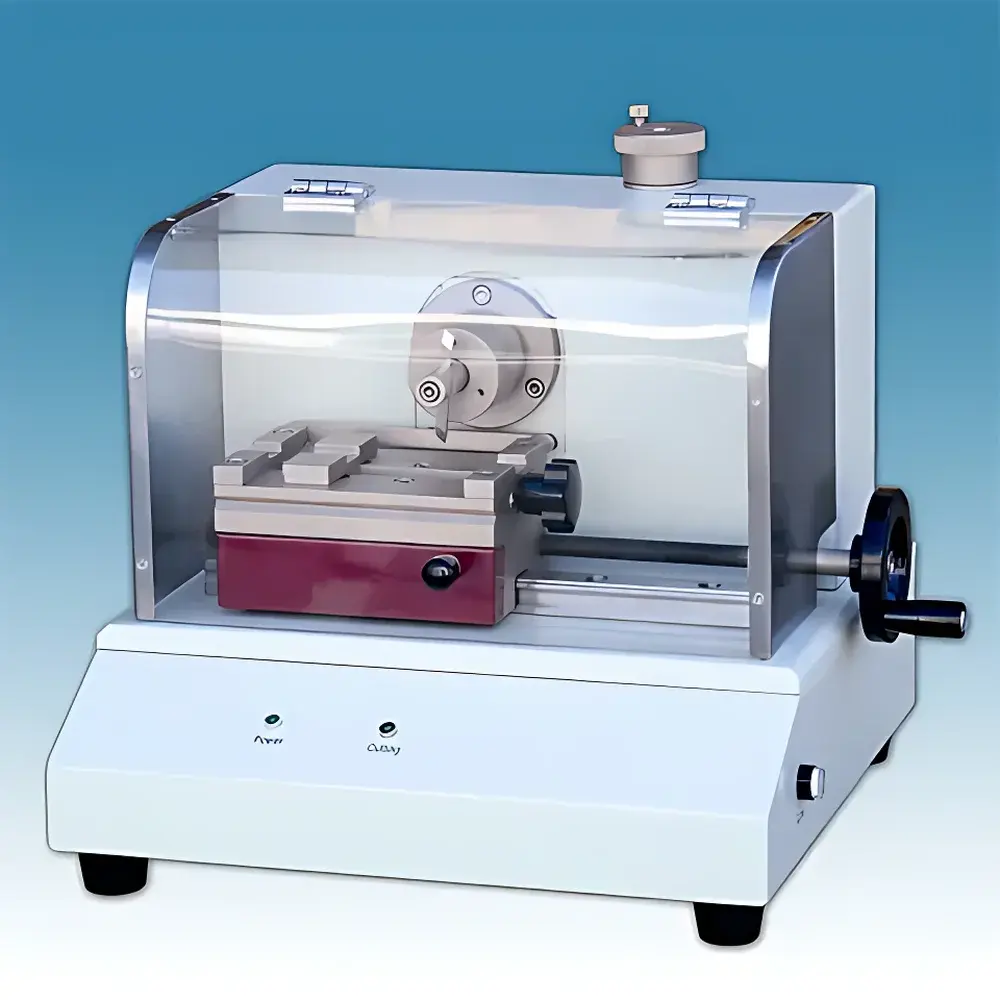
Hengyi HY-QKERT Notching Machine for Charpy/Izod Impact Testing
| Brand | Hengyi |
|---|---|
| Origin | Shanghai, China |
| Manufacturer | Hengyi Test Equipment Co., Ltd. |
| Model | HY-QKERT |
| Compliance | ISO 179–2000, ISO 180–2001, GB/T 1043–2008, GB/T 1843–2008 |
| Sample Dimensions | 80 mm × 10 mm × 4 mm (customizable) |
| Notch Types | Type A (45° ± 0.2°, r = 0.25 ± 0.05 mm), Type B (45° ± 0.2°, r = 1.0 ± 0.05 mm), Type C (45° ± 0.2°, r = 0.1 ± 0.02 mm) |
| Feed Rate | 0–2.5 mm adjustable |
| Feed Stroke | 10 mm |
| Table Travel | >90 mm |
| Cutting Speed | 30 mm/min |
| Throughput | ≥60 notched specimens per 10 minutes (20 specimens loaded simultaneously) |
| Power Supply | 220 VAC ±10% / −15%, 50 Hz, single-phase three-wire |
| Overall Dimensions | 400 mm (L) × 270 mm (W) × 300 mm (H) |
| Tool Material | Imported European high-alloy steel, hardness > HRC 60, surface roughness Ra < 0.4 µm |
Overview
The Hengyi HY-QKERT Notching Machine is a precision-engineered benchtop system designed exclusively for the reproducible preparation of standardized notches in rigid plastic and non-metallic specimens prior to Charpy (simply supported beam) or Izod (cantilever beam) impact testing. It operates on a controlled linear feed principle, utilizing hardened alloy steel cutting tools to generate geometrically precise V-notches—critical for eliminating inter-laboratory variability in impact energy measurements. The machine conforms strictly to the dimensional and tolerancing requirements defined in ISO 179–2000 (Charpy impact), ISO 180–2001 (Izod impact), GB/T 1043–2008, and GB/T 1843–2008, ensuring full traceability and compliance with international mechanical testing protocols used in quality control laboratories, R&D centers, and third-party certification bodies.
Key Features
- High-throughput batch processing: Simultaneous clamping of up to 20 specimens; average production rate exceeds 60 notched samples per 10-minute cycle.
- Multi-notch capability: Interchangeable tool holders support rapid switching between Type A (r = 0.25 mm), Type B (r = 1.0 mm), and Type C (r = 0.1 mm) notch geometries—all compliant with ISO/GB angular tolerance (45° ± 0.2°) and radius tolerance specifications.
- Precision motion control: Linear table travel >90 mm with fine-adjustable feed range (0–2.5 mm) and fixed stroke (10 mm), enabling consistent depth-of-cut and minimal burr formation.
- Industrial-grade tooling: European-sourced high-alloy steel cutting tools, heat-treated to >HRC 60, with surface finish Ra < 0.4 µm—engineered for extended service life, repeatable sharpening, and dimensional stability over thousands of cuts.
- Operator ergonomics & safety: Fully enclosed cutting zone with interlocked guard, manual feed override, and integrated chip collection tray to minimize handling exposure and maintain workspace cleanliness.
Sample Compatibility & Compliance
The HY-QKERT accepts standard test bars measuring 80 mm × 10 mm × 4 mm (length × width × thickness), as specified in ISO 179 and ISO 180. Custom specimen dimensions—including alternative widths (e.g., 15 mm) or thicknesses (e.g., 3 mm or 6 mm)—can be accommodated via optional fixture kits. All notch profiles are validated against metrological reference standards: certified gauge blocks (L120, L80, L63.5 mm) are supplied for routine calibration verification of table positioning accuracy. The machine’s output is fully compatible with accredited impact testing workflows under ISO/IEC 17025, supporting GLP-compliant documentation when paired with laboratory information management systems (LIMS).
Software & Data Management
The HY-QKERT is a standalone electromechanical instrument with no embedded microprocessor or digital interface. Its operation relies entirely on analog controls and mechanical repeatability—eliminating firmware dependencies, cybersecurity risks, or software validation requirements. This architecture ensures long-term operational consistency and simplifies regulatory audits under FDA 21 CFR Part 11 (where electronic records are not generated) or ISO 9001:2015 clause 7.1.5.1 (monitoring and measurement resource control). Maintenance logs, calibration records, and tool usage history can be maintained manually or integrated into existing LIMS via barcode-scanned specimen IDs and operator-entered batch metadata.
Applications
- Preparation of ASTM D6110 / ISO 179-compliant specimens for Charpy impact evaluation of thermoplastics (e.g., ABS, PC, PP), thermosets (e.g., epoxy, phenolic), and fiber-reinforced composites.
- Routine QC in polymer compounding facilities requiring daily verification of notch sensitivity across production lots.
- Academic research labs conducting comparative fracture mechanics studies where notch root radius (r = 0.1–1.0 mm) is a critical independent variable.
- Certification testing per UL 94, IEC 60695, or EN 60695-11-10, where standardized impact resistance data informs flammability classification.
- Supplier qualification programs demanding ISO 17025-accredited impact test data with documented specimen preparation traceability.
FAQ
Does the HY-QKERT require computer connectivity or proprietary software?
No. It is a fully mechanical-electrical device with manual feed control and no digital interface, ensuring operational simplicity and audit readiness.
Can the machine produce both ISO Type A and Type B notches on the same specimen batch?
Yes—tool changeover takes under 90 seconds using the included hex key; each tool is pre-calibrated and referenced to its respective gauge block set.
What maintenance is required to sustain notch dimensional accuracy over time?
Monthly inspection of tool sharpness using optical profilometry or calibrated magnifiers; annual recalibration of table travel using the supplied L120 gauge block and dial indicator.
Is the HY-QKERT suitable for use in an ISO 17025-accredited laboratory?
Yes—its design supports documented calibration, traceable tool certification, and operator training records, fulfilling ISO/IEC 17025:2017 clauses 6.4.3 (environmental conditions) and 6.5.2 (measurement traceability).
Are replacement tools and fixtures available through global distribution partners?
Yes—Hengyi maintains ISO 9001-certified tool manufacturing in Europe; all replacement cutters carry material certificates and hardness verification reports.
Related Products



