
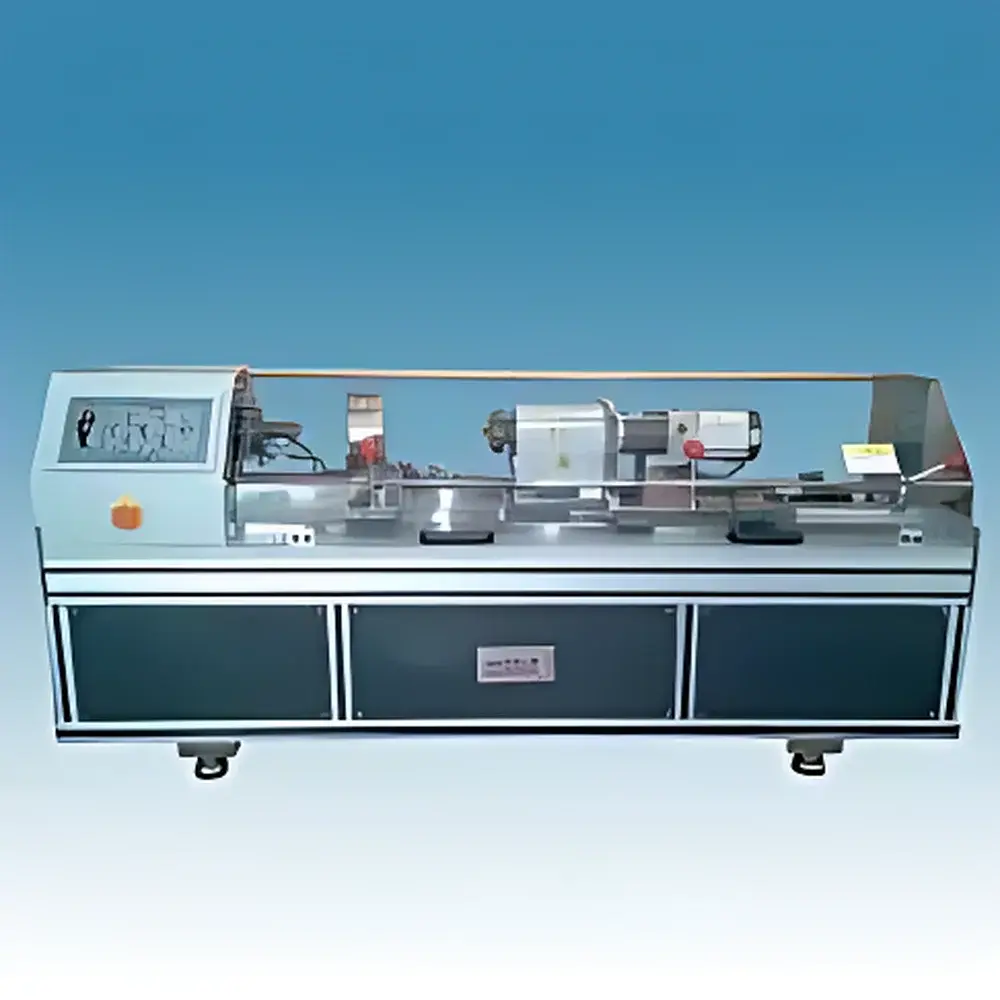
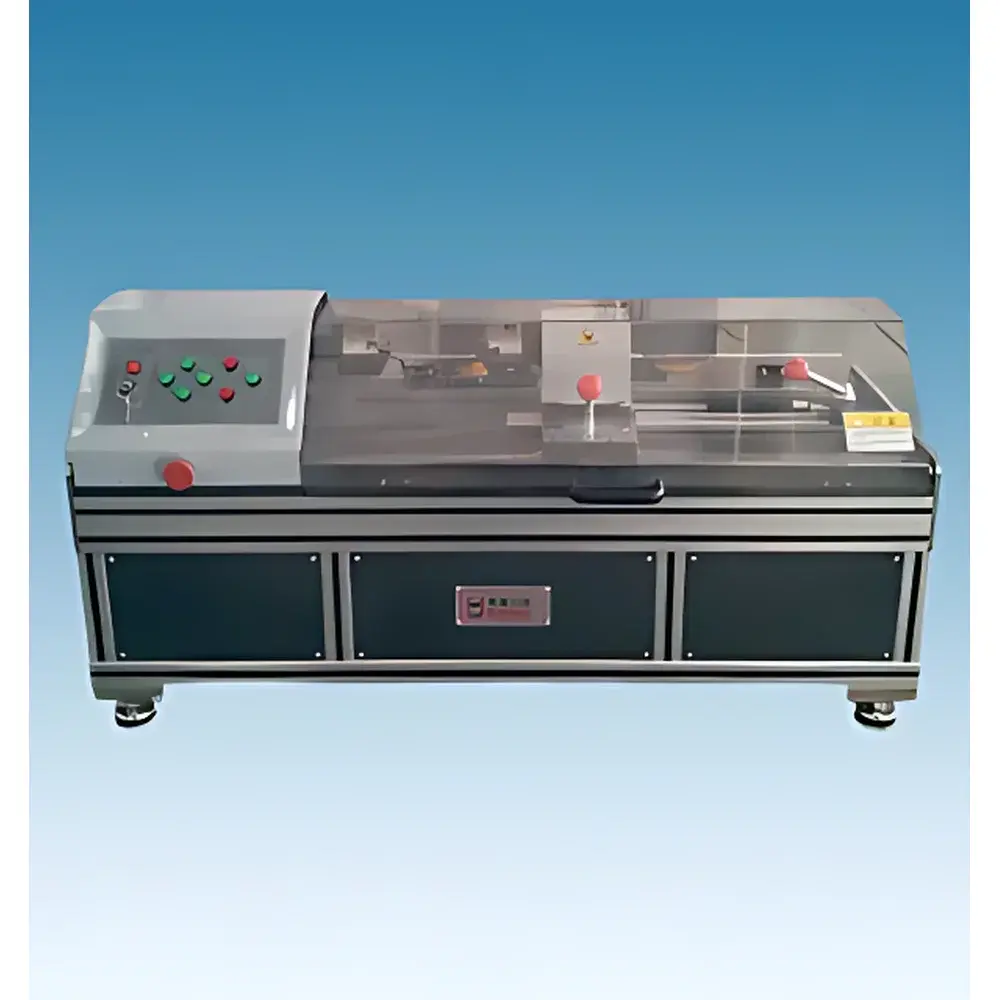
Hengyi HY-50N·m Orthopedic Implant Bone Screw Torsion Testing Machine
| Brand | Hengyi |
|---|---|
| Origin | Shanghai, China |
| Manufacturer Type | Direct Manufacturer |
| Model | HY-50N·mPKBBFD |
| Max Torque | 50 N·m |
| Torque Measurement Range | 0.1–50 N·m |
| Torque Resolution | 1/500,000 FS |
| Torsion Angle Range | 0–100,000° (or continuous rotation) |
| Motor Power | 0.4 kW |
| Torque Accuracy | ±0.5% FS |
| Angular Accuracy | ±0.5% FS |
| Angular Resolution | 0.0045° |
| Rotational Speed Range | 0–1000°/min |
| Specimen Clamping Diameter | Φ1–Φ5 mm (customizable) |
| Gauge Length Adjustment | Up to 200 mm |
| Dimensions (L×W×H) | ≈1000×420×500 mm |
| Weight | 200 kg |
Overview
The Hengyi HY-50N·m Orthopedic Implant Bone Screw Torsion Testing Machine is a precision-engineered, horizontally configured torsion testing system designed specifically for biomechanical evaluation of orthopedic implants—particularly cortical and cancellous bone screws—and related biomaterials. It operates on the principle of controlled rotational loading under static or quasi-static conditions, applying calibrated torque while simultaneously measuring angular displacement and real-time torsional response. The system complies with fundamental mechanical test methodologies defined in ISO 14801 (Dental implants — Dynamic fatigue testing), ASTM F543 (Standard Specification and Test Methods for Metallic Medical Bone Screws), and ISO 6474-1 (Ceramic implants — Mechanical testing of ceramic components). Its architecture integrates high-fidelity torque transduction, sub-arcminute angular resolution, and closed-loop servo control to ensure traceable, repeatable, and GLP-compliant data acquisition for regulatory submissions and peer-reviewed research.
Key Features
- High-resolution torque measurement using a calibrated load cell with 1/500,000 full-scale resolution and verified accuracy of ±0.5% FS across the entire 0.1–50 N·m range.
- Panoramic angular measurement via imported optical encoder with 0.0045° resolution and ±0.5% FS linearity—enabling precise determination of shear modulus (G), non-proportional shear stress (τp), yield torque, ultimate torsional strength, and fracture angle.
- Japan Panasonic AC servo motor drive system with 1:2,000,000 speed regulation ratio and ≤0.5% speed stability—supporting controlled ramp, step, hold, and cyclic torsional profiles from 0.01°/min to 1000°/min.
- Bidirectional torsional capability with programmable reversal logic, enabling fatigue-relevant hysteresis loop analysis and reverse-torque failure assessment per ISO 14801 Annex C.
- Modular jaw design accommodating cylindrical specimens from Φ1 mm to Φ5 mm; optional custom fixtures available for K-wires, cannulated screws, and tapered self-tapping geometries.
- Integrated ARM32-based controller with 56 MIPS processing power, 100 Hz real-time sampling, and dual-channel synchronous acquisition for torque-angle, torque-time, and angle-time data streams.
- Compliance-ready software architecture supporting audit trails, electronic signatures, and configurable report templates aligned with FDA 21 CFR Part 11 requirements for regulated laboratories.
Sample Compatibility & Compliance
This torsion tester is validated for use with metallic (titanium alloy Ti-6Al-4V, stainless steel 316L), polymer (PEEK, UHMWPE), and composite orthopedic fasteners. It supports standardized test configurations for ASTM F543 Annex A (static torsion), ISO 14801 Clause 7.3 (dynamic torsion), and ISO 6474-1 Annex B (ceramic screw torsional strength). Specimen mounting follows ISO 5832-3 (implant materials) and ISO 12417-1 (surgical implants—general requirements). The machine’s mechanical repeatability (<0.8% CV across 10 repeated tests on identical titanium screws) meets ISO/IEC 17025 calibration verification thresholds for accredited testing labs.
Software & Data Management
The proprietary Hengyi TorsionTest v4.x software runs natively on Windows OS and provides synchronized multi-curve visualization (torque vs. angle, torque vs. time, angle vs. time), automatic parameter extraction (e.g., proportional limit torque, maximum torque, fracture angle, plastic deformation angle), and export to CSV, XML, or PDF formats. All test sessions are timestamped and logged with operator ID, environmental metadata (optional temperature/humidity input), and instrument calibration status. Raw data files include embedded checksums and are stored with SHA-256 hash integrity verification. The software supports user-defined test protocols, batch sequencing, and statistical post-processing (mean, SD, CV%, confidence intervals) per ISO 5725-2. Audit trail logs record every parameter change, result modification, or report generation event—fully compliant with GLP and GMP documentation standards.
Applications
- Static torsional strength and ductility evaluation of orthopedic bone screws per ASTM F543 and ISO 14801.
- Determination of shear modulus (G) and non-proportional shear stress (τp) using micro-angle measurement add-ons.
- Comparative torsional fatigue pre-screening of novel thread designs, surface coatings (hydroxyapatite, DLC), or heat-treated alloys.
- Mechanical validation of resorbable polymer screws (PLLA, PDLA) under simulated physiological torque loads.
- Quality control testing in ISO 13485-certified manufacturing environments for implant OEMs and contract manufacturers.
- Academic biomechanics research on bone–implant interface mechanics, including torsional loosening kinetics and interfacial shear stress distribution modeling.
FAQ
What international standards does this machine support for orthopedic screw testing?
It fully supports ASTM F543 (metallic bone screws), ISO 14801 (dental and orthopedic implant dynamic testing), ISO 6474-1 (ceramic implants), and ISO 5832 series (implant material specifications). Custom protocol scripting allows alignment with internal SOPs or regional regulatory expectations (e.g., MDR Annex I, PMDA guidance).
Can the system perform cyclic torsion fatigue tests?
Yes—the servo-controlled bidirectional actuation and high-speed data acquisition (100 Hz) enable programmable sinusoidal, trapezoidal, or block-wave torsional loading profiles for low-cycle fatigue (LCF) screening up to 10⁵ cycles, subject to optional thermal management and environmental chamber integration.
Is the software compliant with FDA 21 CFR Part 11?
The software includes role-based access control, electronic signature workflows, immutable audit trails, and data integrity safeguards meeting core technical requirements of 21 CFR Part 11 Subpart B. Full validation documentation (IQ/OQ/PQ) is available upon request for regulated users.
What is the minimum measurable torque and angular increment?
The system resolves torque down to 0.1 N·m with 1/500,000 FS resolution (equivalent to 0.0001 N·m at full scale), and angular displacement to 0.0045°—sufficient for precise elastic region characterization and micro-yield detection in small-diameter implants.
Does the machine require external calibration services?
The torque sensor and encoder are factory-calibrated with NIST-traceable certificates. Users may perform in-house verification using certified reference torque standards (e.g., ISO 376 Class 0.5) and angular goniometers; annual recalibration by an ISO/IEC 17025-accredited lab is recommended for GLP/GMP compliance.



