
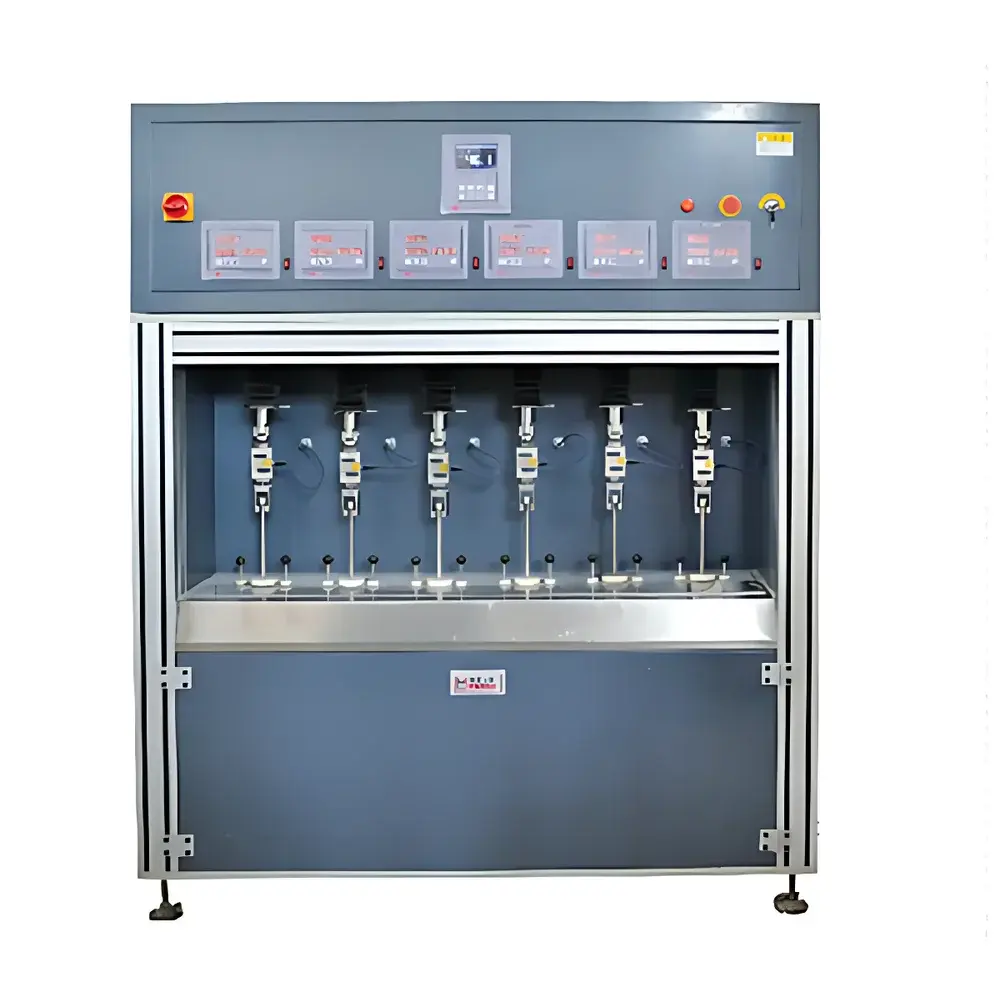
Hengyi HY-QKRBRTV Full-Notch Creep Testing System
| Brand | Hengyi / Hengyitest |
|---|---|
| Origin | Shanghai, China |
| Manufacturer Type | Direct Manufacturer |
| Region of Origin | Domestic (China) |
| Model | HY-QKRBRTV |
| Pricing | Upon Request |
| Load Capacity | 2000 N (interchangeable load cells available below 2000 N |
| Force Measurement Range | 0.4–99.99999% of full scale |
| Effective Test Width | 120 mm |
| Effective Test Height | 200 mm |
| Test Speed Range | 0.001–100 mm/min (infinitely variable) |
| Speed Accuracy | ±1% of indicated value |
| Displacement Measurement Accuracy | ±1% of indicated value |
| Strain/Deformation Measurement Accuracy | ±1% of indicated value |
| Test Stations | 6 or 12 independent stations |
| Temperature Control Range (Constant-Temp Bath) | Ambient to 95 °C |
| Temperature Stability | ±0.5 °C |
| Control Interface | PC-based software with automated data acquisition and real-time monitoring |
| Power Requirement | 10 kW, 220 V AC |
| Unit Weight | 850 kg |
| Dimensions (W×D×H) | 1620 × 850 × 1750 mm |
| Compliance Standards | GB/T 15820–1995, GB/T 11546, GB/T 32682–2016, ISO 899-1, ISO 16770, ISO 3501 |
Overview
The Hengyi HY-QKRBRTV Full-Notch Creep Testing System is a precision-engineered, multi-station mechanical testing platform designed specifically for evaluating environmental stress cracking (ESC) resistance and time-dependent deformation behavior in thermoplastic polymers—particularly polyethylene (PE) pipe materials, geomembranes, and high-performance composites. It implements the standardized Full-Notch Creep Test (FNCT), a critical accelerated aging methodology defined in ISO 16770 and GB/T 32682–2016. Unlike conventional tensile creep tests, FNCT introduces a controlled geometric stress concentrator (a full-thickness notch) into the specimen, enabling quantification of crack initiation and propagation under sustained static load in aggressive chemical environments (e.g., surfactant solutions) at elevated temperatures. The system operates within a thermostatically regulated water bath, ensuring precise thermal conditioning during long-duration tests that may extend from hundreds to thousands of hours. Its architecture supports simultaneous, statistically independent evaluation across up to 12 test stations—each with isolated mechanical loading, displacement sensing, and thermal management—thereby enhancing throughput, reproducibility, and inter-laboratory comparability.
Key Features
- Modular 6- or 12-station configuration with fully independent electromechanical loading units—no cross-talk between stations due to decoupled elastic support structures;
- High-resolution force control via interchangeable load cells (standard 2000 N capacity; optional lower-range transducers for enhanced sensitivity);
- Continuous closed-loop speed control from 0.001 to 100 mm/min, with traceable accuracy of ±1% of reading;
- Integrated constant-temperature water bath with PID-controlled heating and circulation, maintaining ±0.5 °C stability across the full 20–95 °C operational range;
- Automated diagnostic routines—including overload protection, thermal runaway prevention, and sensor calibration validation—to ensure uninterrupted operation over extended test cycles;
- Real-time synchronization of load, displacement, temperature, and time data streams at configurable sampling intervals (down to 100 ms);
- Rigid steel frame construction (850 kg total mass) minimizing vibrational artifacts and supporting long-term dimensional stability under sustained load.
Sample Compatibility & Compliance
The HY-QKRBRTV accommodates standard FNCT specimens per ISO 16770 (10 mm × 10 mm × 4 mm rectangular bars with full-thickness edge notch) as well as custom geometries for pipe pull-out (per GB/T 15820) and unnotched tensile creep (per ISO 899-1). Specimen holders are corrosion-resistant and compatible with aqueous surfactant media (e.g., Igepal CO-630, Triton X-100) and saline solutions. All mechanical and thermal subsystems comply with national and international metrological requirements for creep testing instrumentation. The system satisfies essential regulatory expectations for data integrity and audit readiness: raw measurement logs include timestamped metadata, user authentication tags, and immutable digital signatures—supporting GLP-compliant workflows and alignment with FDA 21 CFR Part 11 principles for electronic records and signatures when deployed in regulated quality assurance environments.
Software & Data Management
Hengyi’s proprietary Windows-based control software provides a dual-language (English/Chinese) interface for test definition, real-time monitoring, and post-processing. Users define test parameters—including target stress level (MPa), bath temperature, duration, and failure criteria—via intuitive wizards. During operation, the software continuously acquires synchronized force, displacement, and temperature signals, storing them in structured binary archives compliant with ASTM E1447 data exchange conventions. Automated analysis modules compute time-to-failure (TTF), calculate creep compliance (J(t)), generate master curves using time–temperature superposition (TTS), and plot standardized outputs: force–time, displacement–time, and log(stress) vs. log(TTF) scatter plots. Export options include CSV, PDF reports, and XML metadata files suitable for LIMS integration. Audit trails record all operator actions, parameter changes, and system events with ISO 8601 timestamps—enabling full traceability for internal QA reviews or external accreditation audits (e.g., CNAS, ILAC-MRA).
Applications
- Accelerated ESC screening of PE100 and PE100-RC pipe resins for gas/water distribution infrastructure;
- Comparative ranking of antioxidant package efficacy in HDPE geomembranes used in landfill liners;
- Validation of fusion joint integrity in butt-welded PE pipelines under simulated service conditions;
- Long-term performance modeling of polymer composites exposed to chlorinated water or ethanol blends;
- Supporting ISO 9001-certified QC laboratories in fulfilling contractual ESC test requirements per EN 12201 or AS/NZS 4130;
- Academic research on viscoelastic fracture mechanics and damage accumulation kinetics in semi-crystalline thermoplastics.
FAQ
What standards does the HY-QKRBRTV system directly support?
It is fully aligned with ISO 16770 (FNCT), ISO 899-1 (tensile creep), GB/T 32682–2016, GB/T 11546, and GB/T 15820 for pipe pull-out testing.
Can the system operate unattended for multi-week tests?
Yes—its embedded watchdog circuitry, redundant thermal safeguards, and non-volatile data logging enable continuous operation without manual intervention for up to 6,000 hours.
Is third-party calibration documentation available?
Each unit ships with NIST-traceable calibration certificates for load cells and temperature sensors, valid for 12 months from commissioning.
How is cross-contamination prevented between test stations?
Each station features physically isolated bath compartments with dedicated fluid circulation paths and independent heater–thermistor pairs.
Does the software support automated pass/fail evaluation against predefined TTF thresholds?
Yes—the test protocol editor allows users to embed conditional logic (e.g., “terminate if displacement exceeds 5 mm within 1,000 h”) and auto-generate compliance flags in final reports.



