
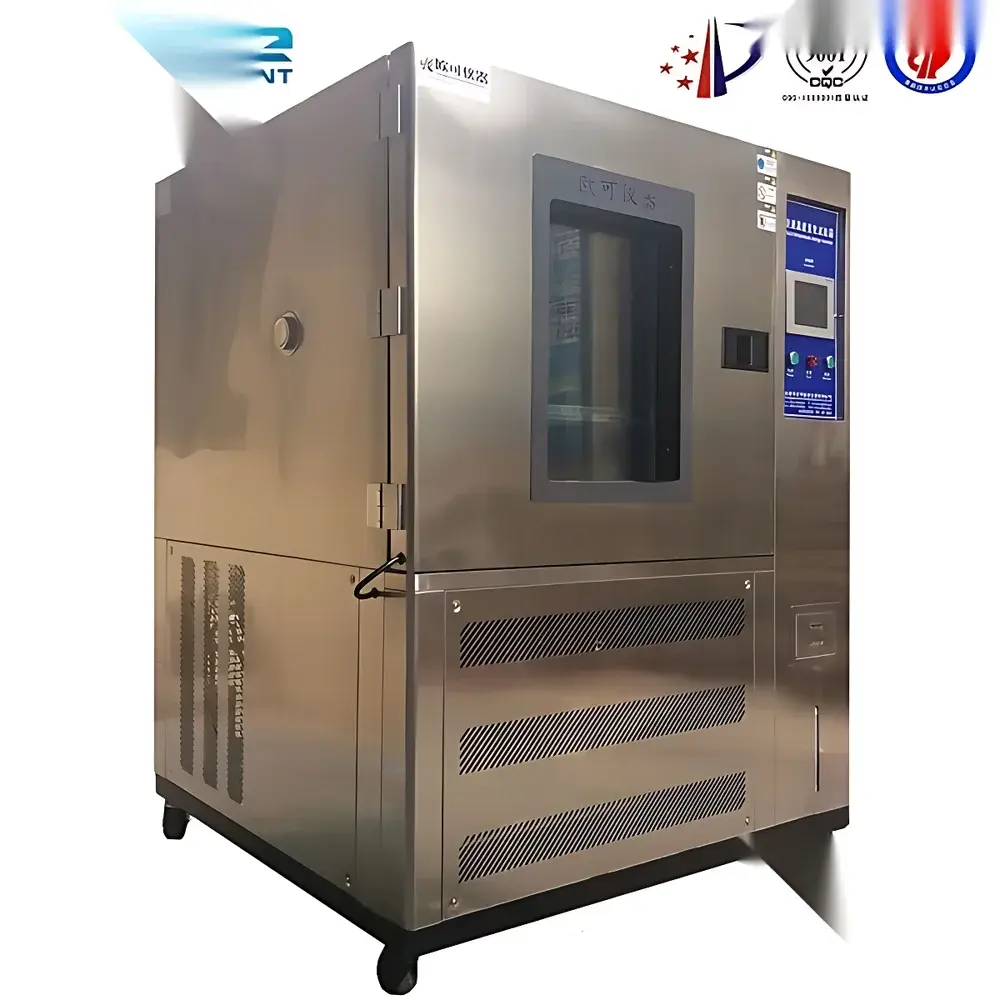
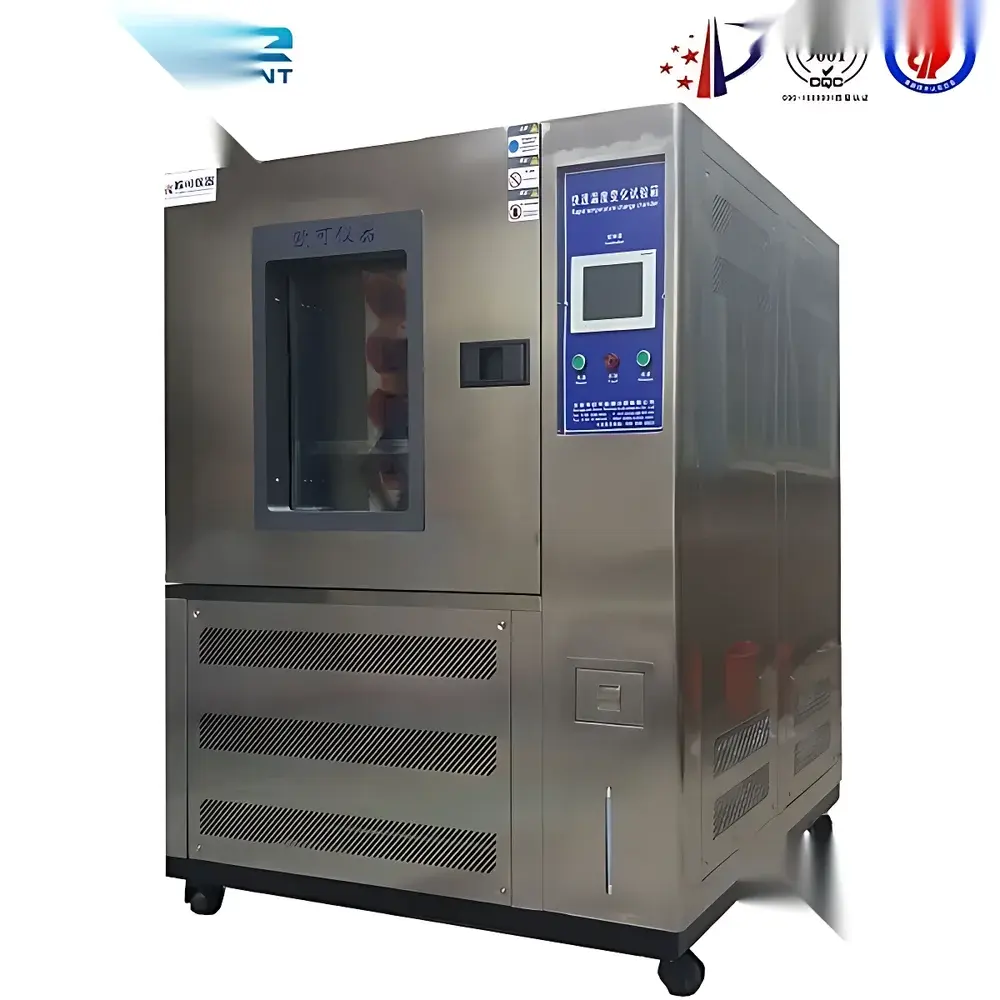
EngineerPro QT-150 to QT-1000 Series Rapid Thermal Cycling Chamber for Engine Components
| Key | Brand: OEM/White-Label |
|---|---|
| Origin | Imported (EU/Asia-sourced) |
| Manufacturer Type | Authorized Distributor |
| Price | USD 2,650–3,400 (FOB) |
| Internal Volume | 150–1000 L |
| Temperature Range | −70 °C to +150 °C |
| Humidity Range (optional) | 20–98% RH |
| Rapid Thermal Transition Range | −45 °C to +85 °C |
| Thermal Ramp Rate | 5–30 °C/min (linear or non-linear, model-dependent: A–F) |
| Temp. Uniformity | ±2.0 °C |
| Temp. Stability | ±0.5 °C |
| Humidity Uniformity | ±3.0% RH |
| Humidity Stability | ±2.5% RH |
| Temp. Resolution | 0.1 °C |
| Humidity Resolution | 0.1% RH |
| Construction | SUS304 stainless steel inner chamber |
| Insulation | 100–120 mm high-density polyurethane foam |
| Viewing Window | Multi-layer laminated tempered glass with embedded conductive ITO film |
| Cooling System | Dual-stage cascade refrigeration (French Tecumseh or German Bitzer compressors) |
| Control System | Fuji PXR4/PXR7 digital PID controller with SSR output, PT100 platinum RTD sensors |
| Safety Protections | High/low pressure cut-off, over-temperature/over-humidity interlock, phase failure detection, water shortage alarm, compressor overload protection |
| Power Supply | AC 380 V, 3-phase 5-wire, 50/60 Hz |
| Weight | 950–2300 kg |
Overview
The EngineerPro QT-Series Rapid Thermal Cycling Chamber is a purpose-engineered environmental test system designed specifically for accelerated thermal stress validation of internal combustion engines, powertrain subassemblies, and critical engine control units (ECUs). Unlike general-purpose climate chambers, the QT-Series implements a dual-stage cascade refrigeration architecture coupled with independent high-power heating circuits to achieve certified linear ramp rates from 5 °C/min up to 30 °C/min across the operational range of −45 °C to +85 °C — a requirement defined in MIL-STD-810H Method 503.5 and ISO 16750-4 for automotive electronics qualification. The chamber’s structural integrity is maintained through a seamless SUS304 stainless steel inner chamber, insulated with ≥100 mm closed-cell polyurethane foam (CFC-free, thermal conductivity ≤0.022 W/m·K), ensuring minimal thermal leakage during rapid transients and long-term stability under cyclic load.
Key Features
- Model-scalable platform covering 150 L to 1000 L internal volumes (QT-150 through QT-1000), enabling full-engine testing or modular component-level validation
- Configurable thermal ramp profiles: selectable linear or non-linear rate control with programmable dwell, soak, and transition segments per IEC 60068-2-14
- Optically optimized observation window featuring triple-layer tempered glass with sputtered indium tin oxide (ITO) conductive film — maintains >85% visible light transmission while eliminating condensation and frost accumulation during humidity-enabled cycles
- Dual independent thermal management: segregated heating (nickel-chromium far-infrared wire arrays) and cooling (cascade refrigeration with R404A/R23 refrigerant pairs) subsystems prevent cross-interference and ensure repeatability
- Fuji PXR-series digital controller with auto-tuning PID algorithm, real-time deviation compensation, and password-protected parameter locking — compliant with GLP audit requirements for traceable test execution
- Comprehensive safety architecture including refrigerant high/low pressure monitoring, solid-state over-temperature cutoff, phase-loss detection, and integrated fault logging with timestamped event history
Sample Compatibility & Compliance
The QT-Series accommodates engine blocks, cylinder heads, turbochargers, fuel injection systems, exhaust gas recirculation (EGR) valves, and electronic throttle bodies — with optional access ports (glove-compatible or feedthrough-configured) supporting real-time sensor cabling and thermocouple integration. All standard configurations meet EN 60068-2-14 (change of temperature), ISO 16750-4 (road vehicles — environmental conditions), and SAE J2334 (corrosion lab testing) mechanical interface specifications. Optional humidity capability (20–98% RH) extends applicability to ISO 16750-3 and ASTM D4329 for combined thermal-hygrometric aging of elastomeric seals and gasket materials. The chamber’s construction materials and electrical grounding comply with CE Machinery Directive 2006/42/EC and RoHS 2011/65/EU.
Software & Data Management
Controller firmware supports direct RS-485/Modbus RTU communication for integration into enterprise MES or LabVantage environments. Test logs — including setpoint trajectories, actual chamber readings, alarm timestamps, and system status flags — are exportable as CSV or XML files with UTC synchronization. When paired with optional data acquisition modules (e.g., 16-channel thermocouple input), the system enables synchronized multi-point thermal mapping per ISO 16750-4 Annex B. Audit trails retain operator ID, parameter changes, and calibration events — satisfying FDA 21 CFR Part 11 requirements when configured with user authentication and electronic signature protocols.
Applications
- Thermal shock endurance testing of aluminum and cast-iron engine blocks per GMW14872 Section 5.2.3
- Cyclic thermal validation of piezoelectric fuel injectors under transient cold-start and hot-soak conditions
- Qualification of ECU housing materials against coefficient-of-thermal-expansion (CTE) mismatch-induced microcracking
- Accelerated life testing of silicone and fluorosilicone gaskets used in turbocharger housings
- Correlation studies between laboratory thermal cycling and field-deployed durability data using Weibull-based failure modeling
- Support for ASAM MCD-2 MC-compliant test automation via CANoe or dSPACE SCALEXIO integration
FAQ
What standards does this chamber support for engine component qualification?
The QT-Series meets core requirements of ISO 16750-4, MIL-STD-810H Method 503.5, SAE J2334, and GMW14872 — with optional humidity extension supporting ISO 16750-3 and ASTM D4329.
Can the chamber maintain humidity while executing rapid temperature ramps?
Humidity control is decoupled from thermal ramping; stable RH is maintained only during isothermal holds. During active ramping, humidity is suspended to preserve thermal fidelity and avoid condensation risk.
Is remote monitoring and control supported?
Yes — via Modbus RTU over RS-485 or optional Ethernet/IP gateway. Full SCADA integration is achievable using standard OPC UA drivers.
What maintenance intervals are recommended for the refrigeration system?
Compressor oil and filter replacement every 12 months or 4,000 operating hours; annual calibration verification of PT100 sensors and controller output accuracy per ISO/IEC 17025 guidelines.
Are custom interior fixtures or mounting rails available?
Yes — EngineerPro offers configurable load-bearing shelf systems, vibration-isolated engine cradles, and liquid-coolant loop interfaces compatible with SAE J1952 coolant conditioning modules.



