
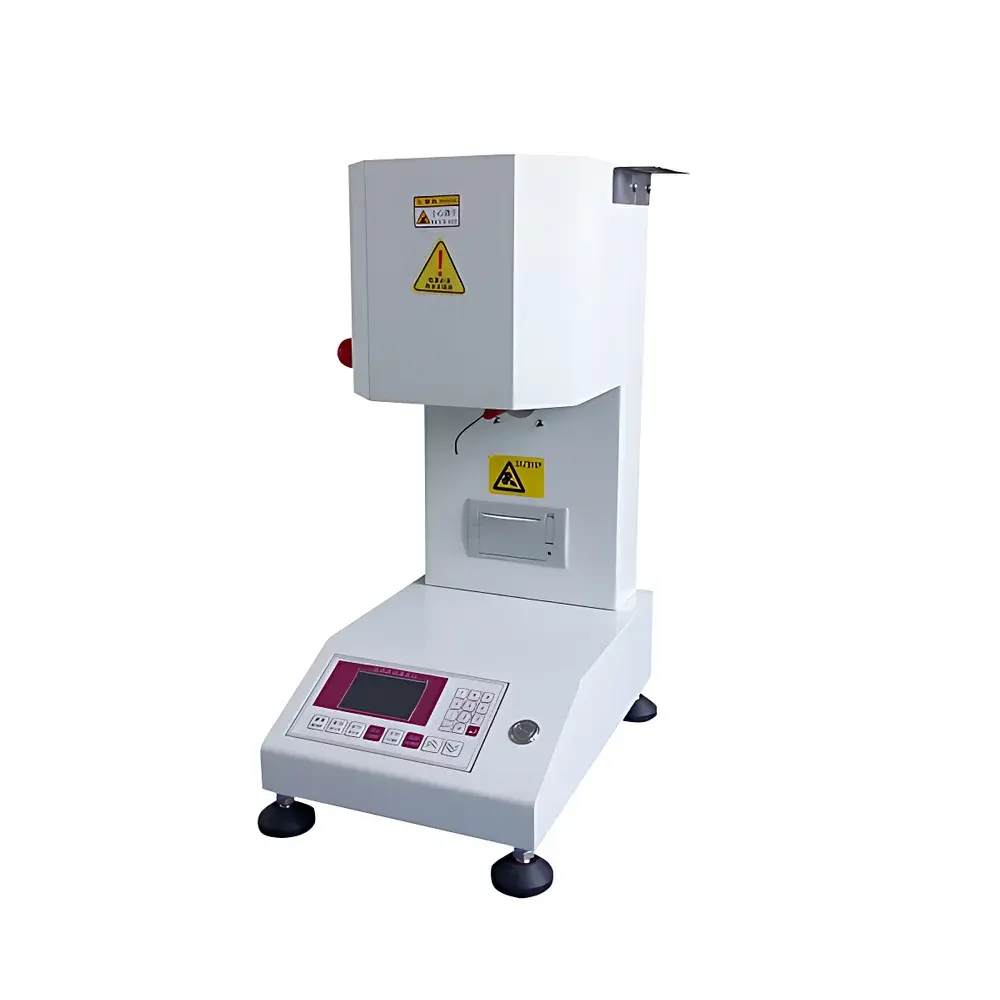
Hengyi HY(RZ)r Melt Flow Rate Tester
| Brand | Hengyi / Hengyitest |
|---|---|
| Origin | Shanghai, China |
| Manufacturer Type | Direct Manufacturer |
| Regional Classification | Domestic (China) |
| Model | HY(RZ)r |
| Pricing | Available Upon Request |
Overview
The Hengyi HY(RZ)r Melt Flow Rate Tester is an engineered instrument for the precise determination of melt mass flow rate (MFR) and melt volume flow rate (MVR) of thermoplastic polymers under standardized load and temperature conditions. It operates on the fundamental principle of extrusion rheology: a polymer sample is heated to a specified temperature in a cylindrical barrel, subjected to a defined compressive force via calibrated dead-weight loads, and extruded through a standardized capillary die. The mass or volume of extrudate collected over a defined time interval is used to calculate MFR (g/10 min) or MVR (cm³/10 min), per ISO 1133-1:2011, ASTM D1238-22, and GB/T 3682–2018. Designed for routine quality control and material specification verification in polymer production, compounding, and R&D laboratories, the HY(RZ)r integrates thermal stability, mechanical repeatability, and regulatory-compliant operation into a robust benchtop platform.
Key Features
- Thermal system with maximum operating temperature ≥400 °C and temperature control accuracy ≤±0.2 °C; achieves setpoint stabilization within ≤30 minutes and recovers thermal equilibrium in 2–4 minutes after sample loading.
- Dual-mode measurement capability: fully automated mass-based (MFR) and volume-based (MVR) testing, each compliant with ISO 1133-1 and GB/T 3682–2018 protocols.
- Eight-level standard load configuration (0.325 kg to 21.600 kg), traceable to SI units and validated against ISO 1133 Annex B; includes full set of certified weights with documented nominal forces (3.187 N to 211.82 N).
- Precision-machined capillary die: 2.095 ± 0.005 mm nominal diameter, 8.000 ± 0.025 mm length; barrel inner diameter 9.550 ± 0.025 mm, length 152.0 ± 0.1 mm; piston head diameter 9.475 ± 0.015 mm, length 6.350 ± 0.100 mm — all dimensions conforming to ISO 1133 geometric tolerances.
- Full-color PLC-based touchscreen interface with embedded control software supporting real-time temperature profiling, automatic timed cutting, calibration management, parameter logging, and simultaneous display of MFR/MVR results.
- Integrated safety architecture: insulated high-temperature zones with anti-scald shielding, quick-release mechanisms for wear-prone components (e.g., die, barrel, piston), and modular design enabling field replacement without specialized tools.
Sample Compatibility & Compliance
The HY(RZ)r supports a broad spectrum of thermoplastic resins including polyethylene (PE), polypropylene (PP), polystyrene (PS), polyoxymethylene (POM), ABS, polycarbonate (PC), nylon (PA6, PA66), and fluoropolymers (e.g., PTFE, PVDF). All operational parameters and mechanical tolerances comply with national and international standards: GB/T 3682–2018, JB/T 5456–2005, ISO 1133-1:2011, and ASTM D1238-22. Structural packaging meets GB/T 13384 (general requirements for packaging of mechanical and electrical products); transport compliance follows GB/T 191 (marking for packaging) and GB/T 6388 (transportation marking). The instrument’s mechanical design and thermal performance are suitable for GLP environments where method traceability and equipment qualification are required.
Software & Data Management
The embedded PLC control system provides deterministic real-time operation without reliance on external PCs. Software functions include user-defined test profiles (temperature, load, cut interval), automatic start/stop logic, live temperature curve plotting, and dual-unit result output (MFR in g/10 min, MVR in cm³/10 min). All test parameters, timestamps, and raw measurements are stored internally with non-volatile memory retention. Audit-ready data export is supported via USB interface in CSV format, preserving full metadata (operator ID, date/time, calibration status, environmental notes). While not natively 21 CFR Part 11 compliant, the system supports integration into validated laboratory informatics environments when deployed with supplementary procedural controls (e.g., password-protected access, manual logbooks, periodic electronic backup validation).
Applications
- Quality assurance of incoming polymer pellets and compounded masterbatches in manufacturing facilities.
- Batch-to-batch consistency verification during extrusion and injection molding process development.
- Correlation studies between MFR/MVR and mechanical properties (e.g., tensile strength, impact resistance) in R&D labs.
- Regulatory submission support for medical-grade polymers (ISO 10993-1) and food-contact materials (FDA 21 CFR 177).
- Educational use in polymer science curricula for demonstrating shear-thinning behavior and thermal degradation effects on melt viscosity.
FAQ
What standards does the HY(RZ)r comply with for MFR testing?
It conforms to GB/T 3682–2018, ISO 1133-1:2011, and ASTM D1238-22 for both MFR and MVR determinations.
Can the instrument perform both mass and volume flow rate measurements automatically?
Yes — it features fully automated timed cutting and integrated displacement sensing for concurrent MFR and MVR calculation without manual intervention.
Is the temperature control system validated for ISO 1133 thermal uniformity requirements?
The barrel zone maintains axial temperature deviation ≤±0.5 °C across the critical 30 mm die region at steady state, meeting ISO 1133-1 Annex A tolerance criteria.
How is traceability ensured for the applied test loads?
Each weight set is supplied with a manufacturer’s calibration certificate referencing national metrology standards; nominal forces are calculated from mass × local gravitational acceleration (g = 9.80665 m/s²).
What maintenance intervals are recommended for routine operation?
Capillary die and barrel should be inspected for wear or carbon buildup after every 50 tests; piston polishing and die bore verification are advised quarterly or per 200 cycles, whichever occurs first.



