
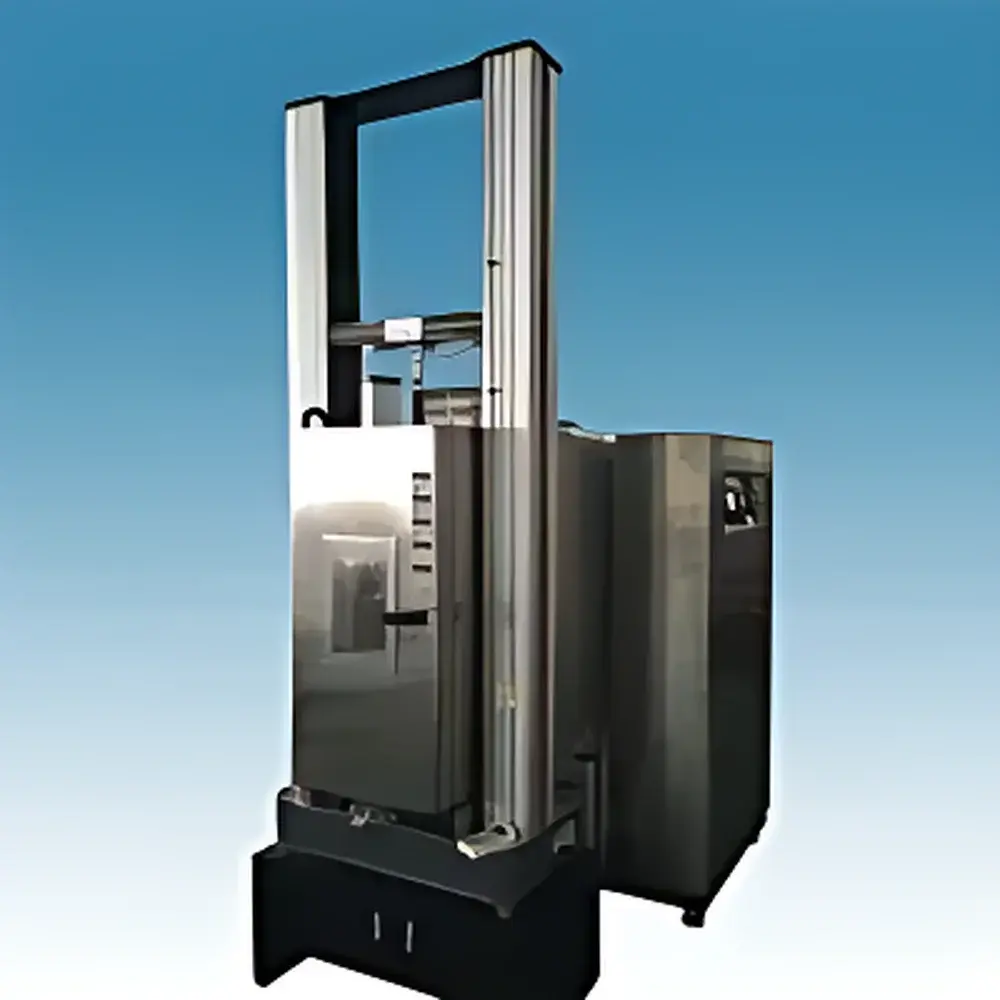
Hengyi HY-3080JUIII High-Temperature Tensile Testing Machine for Porous Ceramics
| Brand | Hengyi |
|---|---|
| Origin | Shanghai, China |
| Manufacturer Type | Direct Manufacturer |
| Product Category | Domestic |
| Model | HY-3080JUIII |
| Instrument Type | Electromechanical Universal Testing Machine |
| Load Capacity | 30 kN |
| Accuracy Class | ≤0.5 |
| Effective Test Width | 380 mm |
| Effective Test Height | 800 mm |
| Speed Range | 0.001–500 mm/min |
| Speed Accuracy | ±0.5% of indicated value |
| Force Resolution | ±500,000 counts at full scale |
| Displacement Accuracy | ±0.5% of indicated value |
| Strain Measurement Accuracy | ±0.5% of indicated value |
| Stress Control Rate Range | 0.005–6% FS/s |
| Strain Control Rate Range | 0.002–6% FS/s |
| Protection Features | Electronic limit switch, overload protection (110% FS), automatic fault diagnosis |
| Power Supply | 220 V AC, 750 W |
| Host Dimensions | 700 × 420 × 1510 mm |
| Host Weight | 210 kg |
Overview
The Hengyi HY-3080JUIII High-Temperature Tensile Testing Machine is a precision-engineered electromechanical universal testing system specifically designed for mechanical characterization of porous ceramics and ceramic matrix composites (CMCs) under elevated temperature conditions. Built on a rigid龙门 (gantry-type) structural architecture, the system integrates high-stiffness load frame mechanics with thermally stable actuation and real-time closed-loop control of force, displacement, and strain. Its core measurement principle follows ISO 527-2 and ASTM D638-compliant uniaxial tensile methodology, adapted for high-temperature environments via optional furnace integration (up to 1200 °C, configurable per user requirement). The machine operates within a calibrated force range of 0.1% to 100% of full scale (30 kN), delivering ≤0.5 class accuracy per ISO 7500-1 and GB/T 228.1, making it suitable for R&D laboratories and quality control departments requiring traceable, repeatable data in compliance with GLP and GMP-aligned workflows.
Key Features
- Gantry-style load frame with 210 kg mass and reinforced aluminum-alloy crosshead for minimized thermal drift and mechanical resonance during high-temperature testing
- High-resolution force transduction: ±500,000-count A/D resolution across full 30 kN capacity, no internal range switching required
- Precision ball-screw-driven actuator with dual-speed (fast/slow) manual and programmable motorized crosshead positioning
- Real-time closed-loop control modes: stress rate (0.005–6% FS/s), strain rate (0.002–6% FS/s), and displacement rate (0.001–500 mm/min), all with ≤±0.5% fidelity at ≥0.05% FS/s
- Integrated electronic limit switches and multi-level safety interlocks including 110% overload cutoff, emergency stop circuitry, and autonomous diagnostic self-check at power-on and test initiation
- Modular fixture interface compatible with ISO 26203-1–aligned tensile grips, ASTM C1359-compliant compression platens, and Iosipescu shear fixtures for in-plane characterization of CMCs
Sample Compatibility & Compliance
The HY-3080JUIII accommodates specimens up to 380 mm wide and 800 mm tall—configurable for extended dimensions—enabling evaluation of monolithic porous ceramics, fiber-reinforced CMCs, and hybrid ceramic-polymer laminates. Standard test configurations support ASTM C1161 (flexure), ASTM C1211 (tensile strength of refractory ceramics), ISO 13586 (fracture toughness), and JIS R1601 (mechanical properties at elevated temperatures). When paired with optional high-temperature furnaces and ceramic-specific extensometry (e.g., non-contact video extensometer or high-temp clip gauge), the system meets requirements for ISO 7438 (hot tensile testing) and ASTM E21 (tensile tests at elevated temperatures). All hardware and firmware comply with CE electromagnetic compatibility (EMC) directives and support audit-ready documentation per FDA 21 CFR Part 11 when used with validated HENGYITEST software configurations.
Software & Data Management
HENGYITEST v4.x software provides ISO/IEC 17025-aligned test automation, featuring synchronized acquisition of load, displacement, and strain signals at ≥1 kHz sampling rate. The platform supports real-time plotting of stress–strain, load–displacement, and time-based curves with auto-scaling axes and dynamic toggling between primary and secondary Y-axes. Multi-curve overlay functionality enables statistical comparison across replicate specimens; localized zoom, feature-point annotation (yield point, UTS, fracture strain), and playback-mode reconstruction of test sequences are fully supported. Raw data export is available in CSV, XML, and proprietary .hdt formats—compatible with MATLAB, Python (NumPy/Pandas), and Minitab for downstream statistical analysis. Audit trails, user access levels, and electronic signature capture are enabled for regulated environments requiring GLP/GMP adherence.
Applications
- Mechanical property mapping of porous SiC, Al₂O₃, and ZrO₂ ceramics across 25–1100 °C temperature gradients
- Tensile strength, Young’s modulus, Poisson’s ratio, and elongation-at-break quantification for CMCs used in aerospace thermal protection systems
- Interfacial shear strength assessment via microbond or single-fiber pull-out protocols using custom shear fixtures
- Creep and stress-relaxation behavior analysis under constant load or strain hold conditions
- Fracture initiation and propagation analysis using digital image correlation (DIC)-ready specimen geometries
- Validation of sintering process parameters through comparative tensile performance of green-state vs. fully densified ceramic bodies
FAQ
Does the HY-3080JUIII include high-temperature furnace capability as standard?
No—the base configuration operates at ambient temperature. High-temperature testing requires optional furnace integration (e.g., split-tube muffle furnace with PID-controlled zone, maximum 1200 °C), which must be specified at order stage.
Can the system perform compression and shear tests on the same platform?
Yes—via interchangeable ISO- and ASTM-compliant fixtures, including plane compression platens (ASTM C133), Iosipescu shear fixtures (ASTM D5379), and three-point bend assemblies (ASTM C1161).
Is HENGYITEST software compliant with 21 CFR Part 11 for pharmaceutical or medical device applications?
When deployed with role-based user accounts, electronic signatures, and audit trail logging enabled, the software meets foundational technical requirements for Part 11 compliance; formal validation documentation is provided upon request for IQ/OQ/PQ execution.
What calibration standards does the system reference?
Force calibration conforms to ISO 376 and GB/T 13634; displacement verification follows ISO 9513; system-level verification is performed per ISO 7500-1 Class 0.5 protocol using NIST-traceable reference standards.
Are custom extensometers supported for high-temperature strain measurement?
Yes—the system features analog and digital input channels compatible with LVDT-based high-temp extensometers (up to 1000 °C), non-contact video extensometers, and laser interferometric gauges.



