
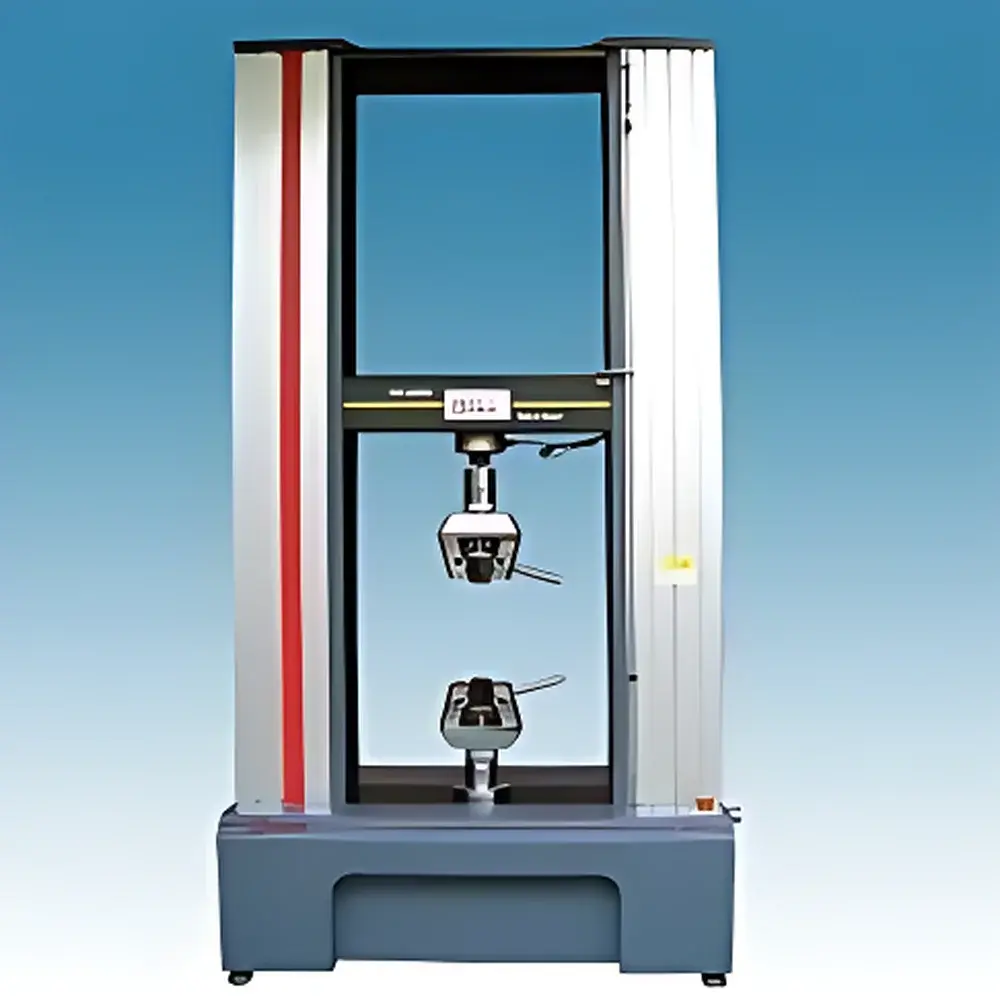
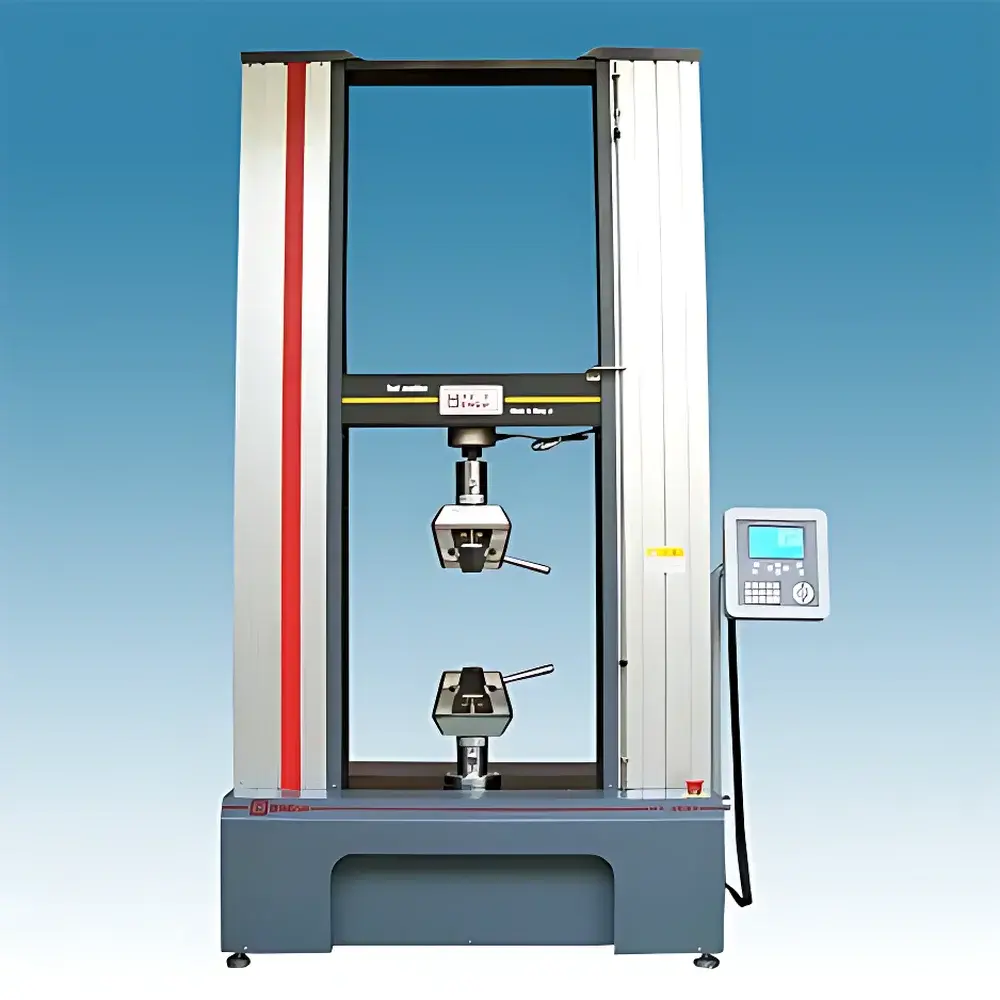
Hengyi HY-10080WDW Universal Testing Machine
| Brand | Hengyi |
|---|---|
| Origin | Shanghai, China |
| Manufacturer Type | Direct Manufacturer |
| Regional Category | Domestic (China) |
| Model | HY-10080WDW |
| Instrument Type | Electromechanical Universal Testing Machine |
| Max Load Capacity | 10 kN / 20 kN / 30 kN / 50 kN / 100 kN |
| Accuracy Class | 0.5 |
| Effective Test Width | 600 mm |
| Effective Test Height | 800 mm |
| Speed Range | 0.001–500 mm/min |
| Speed Accuracy | ±0.5% of indicated value |
| Force Resolution | ±500,000 counts (full-scale, no range switching) |
| Force Measurement Range | 0.1%–100% FS |
| Displacement Accuracy | ±0.5% of indicated value |
| Strain Measurement Accuracy | ±0.5% of indicated value |
| Stress Control Rate Range | 0.005–6% FS/s |
| Strain Control Rate Range | 0.002–6% FS/s |
| Constant-Load/Displacement/Strain Range | 0.5–100% FS |
| Protection Features | Electronic limit switches, overload protection (110% FS), automatic fault diagnosis (overvoltage, overcurrent, overload), emergency stop |
| Power Supply | 220 V AC, single-phase, 2000 W |
| Machine Dimensions (W×D×H) | 1000 × 680 × 2200 mm |
| Net Weight | 1250 kg |
Overview
The Hengyi HY-10080WDW Universal Testing Machine is an electromechanical static testing system engineered for high-precision mechanical characterization of metallic and non-metallic materials under uniaxial tensile, compressive, flexural, peel, puncture, and shear loading conditions. Based on servo-controlled electromechanical actuation and closed-loop digital feedback architecture, it complies with core principles defined in ISO 7500-1 (static calibration of force-proving instruments), ASTM E4 (load verification of testing machines), and ISO 5893 (tensile testing machine requirements). Its modular load frame—constructed from high-rigidity extruded aluminum enclosures and electrostatically applied industrial-grade enamel coating—ensures dimensional stability across extended test cycles while maintaining aesthetic consistency in regulated laboratory environments.
Key Features
- High-fidelity force measurement system with 0.5-class accuracy per ISO 7500-1, delivering traceable resolution of ±500,000 digits across the full load range (10–100 kN), without internal range switching.
- Wide dynamic speed control: 0.001–500 mm/min, adjustable in real time with ±0.5% speed fidelity—enabling compliance with strain-rate-sensitive standards such as ASTM D638 (plastics) and ASTM E8 (metals).
- Dual-mode closed-loop control: independent stress-rate and strain-rate regulation, supporting both displacement-controlled and load-controlled test profiles per ISO 6892-1 and ASTM E21.
- Integrated safety architecture: electronic end-of-travel limit switches, programmable auto-return, overload cutoff at 110% FS, and self-diagnostic monitoring of drive voltage, current, and thermal load status.
- Real-time synchronized acquisition of force, displacement, large-strain (via extensometer interface), and small-strain (via clip-on or video-based extensometry inputs), all time-stamped to microsecond resolution.
- Modular test space: 600 mm effective width and 800 mm vertical clearance accommodate standard and custom fixtures—including wedge-action grips, compression platens, bend jigs, and peel fixtures—without mechanical reconfiguration.
Sample Compatibility & Compliance
The HY-10080WDW supports standardized specimen geometries per ISO 6892-1 (tensile bars), ASTM D638 (dog-bone plastics), ASTM C39 (concrete cylinders), and ISO 178 (flexural testing). It accommodates specimens up to 100 mm wide and 800 mm tall, with optional extensometer mounting points compliant with ISO 9513 (class 1 or class 0.5 strain measurement). All firmware and control logic adhere to GLP/GMP data integrity expectations, including audit-trail-enabled parameter logging, user-access controls, and timestamped event records. While not pre-certified for FDA 21 CFR Part 11, its software architecture supports validation protocols required for regulated QC labs conducting material release testing per USP or ISO 13485.
Software & Data Management
The embedded Windows-based control suite provides real-time plotting of stress–strain, load–displacement, and time-series curves with automatic axis scaling, zoom, and cursor-based point interrogation (yield point, UTS, modulus, elongation at break). Data export conforms to ASTM E1432 (standardized test report format) and supports CSV, XML, and PDF output with embedded metadata (operator ID, calibration date, environmental conditions). Custom test methods can be scripted using VB.NET integrated into the SQL-backed database engine, enabling lab-specific workflows—for example, automated calculation of Young’s modulus via secant method between 0.05%–0.25% strain, or conditional rupture detection based on first derivative thresholds. All raw channel data are stored with lossless precision; no interpolation or smoothing is applied during acquisition.
Applications
This system is routinely deployed in R&D labs for polymer formulation screening, quality assurance of structural composites, incoming inspection of fasteners and sheet metal, and mechanical validation of medical device components (e.g., suture tensile strength per ISO 10993-12). In academic settings, it supports graduate-level instruction in solid mechanics, failure analysis, and constitutive modeling. Typical use cases include: determination of yield strength (Rp0.2), ultimate tensile strength (Rm), fracture toughness proxies (J-integral via unloading compliance), creep compliance (under constant load), and cyclic fatigue pre-screening (with optional servo-hydraulic upgrade path). Its open API allows integration with LIMS platforms via OPC UA or TCP/IP socket interfaces.
FAQ
What standards does the HY-10080WDW comply with for force calibration?
It meets ISO 7500-1 Class 0.5 requirements when used with certified reference load cells and calibrated via third-party accredited laboratories.
Can the system perform ASTM D790 flexural tests on thermoplastics?
Yes—equipped with a three-point bending fixture and appropriate support span, it satisfies all displacement rate, alignment, and deflection measurement criteria in ASTM D790.
Is the software validated for pharmaceutical or medical device manufacturing?
While the base software is not out-of-the-box 21 CFR Part 11 compliant, it provides the architectural foundation (audit trail, electronic signatures, role-based access) required for site-specific validation per GAMP5 guidelines.
Does the machine support high-temperature testing?
Not natively—but it is mechanically compatible with commercially available environmental chambers (up to 300 °C) mounted between the crosshead and base, provided thermal expansion compensation is applied in post-processing.
What is the warranty and service coverage for international customers?
Hengyi offers a 24-month parts-and-labor warranty, with remote diagnostics support and on-site service available through authorized regional partners in EU, North America, and APAC regions.



