
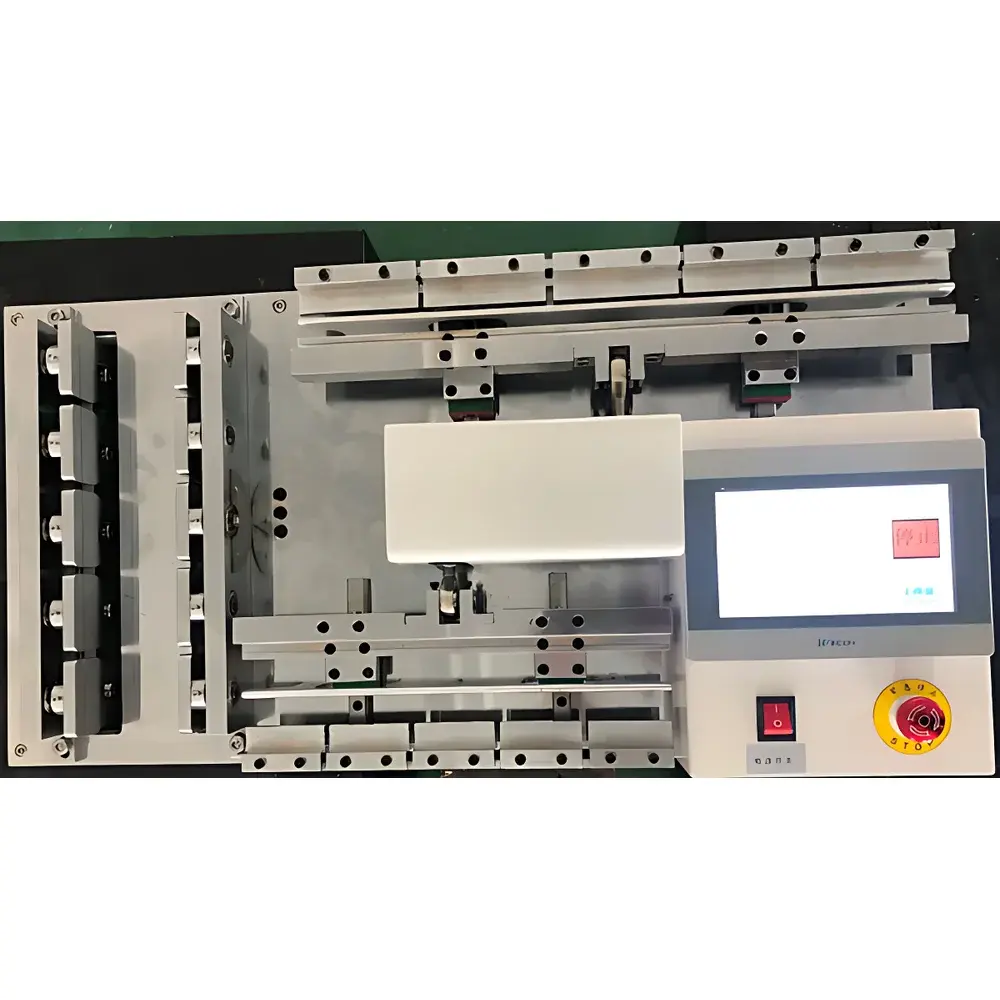
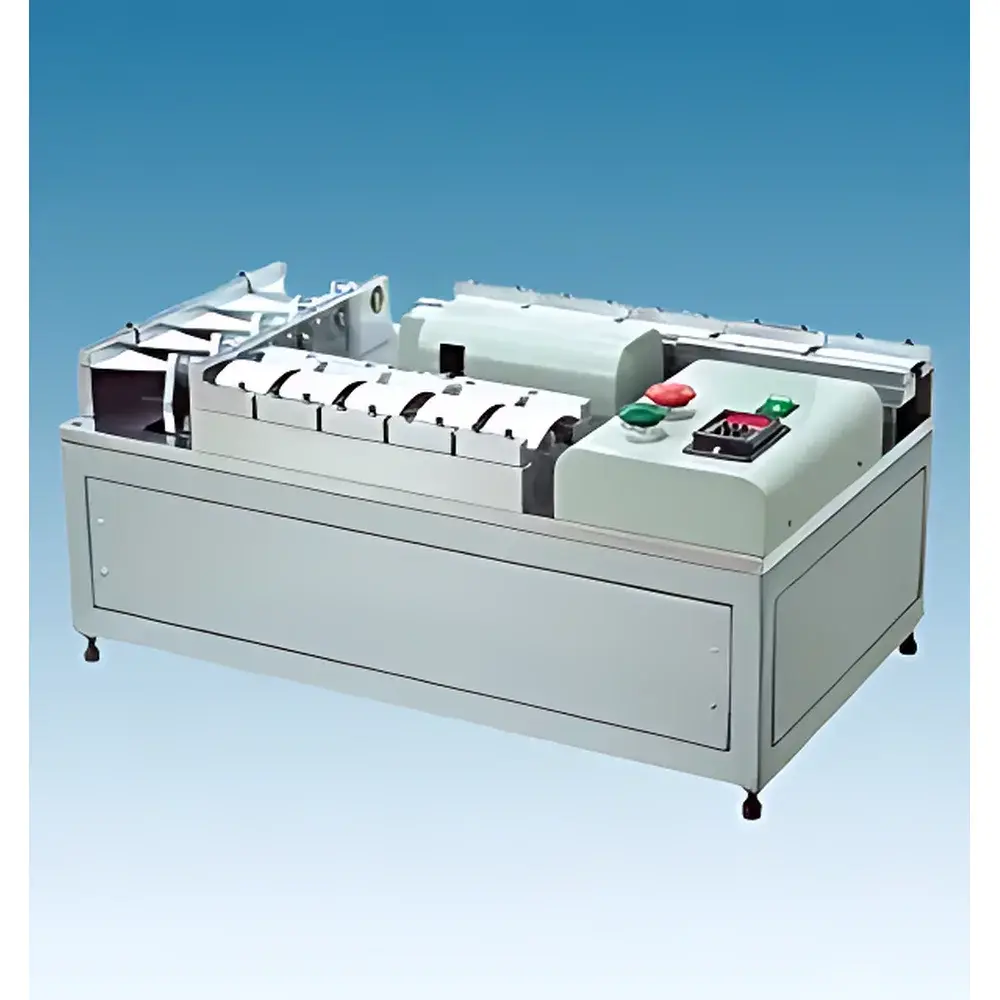
HY (IC) Touchscreen-Controlled Dual-Bending & Torsion Tester for Smart Cards – Hengyi Instruments Model HY(IC)YUJBN
| Brand | Hengyi Instruments |
|---|---|
| Origin | Shanghai, China |
| Manufacturer Type | OEM/ODM Manufacturer |
| Country of Origin | China |
| Model | HY(IC)YUJBN |
| Pricing | Upon Request |
Overview
The HY (IC) Touchscreen-Controlled Dual-Bending & Torsion Tester is a purpose-built mechanical endurance testing system engineered for the standardized evaluation of physical durability in contact and contactless smart cards—including ISO/IEC 7816-compliant integrated circuit (IC) cards, magnetic stripe cards, and embedded chip cards. Designed in strict accordance with GB/T 16649.1, GB/T 17554.1–2006, ISO/IEC 10373-1 (Mechanical Test Methods), and ISO/IEC 7816-1:1998 (Physical Characteristics), this instrument implements three independent test modalities—long-edge bending, short-edge bending, and bidirectional torsion—within a single, synchronized platform. Each modality operates under programmable displacement, angular amplitude, cycle count, and frequency parameters, enabling precise replication of real-world mechanical stress profiles experienced during card insertion, ejection, pocket flexing, and handling fatigue. The system employs a closed-loop electromechanical architecture featuring STK AC variable-speed motors and high-precision gear reduction assemblies to ensure consistent torque delivery and positional repeatability across all 15 test stations (5 per mode). Non-contact optical counting replaces legacy switch-based actuation, eliminating mechanical wear and achieving >99.99% counting reliability over up to 9,999 cycles per test sequence.
Key Features
- Fifteen parallel test stations: five dedicated to long-edge bending (max. displacement: 20 mm, min. 2 mm ±0.5 mm), five to short-edge bending (max. 10 mm, min. 1 mm ±0.5 mm), and five to bidirectional torsion (±15° ±1°, total angular range 30°, pivot diameter d = 86 mm)
- Programmable test frequency: 30 rpm (0.5 Hz) for both bending and torsion modes, compliant with ISO/IEC 10373-1 timing requirements
- Touchscreen HMI interface with intuitive parameter configuration, real-time cycle monitoring, and on-screen status diagnostics
- Optical encoder-based cycle counting system with zero-contact operation, eliminating switch degradation and ensuring traceable, audit-ready cycle logs
- Modular fixture design conforming precisely to ISO/IEC 7816-1 mounting dimensions and GB/T 17554.1 clamping geometry specifications
- Low-power consumption architecture (35 W nominal) with stable AC220 V ±5% input tolerance and robust thermal management
Sample Compatibility & Compliance
The tester accommodates standard ID-1 format cards (85.6 × 53.98 × 0.76 mm) and supports variants including PVC, PET, polycarbonate, and composite laminates used in EMV, NFC, and dual-interface smart cards. All mechanical loading profiles adhere to the force-displacement and angular-torque boundary conditions defined in ISO/IEC 10373-1 Clause 7 (Bending) and Clause 8 (Torsion), as well as GB/T 16649.1 Annex B and GB/T 17554.1–2006 Section 5. The system’s displacement resolution, angular repeatability, and cycle synchronization are validated against internal calibration protocols aligned with ISO/IEC 17025 principles. While not certified to GLP or GMP by default, the architecture supports integration into regulated environments through optional audit-trail logging and user-access control extensions.
Software & Data Management
The embedded firmware provides full-cycle parametric control via a 7-inch capacitive touchscreen, supporting multi-step test sequences, pass/fail threshold definition, and automatic stop-on-failure logic. Cycle data—including cumulative count, elapsed time, and operational status—is stored locally in non-volatile memory with timestamped records. Export functionality enables CSV-formatted output for external analysis in MATLAB, Excel, or LIMS platforms. Though no proprietary PC software is bundled, the device exposes serial (RS-232) and USB-to-serial interfaces for third-party automation integration (e.g., LabVIEW, Python-based test orchestration). Firmware updates are delivered via USB flash drive and include version-locked configuration backups.
Applications
This tester serves quality assurance laboratories in smart card manufacturing, banking card personalization centers, national metrology institutes, and academic research groups investigating polymer substrate fatigue, interlayer delamination, antenna bond integrity, and chip-module adhesion under cyclic mechanical load. It is routinely deployed for pre-compliance screening prior to formal certification at accredited bodies such as UL, Bureau Veritas, or SGS. Use cases include comparative lifecycle benchmarking of new substrate materials, validation of lamination process robustness, and failure mode analysis of cracked antennas or lifted contact pads following repeated flexing.
FAQ
Does the system support automated reporting compliant with ISO/IEC 17025 documentation requirements?
Yes—while the base unit stores raw cycle data with timestamps, optional firmware modules enable PDF report generation with operator ID, calibration date, environmental metadata, and digital signature fields.
Can the bending displacement be adjusted independently for each of the five long-edge stations?
No—displacement parameters are set globally per test mode; all five stations within a mode execute identical kinematic profiles to ensure inter-station comparability.
Is mechanical calibration traceable to national standards?
Calibration certificates are issued upon request, referencing traceable gauges for displacement (micrometer-certified linear stages) and angular position (optical rotary encoder calibrated against NIST-traceable theodolite standards).
What maintenance intervals are recommended for the gear reduction system?
Under continuous lab use, gear oil inspection is advised every 12 months; replacement is required only if viscosity degradation or particulate contamination is observed.
Are custom fixtures available for non-ID-1 card formats?
Yes—Hengyi Instruments offers OEM fixture design services per customer-provided dimensional drawings, subject to minimum order quantity and mechanical feasibility review.
Related Products



