
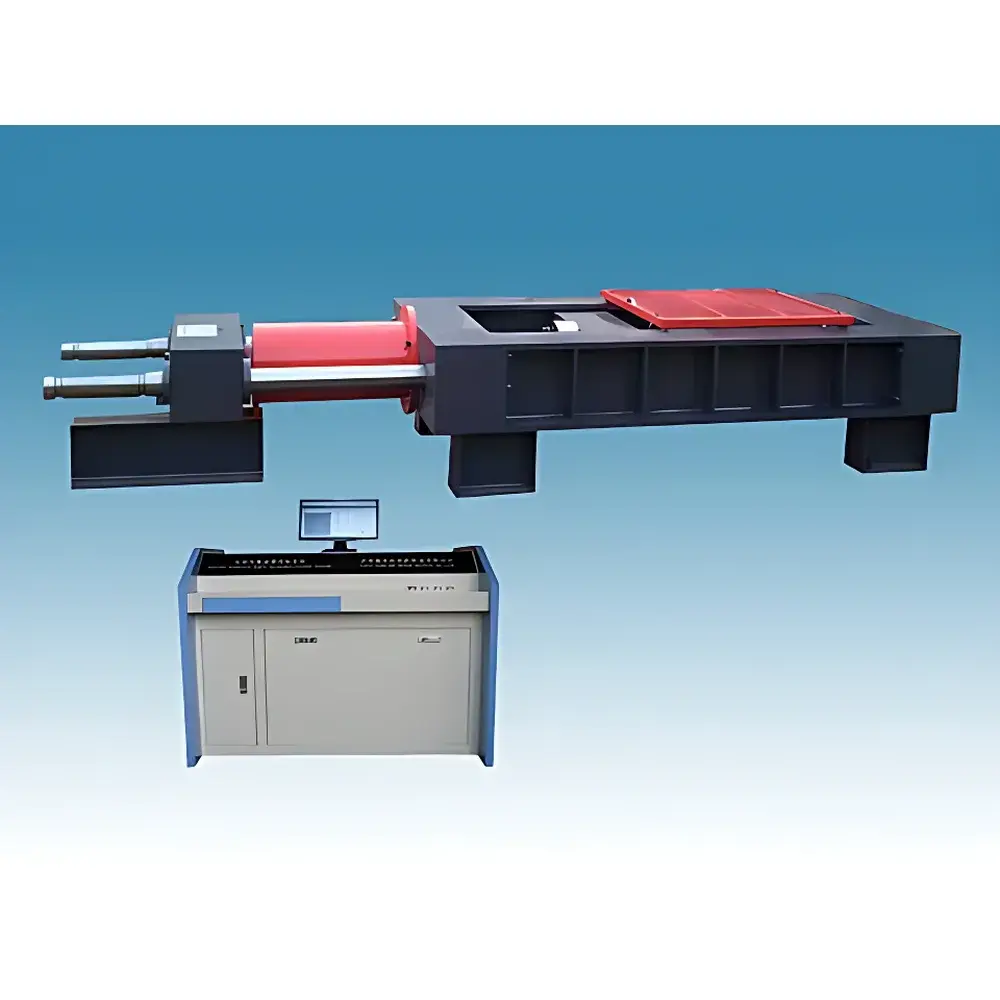
Hengyi HY(WL)-1000KN Computer-Controlled Horizontal Hydraulic Tensile Testing Machine
| Brand | Hengyi |
|---|---|
| Origin | Shanghai, China |
| Manufacturer Type | Direct Manufacturer |
| Instrument Type | Electro-Hydraulic Servo Tensile Tester |
| Model | HY(WL)-1000KN |
| Max Load Capacity | 1000 kN |
| Control System | U65 Intelligent Hardware Platform with Dual-CPU DSP Architecture |
| Actuation | High-Precision Servo Hydraulic System |
| Position Measurement | Optical Encoder (Mounted on Cylinder Side) |
| Force Transduction | Direct-Coupled Load Cell |
| Structural Design | Dual-Frame Horizontal Configuration |
| Compliance Standards | GB/T 228.1–2021, GB/T 2611–2007, GB/T 7314–2005, GB/T 1179–2008 (Annex B), JJF 1103–2003 |
| Software | Windows-Based Dedicated Electro-Hydraulic Testing Software with ASTM/ISO-Compatible Data Export |
| Control Modes | Constant Rate of Traverse (CRT), Constant Rate of Force (CRF), Force Hold, Displacement Hold |
| Safety Features | Dual-Limit Mechanical & Programmable Overload Protection (110% FS), Oil Temperature & Level Monitoring, Filter Clogging Alarm, Emergency Stop Circuit |
Overview
The Hengyi HY(WL)-1000KN is a high-capacity, computer-controlled horizontal hydraulic tensile testing machine engineered for precision mechanical property evaluation of large-section metallic specimens, structural cables, overhead conductors, and heavy-duty composite assemblies. Unlike vertical configurations, its horizontal layout accommodates extended test specimens—such as multi-strand ACSR (Aluminum Conductor Steel Reinforced) wires per GB/T 1179–2008 Annex B—while minimizing gravitational bending moments and ensuring axial alignment throughout loading. The system operates on a load-adaptive inlet throttling hydraulic principle, integrating a Parker-certified high-pressure fluid circuit with a dual-stage pressure-compensated servo control station. Force measurement is achieved via direct-coupling between the piston rod and a traceable, high-stability load cell, eliminating lever-arm error and enabling true force feedback control. Displacement and deformation are monitored by a side-mounted optical encoder referenced to the cylinder housing—ensuring metrological independence from frame flexure. The architecture conforms to ISO 7500-1 Class 1 accuracy requirements for static force measurement and meets the repeatability and linearity criteria defined in GB/T 228.1–2021 for metallic materials testing.
Key Features
- U65 intelligent hardware platform featuring distributed DSP-based signal processing: dedicated CPU cores handle I/O, counter, D/A, and A/D functions independently, with centralized aggregation and real-time bidirectional communication via industrial-grade USB 2.0 interface.
- Dual-mode operation: GT-SV manual jog control (flywheel interface) and fully automated PC-driven testing with seamless mode switching and disturbance-free control loop transition.
- Horizontal dual-frame mechanical structure: upper crosshead houses the servo hydraulic cylinder; lower grip assembly mounts rigidly to the opposing frame beam—eliminating parasitic bending and ensuring pure uniaxial tension.
- GT-UB zero-backlash, wear-resistant ball screw transmission combined with synchronous belt drive and GT-BS hydraulic power unit ensures uniform stress distribution and minimal resonance across 0.001–100 mm/min traverse speed range.
- Integrated safety architecture: programmable force/displacement limits, dual-stage mechanical end stops, oil temperature (10–55 °C) and level monitoring, filter clogging alarm, emergency stop circuit, and automatic unloading upon specimen rupture.
- FF113-95 electro-hydraulic servo valve (7 MPa, 95 L/min flow capacity) paired with a two-stage pressure-compensated hydraulic station incorporating Parker hydraulic fittings, ≤3 µm precision filtration (Wenzhou Liming), and dual-setpoint thermal/level interlocks.
Sample Compatibility & Compliance
The HY(WL)-1000KN is validated for testing specimens up to 1000 kN ultimate tensile load, including stranded conductors (e.g., AAC, AAAC, ACSR), steel wire ropes, prestressed concrete tendons, and large-diameter alloy bars. Its horizontal configuration supports specimen lengths exceeding 3 meters without sag-induced misalignment. The system complies with national and international standards governing mechanical testing methodology and data integrity: GB/T 228.1–2021 (equivalent to ISO 6892-1), GB/T 2611–2007 (general requirements for testing machines), GB/T 7314–2005 (compression testing), GB/T 1179–2008 Annex B (overhead conductor qualification), and JJF 1103–2003 (data acquisition system validation). All control algorithms, calibration procedures, and reporting outputs adhere to GLP-aligned traceability protocols—including digital audit trails for parameter changes, operator logins, and calibration events.
Software & Data Management
The proprietary Windows-based software suite comprises two tightly integrated modules: System Management Software (SMS) and Multi-Function Test Software (MFTS). SMS handles low-level hardware abstraction—sensor configuration, PID tuning, protection threshold definition, real-time oscilloscope display (dual-channel), servo valve current monitoring, and voltage metering. MFTS enables user-defined test sequences via drag-and-drop functional icons (e.g., ramp-to-force, dwell-at-strain, cyclic loading), supporting complex protocols such as random spectrum fatigue simulation. Data acquisition operates at 6 kHz closed-loop refresh rate with 16-bit A/D and D/A resolution. All raw data—including force, displacement, time, and calculated engineering stress/strain—are timestamped, stored in binary format with embedded metadata (operator ID, sample ID, environmental conditions), and exportable to CSV, XML, or ASTM E1435-compliant formats. Audit logs comply with FDA 21 CFR Part 11 requirements for electronic records and signatures when configured with user authentication and electronic signature modules.
Applications
This system serves quality assurance laboratories in power transmission infrastructure, heavy manufacturing, railway rolling stock, and aerospace component supply chains. Typical use cases include: qualification testing of high-voltage overhead conductors per GB/T 1179–2008; tensile verification of post-tensioning systems in precast concrete bridges; mechanical characterization of high-strength steel cables used in suspension bridges and cable-stayed structures; fatigue life assessment of anchorages under variable amplitude loading; and R&D validation of novel metal-matrix composites subjected to quasi-static and slow-rate loading. Its robust hydraulic architecture and horizontal geometry make it especially suitable for evaluating long, flexible, or asymmetric specimens where vertical alignment constraints would compromise measurement fidelity.
FAQ
What is the maximum specimen length this machine can accommodate?
Standard configuration supports specimens up to 3.5 meters; custom extensions are available upon request.
Does the system support closed-loop strain control using extensometers?
Yes—external analog or digital extensometer inputs are supported via dedicated signal conditioning channels and integrated into the primary control loop.
Is the software compliant with FDA 21 CFR Part 11 for regulated environments?
Full compliance is achievable with optional electronic signature module, role-based access control, and immutable audit trail configuration.
Can test results be exported directly to LIMS platforms?
Yes—XML and CSV exports include all required metadata fields; API integration is available via optional OPC UA or RESTful interface add-on.
What maintenance intervals are recommended for the hydraulic system?
Oil analysis every 1,000 operating hours; filter replacement every 2,000 hours or per contamination sensor alert; annual recalibration of load cell and encoder per ISO 376 and ISO 10360-2.



