
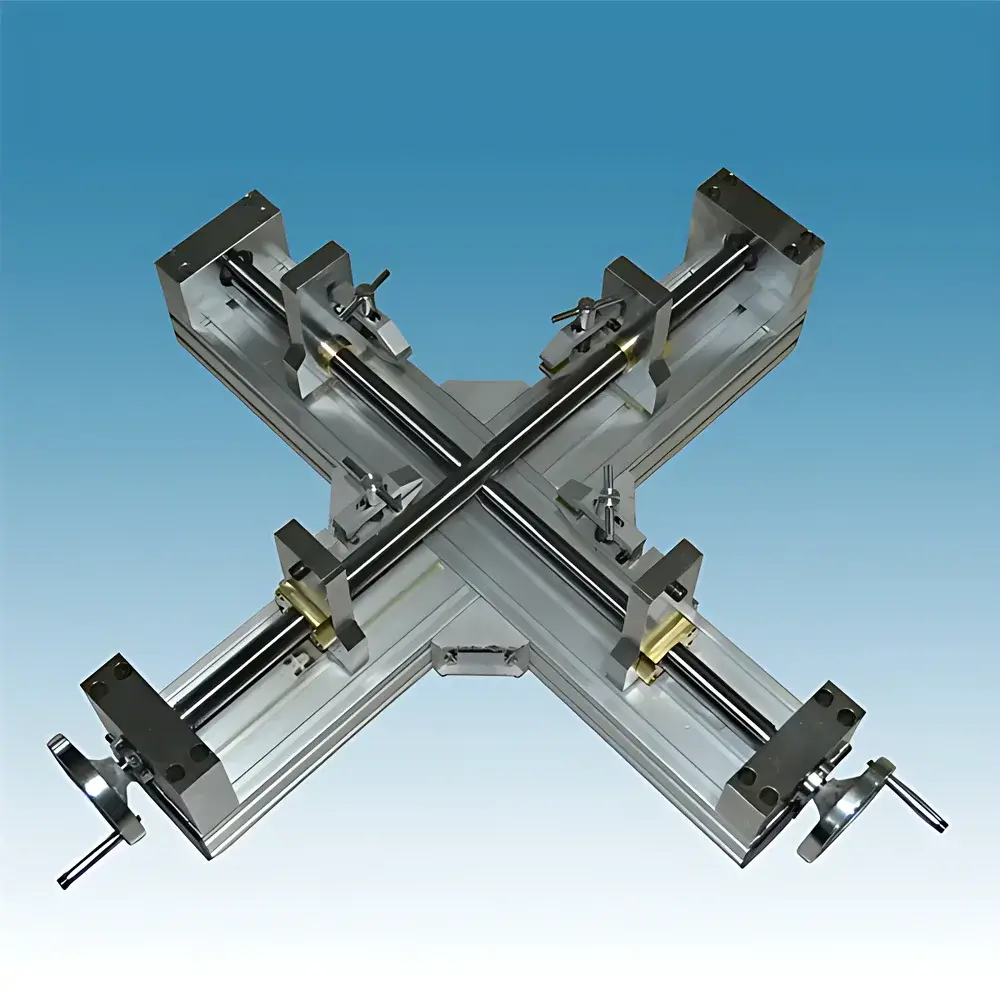
Hengyi HY-0130MKL Biaxial Tensile Testing System for Plastics
| Brand | Hengyi / Hengyitest |
|---|---|
| Origin | Shanghai, China |
| Manufacturer Type | Direct Manufacturer |
| Country of Origin | China |
| Model | HY-0130MKL |
| Quotation | Upon Request |
| Load Capacity | 1000 N |
| X/Y Axis Travel | 300 mm each |
| Test Speed Range | 0.001–300 mm/min |
| Force Accuracy | ±0.5% of reading |
| Displacement & Strain Accuracy | ±0.5% of reading |
| Force Resolution | ±500,000 counts (full-scale, no range switching) |
| Stress/Strain Control Rate Range | 0.005–6 %FS/S |
| Constant-Load/Displacement/Strain Control Accuracy | ±0.1% FS (≥10% FS) |
| Safety Protection | Electronic limit switches, overload cutoff (110% FS), real-time system diagnostics |
| Power Supply | 220 V AC, 400 W |
| Dimensions (W×D×H) | 800 × 800 × 800 mm |
| Weight | 80 kg |
Overview
The Hengyi HY-0130MKL Biaxial Tensile Testing System is an electromechanical materials testing platform engineered for precise, synchronized mechanical characterization of polymeric films, thin metallic foils, elastomeric sheets, and advanced composite laminates under equibiaxial or non-equibiaxial loading conditions. Unlike conventional uniaxial tensile testers, this system implements dual independent servo-controlled actuation axes (X and Y), enabling true planar stress-state control in accordance with ASTM D882, ISO 527-3, and ISO 11843 standards for biaxial deformation analysis. Its monolithic cast-iron “closed-loop” frame architecture—designed without structural seams or bolted joints—minimizes parasitic compliance and ensures dimensional stability across repeated load cycles. The system operates under closed-loop feedback using high-resolution load cells, linear encoders, and strain-sensing options (e.g., digital image correlation or contact extensometry), delivering traceable, reproducible data suitable for R&D validation, quality assurance, and regulatory submission dossiers.
Key Features
- Monolithic cast-iron frame in a rigid “box-in-box” geometry, optimized for minimal deflection (<0.02 mm under full 1000 N load) and long-term geometric fidelity.
- Dual-axis synchronized motion control with independent programmable speed profiles (0.001–300 mm/min), supporting both displacement- and force-driven biaxial protocols.
- High-fidelity force measurement via 1000 N load cell with 0.5-class accuracy and ±500,000-count resolution—no internal range switching required across the full dynamic range (0.1% to 100% FS).
- Integrated electronic limit protection, real-time overtravel detection, and automatic emergency shutdown at 110% of rated capacity.
- Intelligent self-diagnostic subsystem continuously monitors drive amplifier status, encoder signal integrity, power rail stability, and thermal load—logging anomalies for GLP-compliant audit trails.
- Motorized crosshead positioning with dual-speed (fast/slow) jog mode and programmable return-to-home functionality, reducing operator intervention during high-throughput test sequences.
Sample Compatibility & Compliance
The HY-0130MKL accommodates specimens up to 300 mm × 300 mm in planar dimension and supports custom夹具 configurations—including pneumatic, wedge-grip, and vacuum-based clamping—for isotropic and anisotropic sheet materials. It is validated for use with thermoplastics (e.g., PET, PP, PC), biodegradable polymers (PLA, PHA), metal foils (Al, Cu, Ni), and coated substrates used in flexible electronics and packaging. All control firmware and data acquisition modules comply with ISO/IEC 17025 requirements for testing laboratories. Optional software packages support 21 CFR Part 11-compliant electronic signatures, audit logging, and user-access tiering—meeting GMP/GLP documentation prerequisites for medical device and pharmaceutical packaging qualification.
Software & Data Management
Control and analysis are executed via Hengyi’s proprietary TestMaster Pro v4.x software suite, running on Windows-based industrial PCs. The interface supports multi-step test scripting (e.g., ramp-hold-relax sequences), real-time biaxial stress-strain contour mapping, and automated calculation of Poisson’s ratio, yield loci, and forming limit curves (FLCs). Raw data streams are saved in ASCII-compatible .csv format with embedded metadata (timestamp, operator ID, calibration certificate ID, environmental conditions). Export modules enable direct integration with MATLAB, Python (via Pandas), and statistical process control (SPC) platforms such as Minitab and JMP. All software updates, calibration certificates, and firmware patches are distributed through Hengyi’s secure customer portal—requiring authenticated login and version-controlled deployment logs.
Applications
- Characterization of blow-molded and thermoformed plastic containers under biaxial strain to predict burst pressure and wall-thinning behavior.
- Evaluation of stretchability and fracture onset in transparent conductive films (ITO/PEDOT:PSS) for foldable display substrates.
- Validation of adhesion strength and interfacial delamination resistance in multilayer barrier films used in food and pharmaceutical packaging.
- Constitutive modeling input generation for finite element simulations (e.g., Abaqus, ANSYS Mechanical) of polymer processing operations including deep drawing and inflation molding.
- Accelerated aging studies correlating biaxial modulus decay with UV exposure, humidity cycling, or thermal oxidative degradation per ASTM G154 and ISO 4892-3.
FAQ
What standards does the HY-0130MKL support for biaxial testing?
It aligns with ASTM D5279 (Standard Test Method for Plastics—Dynamic Mechanical Properties—In Tension), ISO 16770 (Biaxial tensile testing of thin sheets), and supports user-defined protocols compliant with automotive OEM specifications (e.g., GMW14872, Ford CETP 00.00-L-467).
Can the system perform sequential uniaxial tests in addition to biaxial modes?
Yes—the controller firmware permits standalone X-axis or Y-axis operation, enabling comparative uniaxial tensile, compression, or peel testing without hardware reconfiguration.
Is digital image correlation (DIC) integration supported?
The system includes standardized mounting rails and synchronization I/O ports (TTL trigger, encoder pulse output) compatible with commercial DIC systems (e.g., Correlated Solutions VIC-2D, LaVision StrainMaster) for full-field strain mapping.
What maintenance intervals are recommended for long-term accuracy retention?
Annual recalibration of load cells and position encoders is advised; quarterly verification using NIST-traceable reference standards (e.g., deadweight sets, gauge blocks) satisfies ISO/IEC 17025 Clause 6.5.2 requirements.
Does the system meet electromagnetic compatibility (EMC) requirements for laboratory environments?
Yes—certified to IEC 61326-1:2013 for EMC immunity and emissions, with CE marking valid for installation in Class A laboratory settings per EN 55011.



