
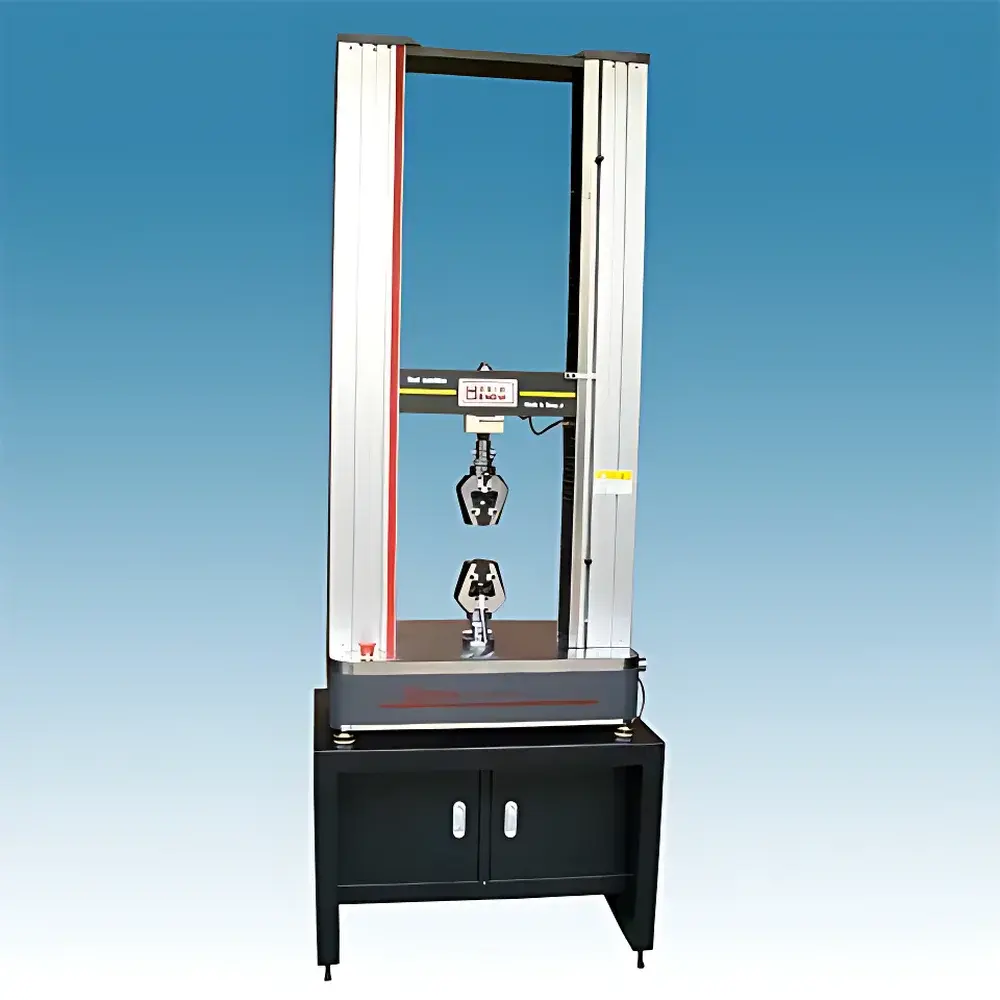
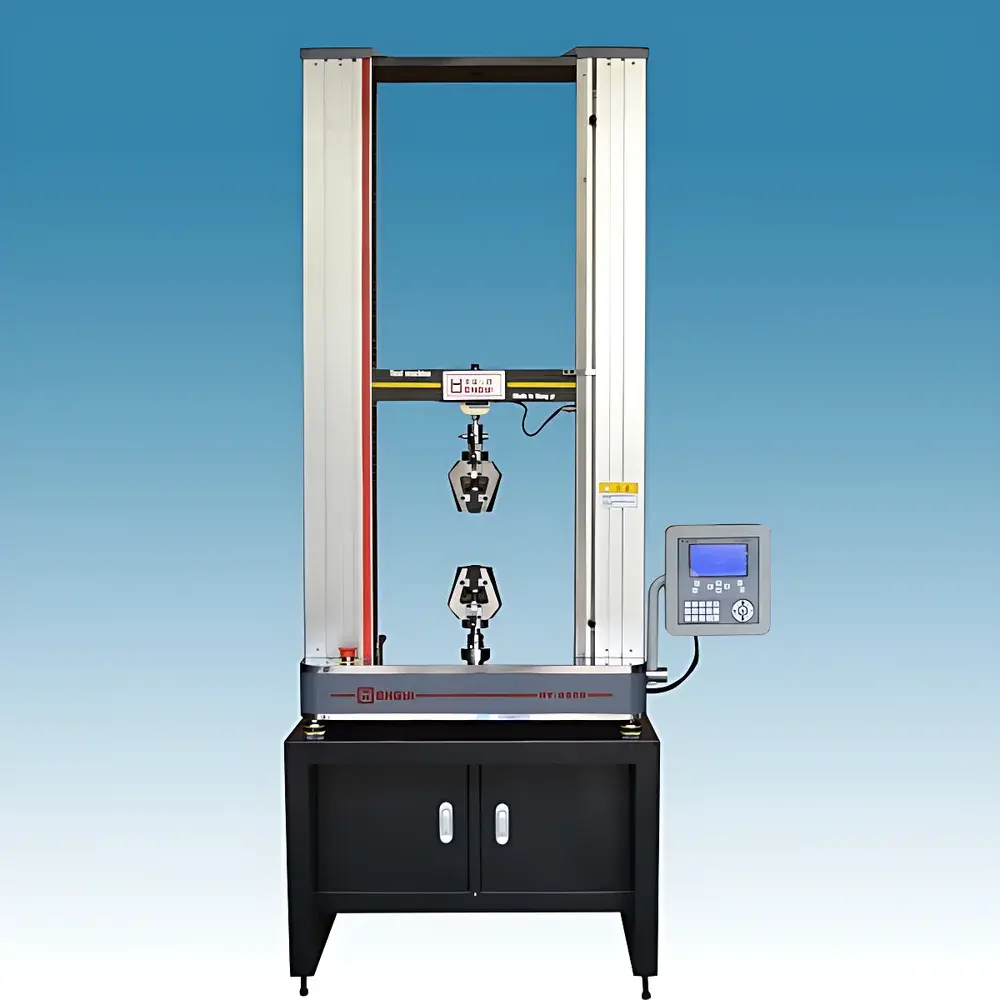
Hengyi HY-3080FGBB Automotive Brake Pad Shear Strength Testing Machine
| Brand | Hengyi |
|---|---|
| Origin | Shanghai, China |
| Manufacturer Type | Direct Manufacturer |
| Regional Category | Domestic (China) |
| Model | HY-3080FGBB |
| Instrument Type | Electromechanical Universal Testing Machine |
| Load Capacity Options | 1 N to 30 kN (multiple transducers available) |
| Accuracy Class | ≤0.5% of reading |
| Effective Test Width | 380 mm (expandable) |
| Effective Test Height | 800 mm (extendable) |
| Speed Range | 0.001–1000 mm/min |
| Speed Accuracy | ±0.5% of set value |
| Force Resolution | ±500,000 counts (no internal range switching) |
| Displacement Accuracy | ±0.5% of reading |
| Strain Measurement Accuracy | ±0.5% of reading |
| Stress/Strain Control Rate Range | 0.002–6% FS/S |
| Constant-Load/Displacement/Strain Control Range | 0.5–100% FS |
| Safety Protection | Electronic limit switches, overload protection (>110% FS), real-time system diagnostics |
| Power Supply | 220 V AC, single-phase, 0.75 kW |
| Machine Weight | 210 kg |
| Dimensions (W×D×H) | 700 × 420 × 1600 mm |
Overview
The Hengyi HY-3080FGBB Automotive Brake Pad Shear Strength Testing Machine is a high-precision electromechanical universal testing system engineered specifically for quantifying interfacial shear resistance in friction materials—particularly automotive brake pads—and validated across a broad spectrum of structural and functional materials. It operates on the principle of controlled uniaxial force application under programmable displacement or load control, compliant with standardized shear test geometries defined in ISO 6892-1, ASTM D1002, and SAE J661. Its dual-column, rigid frame architecture ensures minimal deflection (<0.02 mm under full 30 kN load), critical for maintaining measurement fidelity during high-stiffness shear interface evaluation. The system integrates a closed-loop servo motor drive with high-resolution encoder feedback and preloaded precision ball screws to deliver stable, repeatable motion profiles—even at ultra-low speeds (0.001 mm/min)—enabling precise characterization of viscoelastic slip onset, cohesive failure thresholds, and post-yield shear deformation behavior.
Key Features
- Rigid龙门-style (portal-type) frame with optimized column spacing and reinforced crosshead—designed for minimal compliance during high-force shear testing of brake pad backing plates bonded to friction linings.
- Dual preloaded high-accuracy ball screws (C5 grade) paired with maintenance-free AC servo motor and digital servo driver—ensuring long-term torque stability and positional repeatability over >100,000 cycles.
- Bi-directional load cell (1 N–30 kN range, optional multi-transducer configuration) with ±500,000 internal resolution, no auto-ranging, and linearity error ≤0.02% FS—certified per ISO 376 Class 0.5 requirements.
- Real-time synchronized acquisition of force, displacement, and extensometer-derived strain (optional) at up to 1 kHz sampling rate—supporting dynamic event capture such as shear crack initiation and delamination propagation.
- Multi-language digital controller (English, German, French, Spanish, Chinese) with intuitive menu navigation, configurable test sequences, and embedded safety logic including electronic travel limits and 110% overload cut-off.
- Portable hand-held controller enabling remote start/stop, jog positioning, and emergency stop—critical for operator safety during fixture loading/unloading in constrained lab environments.
Sample Compatibility & Compliance
The HY-3080FGBB accommodates diverse specimen geometries relevant to automotive friction systems—including ASTM D3166-compliant lap-shear coupons, ISO 4587-adapted bonded assemblies, and custom shear fixtures for segmented brake pad cores. It supports standardized shear test configurations for metal-to-rubber, ceramic-to-metal, and polymer-to-fiber interfaces. Validated sample types include brake pad composites, copper/aluminum foils, PV ribbon welds, medical suture anchors, orthopedic bone cement interfaces, elastomeric gaskets, and fiber-reinforced thermoplastics. The system meets mechanical traceability requirements per ISO/IEC 17025 and supports audit-ready documentation for GLP/GMP environments. Optional calibration certificates are traceable to NIM (National Institute of Metrology, China) and compatible with international mutual recognition arrangements (ILAC-MRA).
Software & Data Management
The embedded test software—built on VB.NET with SQL Server Compact backend—supports user-defined method templates, automated pass/fail logic (e.g., shear strength ≥ X MPa, elongation at break ≥ Y%), and real-time statistical process control (SPC) charting. All raw data (force, displacement, time, calculated stress/strain) are stored in encrypted .db3 files with immutable timestamps. Audit trail functionality logs user ID, parameter changes, calibration events, and test execution history—fully compliant with FDA 21 CFR Part 11 when deployed with Windows OS and domain-authenticated login. Export options include CSV, PDF reports with embedded stress–strain curves, and XML for LIMS integration. Curve analysis tools allow manual or algorithmic identification of yield point, maximum shear load, fracture energy (area under curve), and secant modulus—each annotated with confidence intervals derived from sensor uncertainty budgets.
Applications
This system serves as a primary mechanical validation tool in R&D labs developing next-generation low-dust, high-thermal-stability brake formulations; in QC departments performing incoming inspection of friction material batches per OEM specifications (e.g., Ford WSS-M1A365-B1, GM GMW15525); and in third-party certification bodies conducting type approval testing against ECE R90 and UN Regulation No. 13-H. Beyond automotive, it fulfills tensile, peel, and shear protocols for photovoltaic interconnect ribbons (IEC 61215-2 MQT 17), surgical staple line integrity (ASTM F2119), packaging seal strength (ASTM F88), and composite laminate interlaminar shear (ASTM D2344). Universities utilize its modular architecture for graduate-level instruction in solid mechanics, interfacial physics, and materials reliability modeling.
FAQ
What shear test standards does the HY-3080FGBB support out-of-the-box?
It includes preconfigured methods for ISO 4587 (adhesive shear), ASTM D1002 (lap shear), and SAE J661 (brake lining shear), with editable parameters for custom fixture geometry and loading rate.
Can the system perform cyclic shear fatigue testing?
Yes—via programmable load/displacement waveform sequencing (sine, triangle, trapezoidal) with dwell control, cycle counting, and automatic termination on stiffness degradation or cycle limit.
Is third-party calibration and ISO 17025 certification available?
Hengyi provides factory calibration with NIM-traceable certificates; accredited external calibration services are coordinated through authorized regional partners upon request.
How is data integrity ensured during long-duration creep shear tests?
The controller employs non-volatile memory buffering and automatic power-fail recovery—retaining all acquired points and resuming test execution post-interruption without data loss.
Does the system support high-temperature shear testing?
While the base machine operates at ambient temperature, it is mechanically compatible with externally mounted environmental chambers (−70°C to +300°C) and heated shear fixtures—integration requires custom mounting brackets and thermal isolation design review.



