
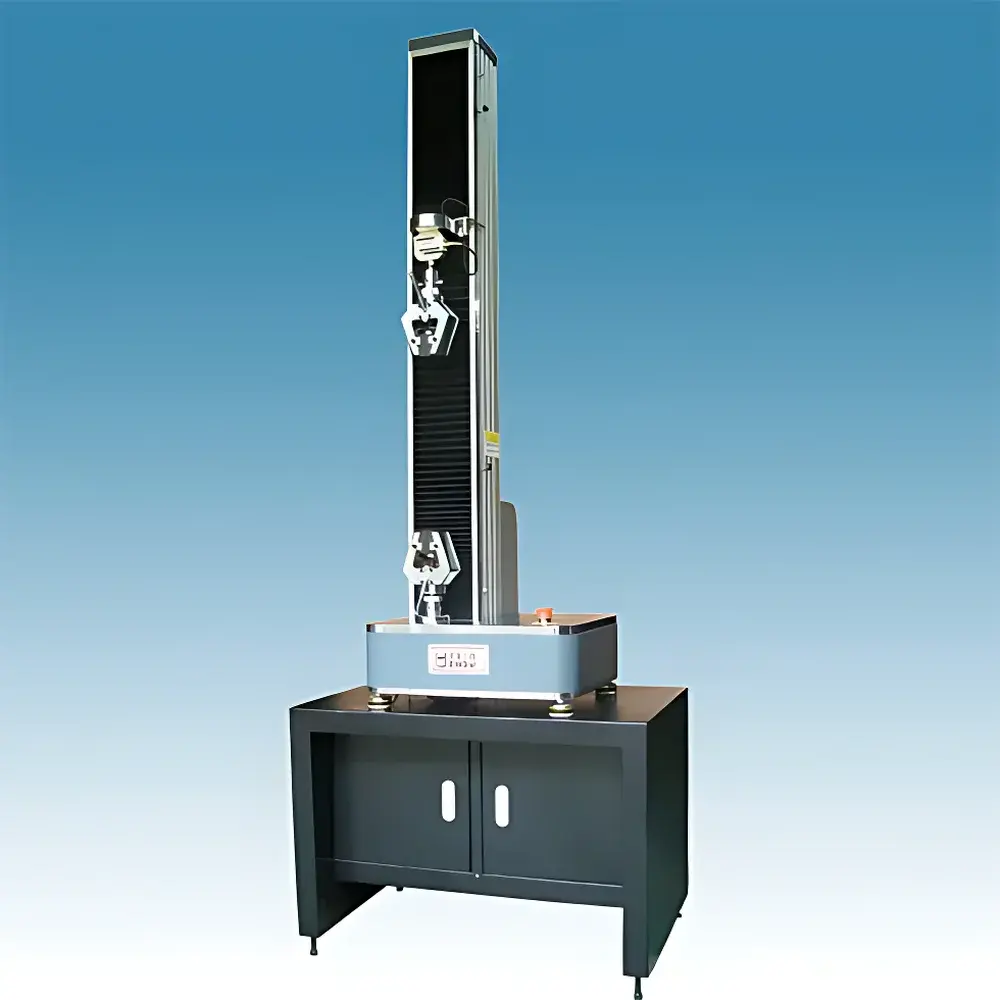
Hengyi HY-0580UIOI Biomedical Tensile Testing Machine
| Brand | Hengyi |
|---|---|
| Origin | Shanghai, China |
| Manufacturer Type | Direct Manufacturer |
| Product Category | Domestic |
| Model | HY-0580UIOI |
| Instrument Type | Electromechanical Tensile Tester |
| Maximum Test Load | 5 kN |
| Force Measurement Range | 0.001–100% FS |
| Force Accuracy | ±0.5% of reading |
| Test Stroke | 800 mm |
| Displacement Resolution | 0.001 mm |
| Speed Range | 0.001–500 mm/min |
| Speed Accuracy | ±0.5% of set value |
| Position Accuracy | ±0.5% of reading |
| Strain Control Range | 0.002–6% FS/s |
| Stress Control Range | 0.005–6% FS/s |
| Load Cell Options | 5 N to 5000 N |
| Effective Test Width | 120 mm |
| Power Supply | 220 V AC, 750 W |
| Net Weight | 95 kg |
| Dimensions (W×D×H) | 470 × 400 × 1510 mm |
Overview
The Hengyi HY-0580UIOI Biomedical Tensile Testing Machine is an electromechanical universal testing system engineered for high-fidelity mechanical characterization of soft and hard biological materials under static and quasi-static loading conditions. Based on servo-controlled linear actuation and precision load cell feedback, the system implements ASTM E8/E8M, ISO 527, ISO 6892-1, ISO 11403, USP , and GB/T 228.1-compliant test protocols to quantify tensile strength, compressive yield, flexural modulus, elongation at break, stress relaxation, and creep behavior. Designed specifically for regulatory-grade biomechanical evaluation, it supports both single-axis tension/compression and controlled displacement/force/stress-rate modes—enabling reproducible assessment of orthopedic implants, cardiovascular grafts, dental biomaterials, and tissue-engineered constructs in accordance with GLP-aligned laboratory practices.
Key Features
- Modular dual-range load cell architecture supporting selectable capacities from 5 N to 5000 N, ensuring optimal signal-to-noise ratio across low-force soft-tissue and high-force metallic implant testing.
- High-resolution displacement measurement system with 0.001 mm resolution and ±0.5% linearity over full 800 mm stroke, validated per ISO 7500-1 Class 0.5 requirements.
- Programmable speed control from 0.001 to 500 mm/min, enabling slow-strain-rate testing (e.g., ligament viscoelasticity) and rapid failure characterization (e.g., suture burst testing).
- Dual-mode closed-loop control: force-controlled ramping for yield point detection and displacement-controlled loading for strain-dependent response mapping.
- Integrated electronic limit protection, overload cutoff (>110% FS), and real-time diagnostic monitoring of drive current, encoder feedback, and amplifier status.
- Quick-release crosshead adjustment with coarse/fine positioning and programmable return-to-start functionality post-test.
- Robust aluminum-alloy frame with vibration-damped base plate, minimizing environmental interference during micro-newton-level measurements.
Sample Compatibility & Compliance
The HY-0580UIOI accommodates a broad spectrum of specimen geometries and mechanical classes: native and decellularized soft tissues (tendons, arteries, corneas), synthetic polymers (PLA, PCL, PU), bioceramics (hydroxyapatite, β-TCP), metallic alloys (Ti-6Al-4V, CoCrMo), composite scaffolds, medical device components (stents, clips, staples), and packaging films. Standardized grips include pneumatic flat-face clamps (for films and sheets), self-tightening cord grips (for sutures and filaments), and custom-designed bone-fixation fixtures compliant with ASTM F543 and ISO 5832-3. All test sequences adhere to audit-trail requirements per FDA 21 CFR Part 11 when paired with optional software validation packages. Data output conforms to ISO/IEC 17025 traceability frameworks, with calibration certificates traceable to NIM (China National Institute of Metrology).
Software & Data Management
The embedded Windows-based control software provides ISO 17025-aligned test method templates—including uniaxial tension per ASTM D638, compression per ASTM D695, three-point bending per ASTM D790, and cyclic fatigue per ISO 14801. Real-time plotting includes true stress–strain, load–displacement, and time–deformation curves with automatic annotation of ReH (upper yield), ReL (lower yield), Rp0.2 (0.2% offset yield), Rm (ultimate tensile strength), and E (Young’s modulus). Raw data exports in CSV, XML, and PDF formats support third-party statistical analysis (e.g., JMP, Minitab) and LIMS integration. Optional 21 CFR Part 11 compliance module delivers electronic signatures, user role-based access control, and immutable audit logs for GMP-regulated environments.
Applications
- Mechanical validation of orthopedic fixation devices: interbody fusion cages, spinal rods, intramedullary nails, and locking plates per ASTM F2624 and ISO 12189.
- Tensile evaluation of vascular grafts and stent coatings under physiological strain rates (0.01–0.1 s⁻¹) and hydration conditions.
- Compression testing of cancellous bone analogs and calcium phosphate scaffolds per ISO 13314.
- Fatigue life assessment of dental implants and abutments using sinusoidal or staircase loading profiles.
- Peel and shear strength quantification of bioadhesives and wound closure systems per ASTM F2255 and ISO 10993-12.
- Quality control of medical packaging integrity (pouch seal strength, blister peel resistance) per ASTM F88 and ISO 11607-2.
FAQ
What standards does the HY-0580UIOI support for biomedical material testing?
It natively executes test methods aligned with ASTM, ISO, GB/T, and JIS standards—including ASTM F2129 (corrosion fatigue), ISO 5832 (metallic implant materials), and USP (mechanical testing of pharmaceutical packaging).
Can the system perform cyclic fatigue testing?
Yes—the controller supports programmable sine, triangle, trapezoidal, and block waveform profiles with frequency ranges up to 5 Hz and fully configurable upper/lower load limits and stop criteria (cycles, crack initiation, or deflection threshold).
Is the software compliant with FDA 21 CFR Part 11?
An optional validated software package is available, including electronic signatures, audit trail generation, role-based permissions, and data encryption—meeting full Part 11 requirements for regulated biocompatibility labs.
What grip types are included as standard equipment?
Standard configuration includes wedge-action flat grips (0–120 mm width), pneumatic film clamps, and adjustable cord/tendon grips; custom fixtures for ASTM F2193 spinal implant testing and ISO 14801 dental implant fatigue are available upon request.
How is calibration maintained over time?
The system supports internal verification via traceable reference load cells and displacement standards; annual recalibration by accredited third-party providers (CNAS-certified) is recommended, with full documentation stored in the audit log.



