
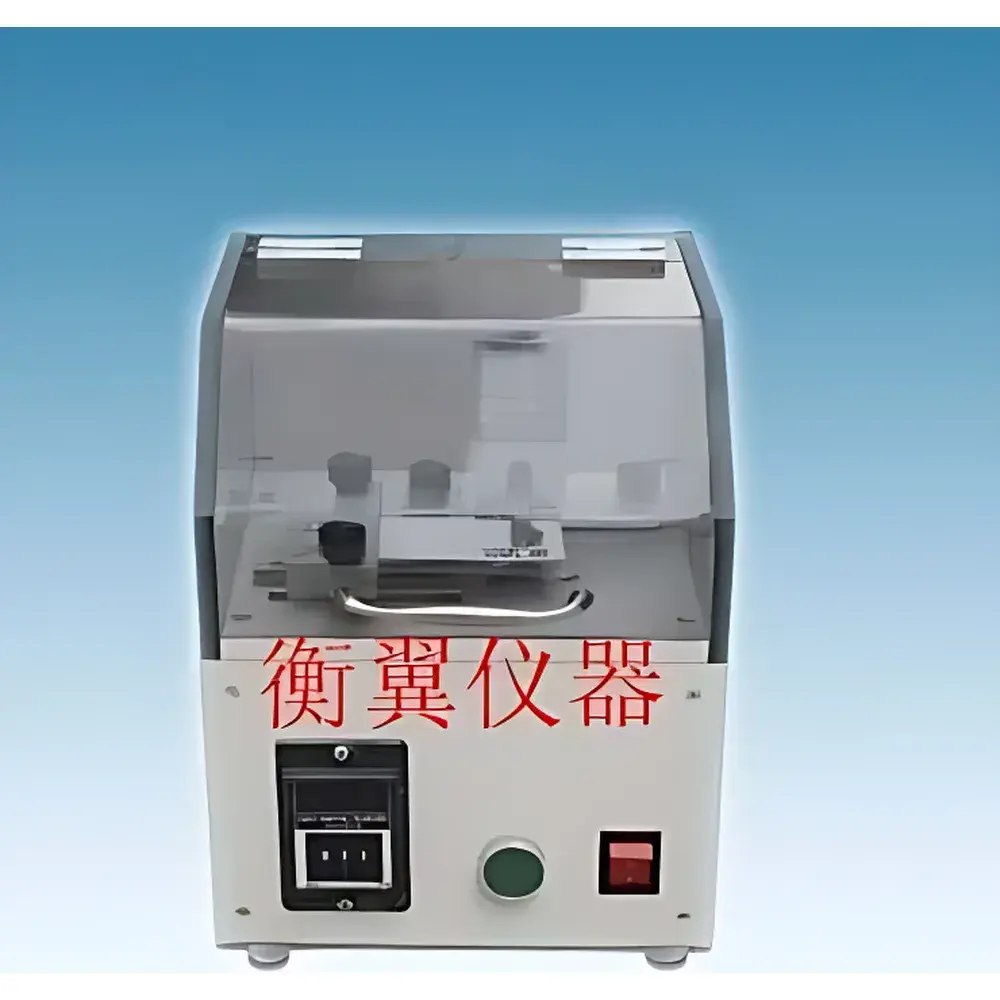
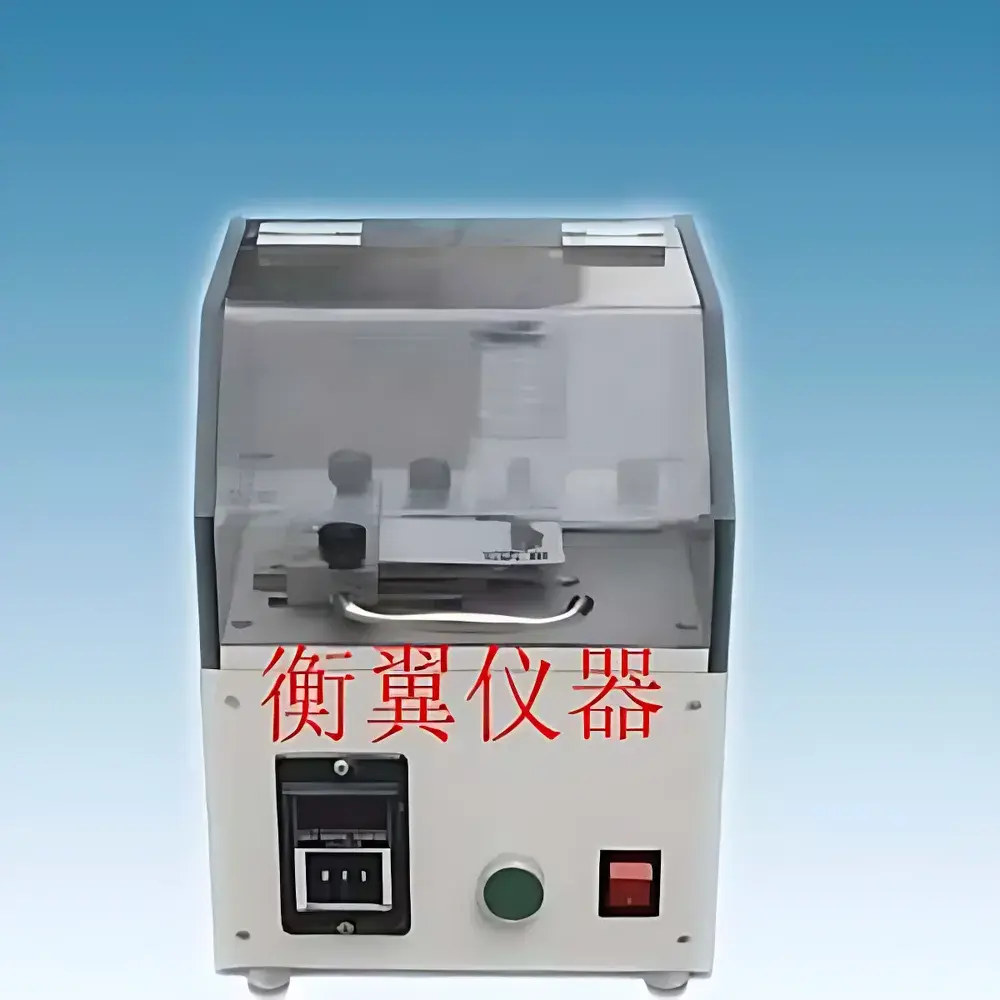
Hengyi HY(SL)e Smart Card Tri-Roll Durability Tester
| Brand | Hengyi |
|---|---|
| Origin | Shanghai, China |
| Manufacturer Type | Direct Manufacturer |
| Country of Origin | China |
| Model | HY(SL)e |
| Power Supply | AC 220 V |
| Cycle Count | 50 forward + 50 backward rolls (100 total) |
| Roll Frequency | 0.5 Hz |
| Applied Load | 8 N (standard), optional 15 N weight included |
| Dimensions (L×W×H) | 255 × 235 × 285 mm |
| Weight | 12 kg |
| Compliance | ISO/IEC 10373-3:2001 Annex D (Tri-Roll Test for IC Cards) |
Overview
The Hengyi HY(SL)e Smart Card Tri-Roll Durability Tester is an electromechanical test system engineered to evaluate the mechanical robustness of contact-type integrated circuit (IC) cards—commonly known as smart cards—under standardized cyclic rolling stress. It implements the tri-roll test method defined in ISO/IEC 10373-3:2001, Annex D, which simulates real-world wear conditions encountered during repeated insertion and extraction in card readers. The device subjects the card’s embedded microchip region to controlled, bidirectional rolling motion using three precision-ground stainless steel rollers arranged in a triangular configuration. Each test cycle comprises 100 discrete roll passes: 50 over the chip’s front edge and 50 over its rear edge, executed at a fixed frequency of 0.5 Hz (one roll every 2 seconds). A calibrated downward force of 8 N is applied via a gravity-loaded roller assembly; an additional 15 N mass is supplied for verification against CQM (Card Qualification Methodology) recommendations used by major payment card schemes. This tester supports objective pass/fail assessment based on post-test electrical functionality and physical integrity of the chip module and contact pads.
Key Features
- Compliant tri-roll geometry aligned with ISO/IEC 10373-3:2001 Annex D and Mastercard CQM requirements
- Programmable dual-phase roll sequence: 50 forward + 50 backward cycles per test run
- Fixed-frequency actuation at 0.5 Hz with mechanical timing stability ±0.02 Hz
- Gravity-based load application with traceable 8 N nominal force; includes certified 15 N auxiliary weight
- Stainless steel rollers with surface finish ≤0.4 µm Ra to minimize abrasive wear variation
- Integrated card retention fixture ensuring consistent lateral alignment and minimal slippage
- Compact benchtop footprint (255 × 235 × 285 mm) and lightweight aluminum–steel frame (12 kg)
- AC 220 V, 50 Hz single-phase input with internal thermal cutoff and overload protection
Sample Compatibility & Compliance
The HY(SL)e accommodates standard ISO/IEC 7810 ID-1 format cards (85.6 × 53.98 × 0.76 mm), including PVC, PET, and composite substrate cards with embedded contact chips. It is validated for use with EMV-compliant cards meeting ISO/IEC 7816-2 mechanical interface specifications. All test procedures align with the functional verification criteria outlined in ISO/IEC 10373-3:2001 Section 6.3.3: post-test continuity checks must confirm uninterrupted electrical connection across all eight contact points (C1–C8), and no visible delamination, cracking, or solder joint fracture shall be observed under 10× magnification. The system supports GLP-aligned documentation when paired with external test logs; while the instrument itself does not include electronic audit trails, its mechanical repeatability enables full traceability in regulated environments requiring ISO/IEC 17025 or ISO 9001 process validation.
Software & Data Management
The HY(SL)e operates as a stand-alone electromechanical tester without embedded firmware or digital interface. All operational parameters—including cycle count, load configuration, and test initiation—are manually configured via physical controls. Users record test metadata (batch ID, card serial number, operator ID, date/time, load condition) in external laboratory notebooks or LIMS-integrated spreadsheets. For quality assurance workflows compliant with FDA 21 CFR Part 11 or EU Annex 11, laboratories may integrate the device into broader validation protocols by documenting calibration history of the 8 N and 15 N weights (per ISO/IEC 17025-accredited mass calibration), roller surface inspection logs, and periodic mechanical timing verification using calibrated stopwatches or photogate sensors.
Applications
- Pre-certification mechanical stress screening for EMV Level 1 and Level 2 smart cards
- Supplier qualification testing per Mastercard CQM and Visa VISAQ requirements
- In-process quality control during smart card lamination and module embedding
- Fatigue life benchmarking of new substrate materials (e.g., biodegradable polymers, thin PETG)
- Root cause analysis of field failures linked to contact wear or interfacial delamination
- Validation of adhesive bonding strength between chip module and card body
FAQ
Does the HY(SL)e support automated data logging or USB/RS-232 output?
No. The HY(SL)e is a purely electromechanical tester with no embedded microcontroller, memory, or communication ports. Data recording requires manual entry into external systems.
Can the roller speed or load be adjusted beyond 0.5 Hz or 8 N / 15 N?
No. The device is mechanically fixed to operate exclusively at 0.5 Hz and the two specified loads to ensure strict compliance with ISO/IEC 10373-3 and CQM test definitions.
Is calibration service available from Hengyi for this model?
Yes. Hengyi provides factory calibration certificates for the applied load masses (8 N and 15 N) traceable to NIM (National Institute of Metrology, China). Roller geometry and timing verification are user-performed per the operation manual.
What maintenance is required for long-term reliability?
Monthly cleaning of roller surfaces with isopropyl alcohol; annual inspection of drive belt tension and bearing smoothness; replacement of the silicone rubber pressure pad every 5,000 cycles or as wear becomes visible.



