
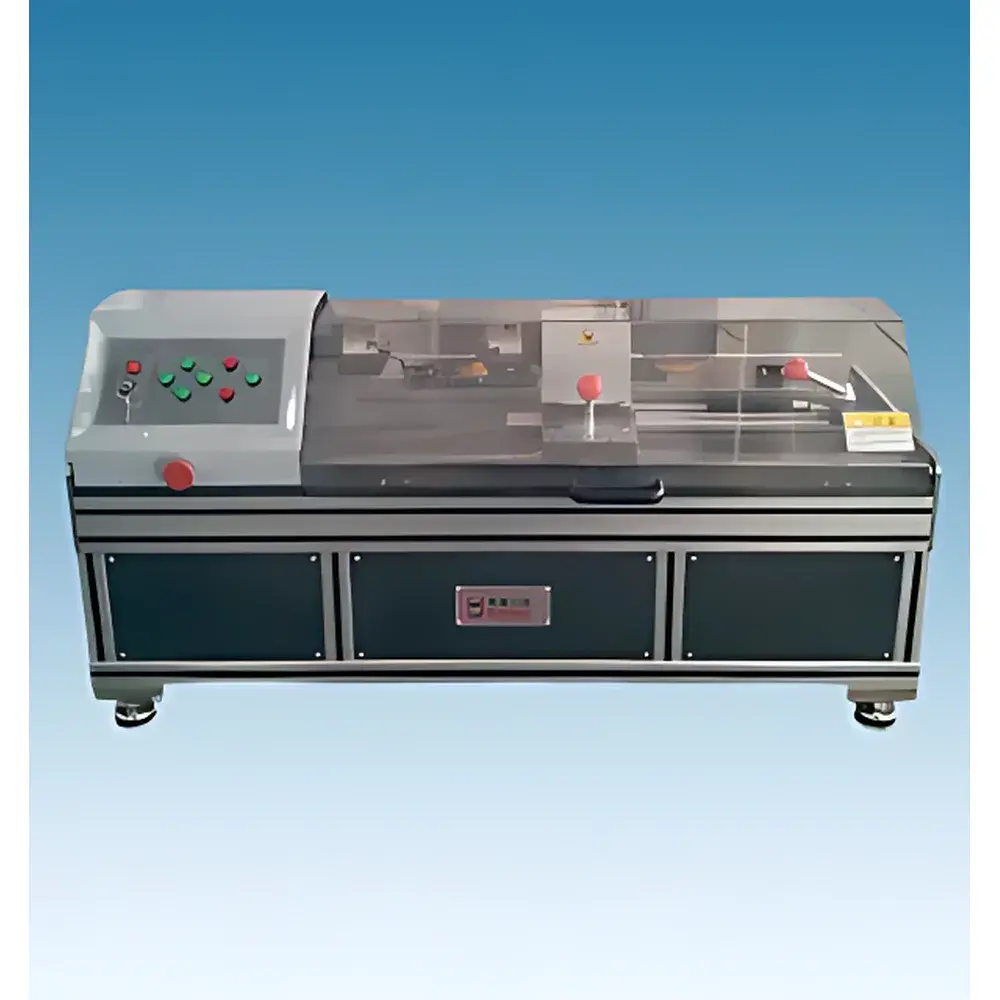
Hengyi HY-100N·m Microcomputer-Controlled Electronic Torsion Testing Machine
| Brand | Hengyi |
|---|---|
| Origin | Shanghai, China |
| Manufacturer Type | Direct Manufacturer |
| Model | HY-100N·mFDF |
| Max Torque | 100 N·m |
| Torque Measurement Range | 0.1–100 N·m |
| Torque Resolution | 0.001 N·m |
| Torsion Angle Range | 0–100,000° (or continuous) |
| Motor Power | 0.4 kW |
| Torque Measurement Accuracy | ±0.5% FS |
| Torsion Angle Resolution | 0.0045° |
| Angular Velocity Range | 0–1000°/min |
| Specimen Grip Diameter Range | Φ1–Φ5 mm (customizable) |
| Test Space (Grip-to-Grip) | 200 mm (adjustable) |
| Weight | 200 kg |
| Dimensions (L×W×H) | ≈1000×420×500 mm |
Overview
The Hengyi HY-100N·m Microcomputer-Controlled Electronic Torsion Testing Machine is a precision electromechanical system engineered for quantitative torsional characterization of solid materials under controlled angular displacement and torque loading. Based on closed-loop servo control architecture, it applies calibrated rotational force to specimens while simultaneously measuring real-time torque (N·m) and angular deformation (°) with high reproducibility. The system operates on the principle of direct torque transduction via high-stability strain-gauge-based load cells and high-resolution optical encoders for angular position feedback—enabling compliance with fundamental torsion mechanics standards including Hooke’s law for shear stress–strain relationships. Designed for laboratory and quality control environments, this machine supports both static and dynamic torsion testing protocols across metallic alloys, polymers, composites, adhesives, biomedical implants (e.g., bone screws, intramedullary nails), and orthopedic prosthetic components. Its modular mechanical frame and digital control interface facilitate integration into ISO/IEC 17025-accredited testing workflows and support traceable calibration per JJG 269 (Verification Regulation for Torsion Testing Machines).
Key Features
- Full-range torque capacity from 0.1 N·m to 100 N·m with resolution of 0.001 N·m (1/500,000 full scale)
- High-fidelity angular measurement up to 100,000° with encoder-based resolution of 0.0045° and accuracy better than ±0.5% FS
- Bidirectional automatic loading—programmable clockwise and counterclockwise torsion sequences with real-time reversal capability
- Adjustable grip-to-grip distance (standard 200 mm; customizable per user specification) and interchangeable chucks accommodating specimens from Φ1 mm to Φ5 mm diameter
- Variable angular velocity control from 0 to 1000°/min with speed stability within ±0.5% of setpoint
- Dedicated electronic measurement and control unit independent of host PC, ensuring deterministic timing and data integrity during transient events
- Integrated peak-hold, auto-tracking, and rate-of-load indication functions for manual verification and operator guidance
Sample Compatibility & Compliance
The HY-100N·m system accommodates cylindrical, rod-shaped, and threaded specimens used in mechanical fastening, biomedical device validation, and structural adhesive bonding applications. It meets mandatory national technical requirements outlined in JB/T 9370–1999 (Technical Specifications for Torsion Testing Machines) and GB/T 10128–2007 (Metallic Materials – Room Temperature Torsion Testing Methods). Optional test method configuration supports user-defined standards—including ASTM F543 (Standard Specification for Metallic Medical Bone Screws), ISO 6892-1 (Tensile Testing of Metals), and EN 14324 (Adhesives – Determination of Torsional Strength). All hardware and firmware are designed to enable audit-ready operation under GLP and GMP frameworks, with optional configuration for FDA 21 CFR Part 11-compliant electronic signatures and data archiving.
Software & Data Management
The embedded Windows-based control software provides synchronized acquisition of torque, angle, time, and calculated derived parameters (e.g., shear modulus, torsional yield strength, ultimate torsional strength, ductility at break). Real-time plotting includes dual-axis displays: torque vs. twist angle and torque vs. time. Data export is supported in CSV, XLSX, and PDF formats—with automated report generation conforming to GB/T 228.1 and GB/T 10128 templates. Calibration coefficients are digitally stored and protected against unauthorized modification. Audit trail functionality records all user actions, parameter changes, and test execution logs with timestamp and operator ID. Raw data files retain native 16-bit ADC resolution for post-processing reanalysis.
Applications
- Mechanical evaluation of metallic fasteners (bolts, screws, pins) per ISO 898-1 and ASTM F568M
- Torsional fatigue and static failure analysis of cardiovascular stents and orthopedic fixation devices
- Quality assurance of structural adhesives and epoxy bondlines in aerospace assemblies
- Shear property quantification of polymer matrix composites and fiber-reinforced rods
- Validation of material homogeneity and microstructural anisotropy in cold-drawn wire and drawn tubing
- Research-grade torsional creep and stress relaxation experiments under constant torque or angle control
FAQ
What standards does the HY-100N·m comply with by default?
It conforms to JB/T 9370–1999 and GB/T 10128–2007 as standard. Custom firmware mapping for ASTM, ISO, or EN methods is available upon request.
Can the machine perform cyclic torsion or fatigue testing?
Yes—software supports programmable multi-step torsion profiles, including sinusoidal, triangular, and stepwise load/unload cycles with dwell periods and reversal limits.
Is calibration traceability provided?
Each unit ships with a factory calibration certificate traceable to CNAS-accredited reference standards; annual recalibration services and NIST-traceable torque calibrators are available.
What is the minimum specimen diameter supported?
Standard grips accommodate Φ1 mm specimens; sub-millimeter clamping fixtures (e.g., for micro-wires or dental implants) can be supplied as optional accessories.
Does the system support remote operation or networked data sharing?
The control software includes TCP/IP communication protocol support for LAN-based monitoring and centralized lab data aggregation via secure API endpoints.



