
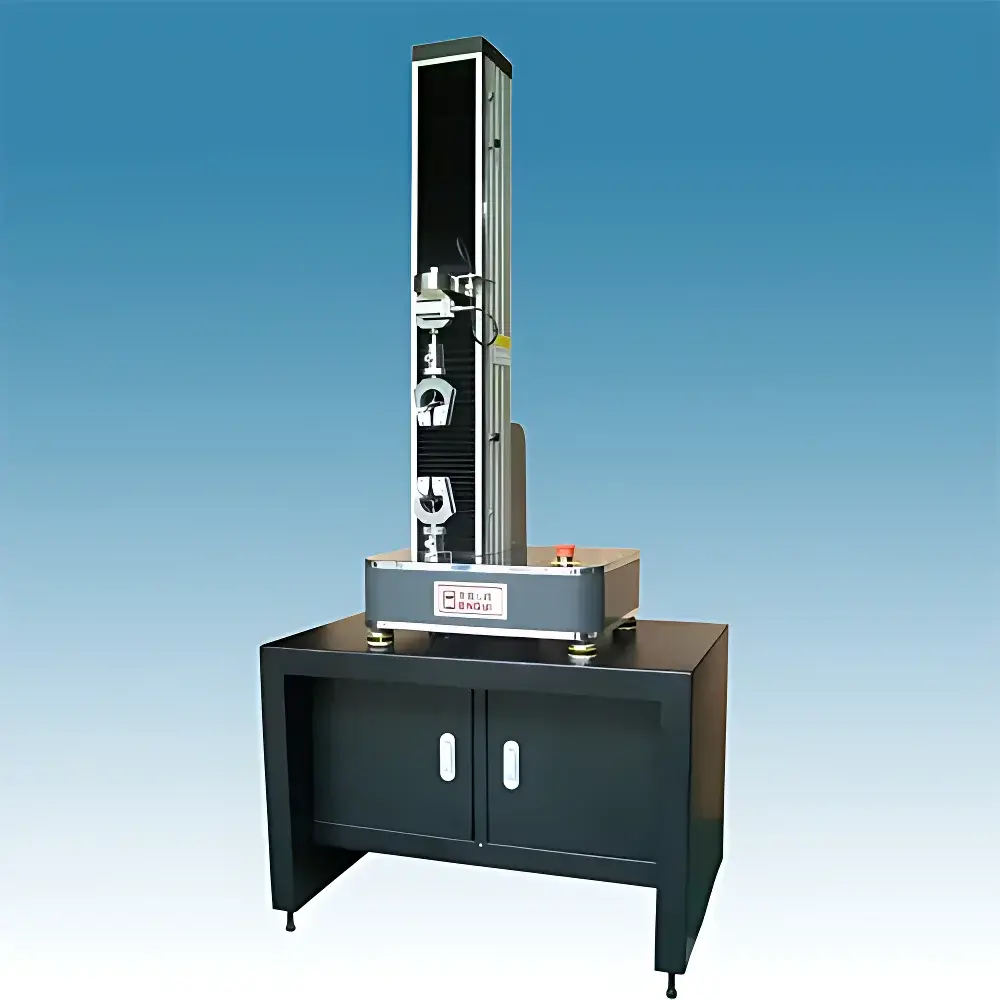
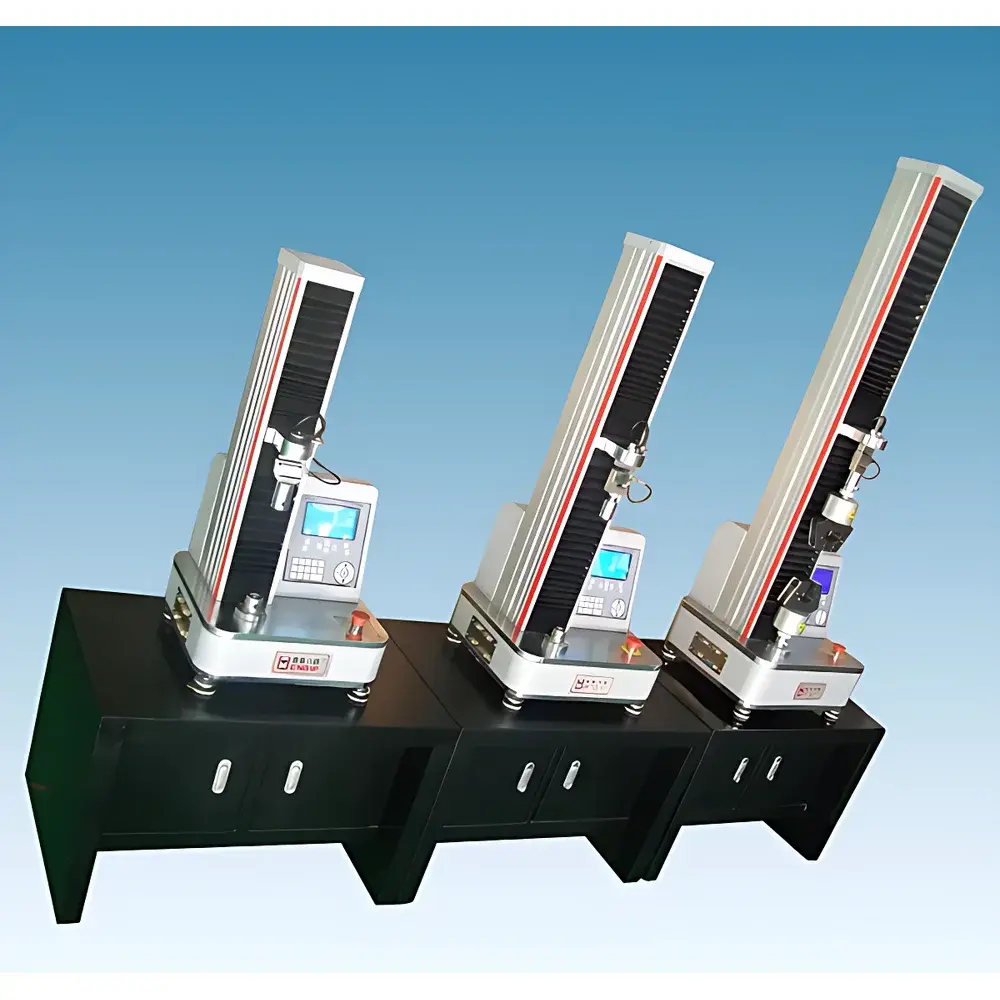
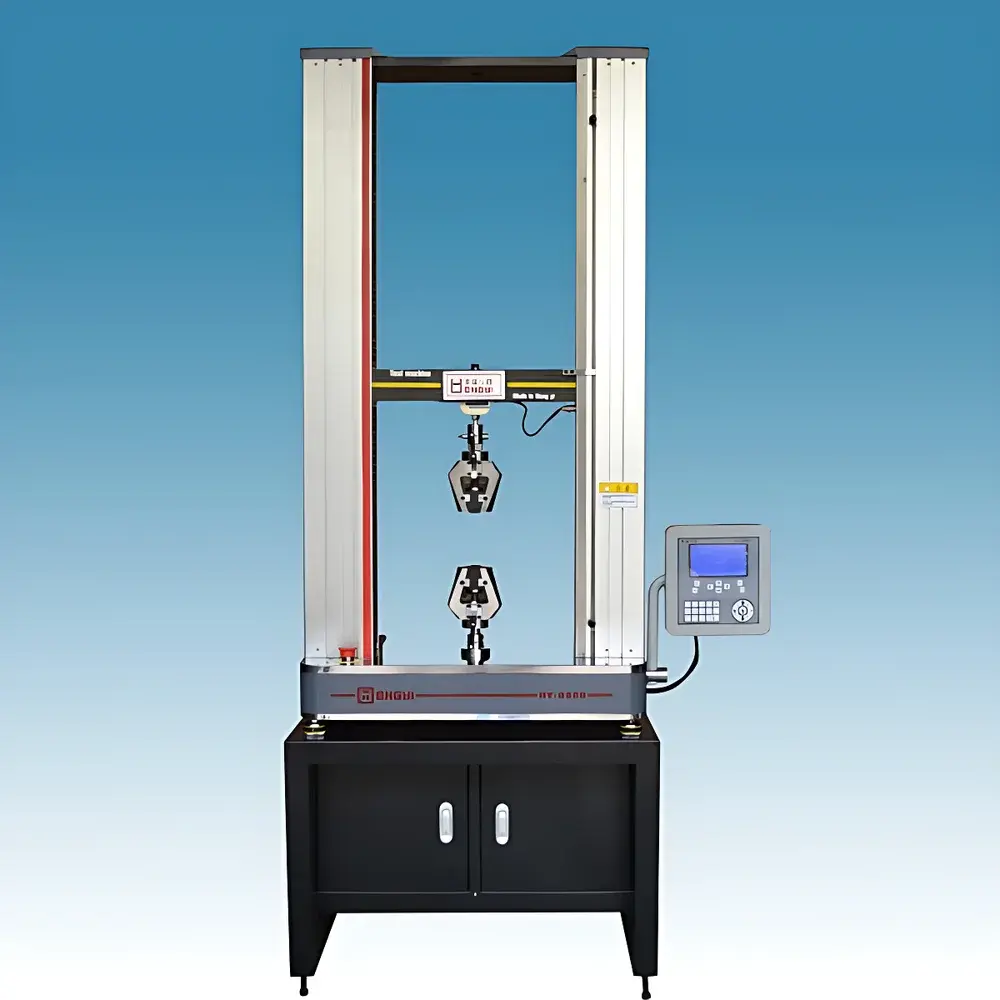
Hengyi HY-0580X1 Universal Tensile Testing Machine
| Brand | Hengyi |
|---|---|
| Origin | Shanghai, China |
| Manufacturer Type | Direct Manufacturer |
| Regional Classification | Domestic (China) |
| Model | HY-0580X1 |
| Instrument Type | Electromechanical Universal Testing Machine |
| Max Load Capacity | 100N–5000N (selectable) |
| Measurement Range | 5N–5000N |
| Accuracy | ±0.5% |
| Speed Range | 0.001–1000 mm/min |
| Speed Accuracy | ±0.5% |
| Stroke Accuracy | ±0.5% |
| Displacement Accuracy | ±0.5% |
| Effective Width | 150 mm |
| Effective Stroke | 800 mm (extendable) |
| Safety Features | Electronic Limit Protection, Emergency Stop Button |
| Control Interface | Full PC Control (Windows OS), Optional LCD Touch Panel & Wireless Remote |
| Software | Multilingual (Chinese/English + 8 additional languages), ASTM/ISO/GB/JIS/DIN Compliant Data Processing |
| Weight | ~85 kg |
| Dimensions (W×D×H) | 590 × 355 × 1640 mm |
| Power Supply | 220 V AC |
Overview
The Hengyi HY-0580X1 Universal Tensile Testing Machine is an electromechanical static materials tester engineered for precision mechanical property characterization across a broad spectrum of solid materials. It operates on the principle of controlled uniaxial force application—using a high-resolution servo-motor-driven crosshead—to measure load-displacement response under tension, compression, bending, shear, peel, tear, and puncture conditions. Designed to meet international metrological standards, the system delivers traceable force measurement with ±0.5% accuracy (certifiable per national calibration protocols), making it suitable for quality control laboratories, R&D centers, and third-party testing facilities requiring ISO/IEC 17025-aligned data integrity. Its modular architecture supports standardized test execution per ASTM D638, ISO 527, GB/T 1040, JIS K7113, DIN 53455, and USP , ensuring regulatory compatibility in pharmaceutical, automotive, aerospace, and construction material validation workflows.
Key Features
- High-fidelity closed-loop control supporting stress, strain, and displacement modes—enabling consistent test repeatability across diverse specimen geometries and compliance requirements.
- Modular load cell selection from 100 N to 5000 N, with full-scale resolution down to 0.01% FS and real-time dynamic compensation for thermal drift and mechanical hysteresis.
- Dual-control interface: Windows-based PC software for advanced test scripting and post-processing, plus optional integrated 7-inch TFT LCD touchscreen or wireless remote for rapid setup and manual intervention.
- Proprietary 32-bit ARM7 microcontroller paired with a 24-bit analog-to-digital converter ensures 56 MIPS deterministic data acquisition at up to 1 kHz sampling rate—critical for capturing transient yield events and low-cycle fatigue signatures.
- Comprehensive safety architecture including programmable electronic stroke limits, hardware emergency stop circuitry, and overload cutoff—fully compliant with EN ISO 12100 and IEC 61508 functional safety guidelines.
- Multi-language software platform (Chinese, English, German, French, Spanish, Japanese, Korean, Russian) with audit-trail-enabled operation logs—supporting FDA 21 CFR Part 11 compliance when configured with user authentication and electronic signature modules.
Sample Compatibility & Compliance
The HY-0580X1 accommodates specimens ranging from thin polymer films (<0.1 mm thick) to metallic rods (up to Ø12 mm), elastomeric sheets, composite laminates, adhesives, textiles, and biomedical sutures. Standardized grips—including wedge-action tensile jaws, compression platens, three-point bend fixtures, and pneumatic peel clamps—are configurable per ISO 20795-1, ASTM D3330, and GB/T 7124. All test procedures adhere to GLP/GMP documentation frameworks, with raw data export in CSV, XML, and PDF formats—including embedded metadata (operator ID, timestamp, environmental conditions, calibration certificate ID). System validation packages are available for IQ/OQ/PQ execution in regulated environments.
Software & Data Management
The embedded Hengyi TestSuite v4.2 provides real-time graphical display of force–displacement, stress–strain, and modulus-vs.-time curves. Automated parameter extraction includes ultimate tensile strength (UTS), yield point (offset method per ASTM E8), Young’s modulus, elongation at break, secant modulus, flexural modulus, compressive yield strength, and peel adhesion energy. Customizable report templates support dual-unit output (N, kN, lbf, kgf), statistical summaries (mean, SD, CV%), and comparative overlay of up to eight test runs. Raw data files are stored with SHA-256 hash verification; revision-controlled software updates follow IEEE 1012 standards for verification and validation.
Applications
- Quality assurance of thermoplastics (PP, PE, PET) and engineering resins (PA6, POM, PC) per ISO 527-2.
- Mechanical screening of lithium-ion battery electrode coatings and separator membranes under tensile and puncture loading.
- Adhesive bond strength evaluation in automotive trim assembly (ASTM D1002, ISO 4587).
- Structural validation of carbon fiber-reinforced polymer (CFRP) laminates in aerospace component certification (SAE AMS 2750E).
- Educational use in university materials science labs for hands-on instruction in elastic-plastic deformation theory and fracture mechanics fundamentals.
FAQ
What international standards does the HY-0580X1 support out-of-the-box?
The system ships with preconfigured test methods for ASTM D638, ISO 527-1/-2, GB/T 1040.1–1040.5, JIS K7113, and DIN 53455, with downloadable add-ons for additional standards via Hengyi’s secure firmware portal.
Is the system compatible with LIMS or MES integration?
Yes—via TCP/IP API and OPC UA protocol support, enabling bidirectional data exchange with laboratory information management systems (e.g., LabWare, Thermo Fisher SampleManager) and manufacturing execution systems.
Can the machine perform cyclic loading or low-cycle fatigue tests?
While primarily optimized for static and quasi-static testing, the controller supports programmed load-controlled waveforms (sine, triangle, trapezoidal) up to 5 Hz with dwell capability—suitable for basic fatigue screening per ASTM D3479.
Does the software generate calibration certificates traceable to NIM or NIST?
Calibration reports issued by accredited third-party labs (CNAS-certified in China or A2LA-accredited internationally) include uncertainty budgets and traceability statements aligned with ISO/IEC 17025:2017.
What maintenance intervals are recommended for long-term accuracy retention?
Annual recalibration of load cells and position encoders is advised; biannual verification of crosshead alignment and grip parallelism using certified gauge blocks and dial indicators ensures continued compliance with ISO 7500-1 Class 0.5 requirements.
Related Products



