
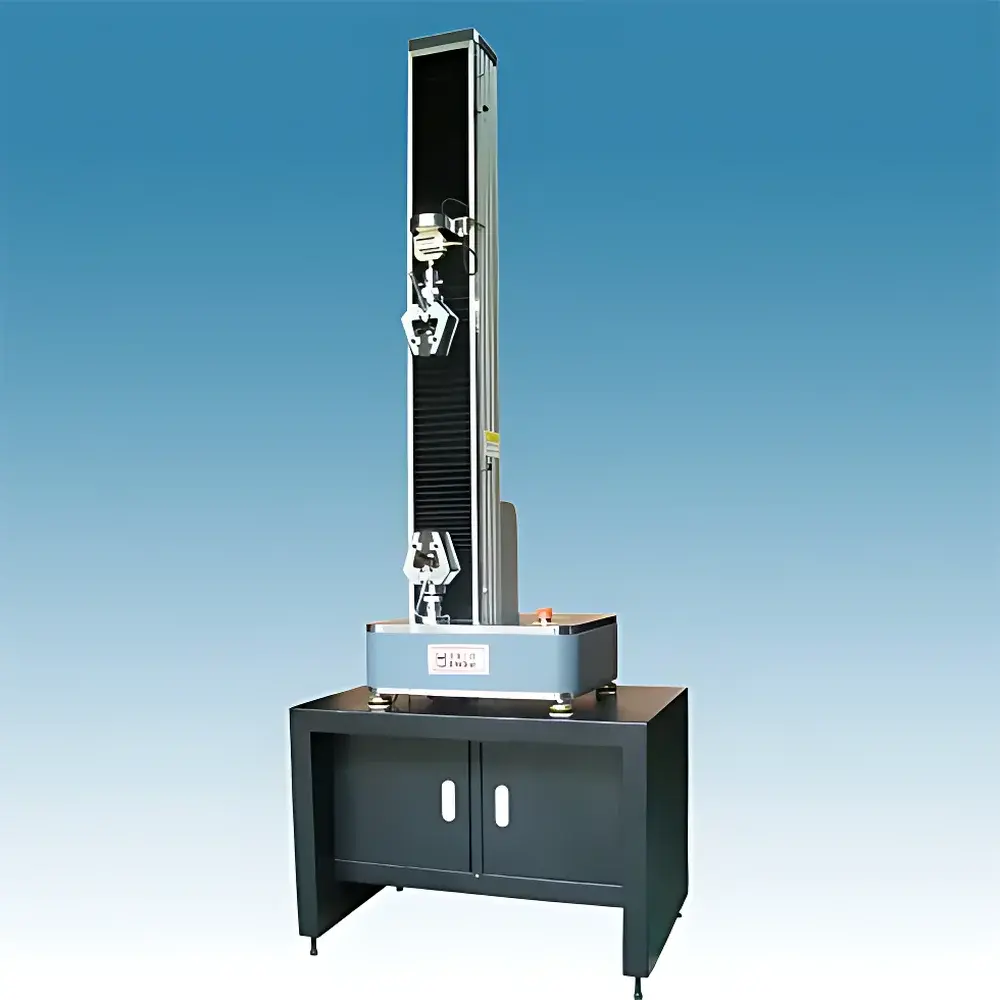
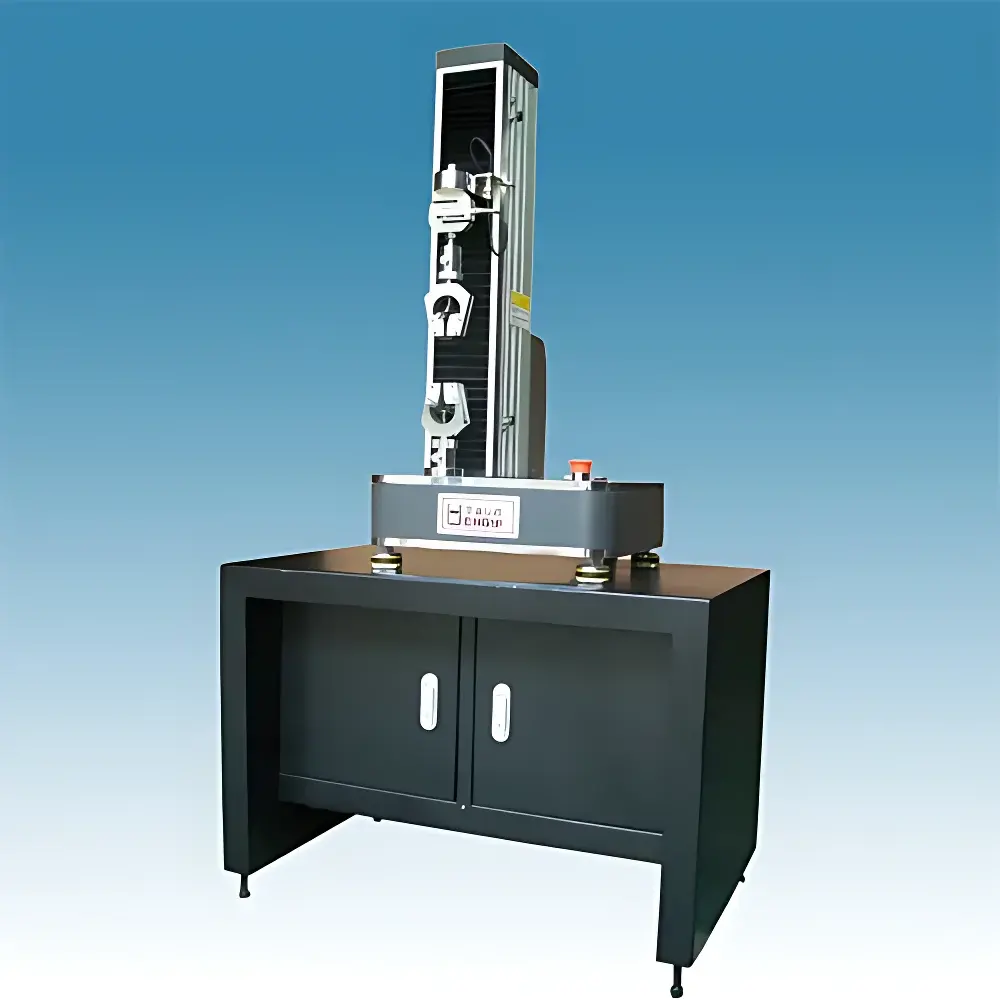
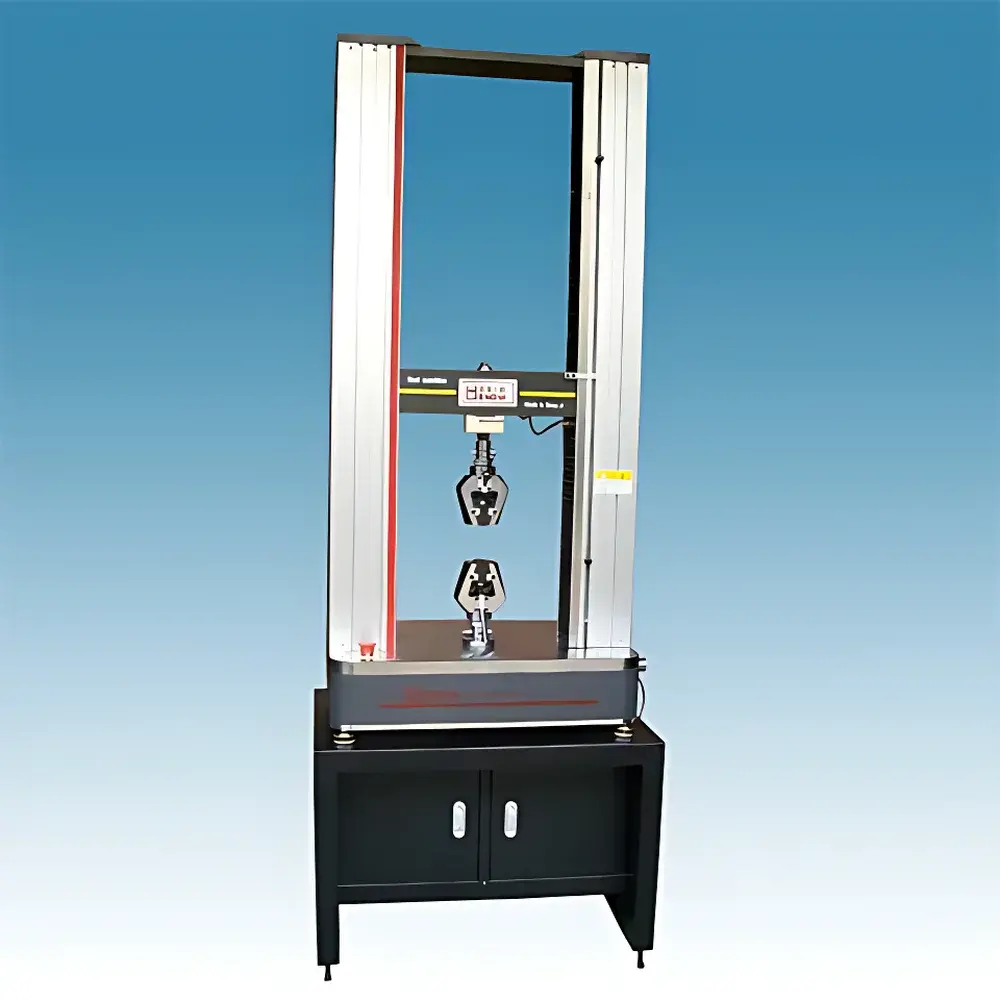
Hengyi HY-0580FGHH Lithium Battery Separator Puncture Strength Tester
| Brand | Hengyi |
|---|---|
| Origin | Shanghai, China |
| Manufacturer Type | Direct Manufacturer |
| Product Category | Domestic |
| Model | HY-0580FGHH |
| Instrument Type | Electromechanical Universal Testing Machine |
| Load Capacity Options | 1 N to 5000 N (interchangeable load cells) |
| Force Accuracy | ≤ ±0.5% of reading |
| Effective Test Width | 120 mm |
| Effective Vertical Travel | 800 mm |
| Speed Range | 0.001–500 mm/min (adjustable) |
| Speed Accuracy | ±0.5% of set value |
| Displacement Accuracy | ±0.5% of reading |
| Strain Measurement Accuracy | ±0.5% of reading |
| Force Resolution | ±500,000 counts (full-scale, no range switching) |
| Control Modes | Stress control (0.005–6 %FS/s), Strain control (0.002–6 %FS/s), Constant Load/Displacement/Deformation |
| Safety Features | Electronic limit protection, overload protection (110% FS), auto-diagnostic system |
| Power Supply | 220 V AC, 750 W |
| Dimensions (W×D×H) | 470 × 400 × 1510 mm |
| Weight | 120 kg |
Overview
The Hengyi HY-0580FGHH Lithium Battery Separator Puncture Strength Tester is a high-precision electromechanical universal testing machine engineered specifically for evaluating the mechanical integrity of microporous polyolefin separators used in lithium-ion batteries. It operates on the principle of controlled axial force application via a servo-motor-driven crosshead, measuring puncture resistance as a critical indicator of separator robustness against dendrite penetration and internal short-circuit risk. Designed with a single-column rigid frame architecture, the system delivers stable load transmission and minimal deflection during high-resolution force-displacement acquisition—essential for detecting subtle yield events and fracture initiation in sub-25 µm thick membranes. Its modular load cell configuration (1 N to 5000 N) enables traceable calibration across multiple force ranges without hardware reconfiguration, supporting both R&D validation and QC release testing under ISO/IEC 17025-accredited environments.
Key Features
- High-fidelity force measurement with ≤ ±0.5% accuracy and 500,000-count resolution across full scale—no range switching required.
- Ultra-low-speed capability down to 0.001 mm/min, enabling quasi-static puncture profiling compliant with ASTM D737 and GB/T 36363-2018 for battery separator evaluation.
- Dual-mode closed-loop control: stress-rate and strain-rate regulation with real-time feedback, supporting ISO 527-3 and IEC 62660-1 test protocols.
- Integrated electronic limit switches and overload cutoff (110% FS) ensure operator safety and equipment longevity during high-cycle or over-travel conditions.
- Modular fixture interface compatible with standardized puncture pins (φ1.0 mm hemispherical tip per GB/T 36363), tensile grips, compression platens, and custom tooling for non-standard geometries.
- Self-diagnostic firmware continuously monitors drive voltage, current draw, encoder signals, and thermal load—logging anomalies prior to mechanical failure.
Sample Compatibility & Compliance
The HY-0580FGHH accommodates thin-film specimens ranging from 5 µm to 150 µm in thickness, including PP/PE mono- or multi-layer separators, ceramic-coated membranes, and functionalized polymer composites. Its 120 mm effective test width and 800 mm vertical travel support edge-clamped, free-hanging, and constrained mounting configurations. The system meets metrological requirements of GB/T 2611-2007 (General Technical Requirements for Testing Machines), GB/T 16491-2008 (Electronic Universal Testing Machines), and ISO 7500-1:2018 (Calibration of Force-Testing Machines). Software-generated test reports include digital signatures, audit trails, and timestamped metadata—fully traceable for GLP/GMP compliance and FDA 21 CFR Part 11 readiness when deployed with validated software modules.
Software & Data Management
The embedded control software provides intuitive test sequence programming, real-time curve overlay (force vs. displacement, stress vs. strain), and automated pass/fail evaluation against user-defined thresholds (e.g., peak puncture force ≥ 300 gf, elongation at break ≤ 15%). Raw data export is supported in CSV, Excel, and XML formats; all files retain embedded calibration certificates and environmental metadata (temperature, humidity, operator ID). Optional add-ons include networked data synchronization to LIMS platforms, PDF report templating with company branding, and remote calibration certificate retrieval via secure API endpoints.
Applications
- Quantification of puncture resistance in lithium-ion battery separators per GB/T 36363-2018 and UL 2580 Annex G.
- Tensile property mapping of anode/cathode coatings on current collectors (adhesion strength, cohesive failure onset).
- Mechanical screening of solid-state electrolyte membranes under biaxial constraint.
- Quality conformance testing of separator batches prior to cell assembly (AQL sampling per ISO 2859-1).
- Accelerated aging studies correlating mechanical degradation with thermal cycling or electrolyte immersion exposure.
- Research-grade characterization of novel nanofiber or electrospun separator architectures.
FAQ
What standards does the HY-0580FGHH support for battery separator testing?
It fully supports GB/T 36363-2018, ASTM D737, ISO 9073-4, and IEC 62660-1 for puncture, tensile, and tear evaluation.
Can the system be integrated into an existing laboratory data management system?
Yes—via OPC UA or RESTful API interfaces; validated integration packages are available for LabWare LIMS and Thermo Fisher SampleManager.
Is third-party calibration certification included with purchase?
A factory-issued ISO/IEC 17025 calibration certificate (traceable to NIM, China) is provided; on-site recalibration services are available globally.
Does the controller support multi-step test profiles for cyclic puncture fatigue?
Yes—the software allows up to 99 programmable steps per test, including dwell periods, ramp reversals, and conditional termination triggers.
What maintenance intervals are recommended for long-term accuracy retention?
Biannual verification of load cell linearity and crosshead alignment is advised; annual full-system recalibration is recommended for GLP-regulated labs.



