
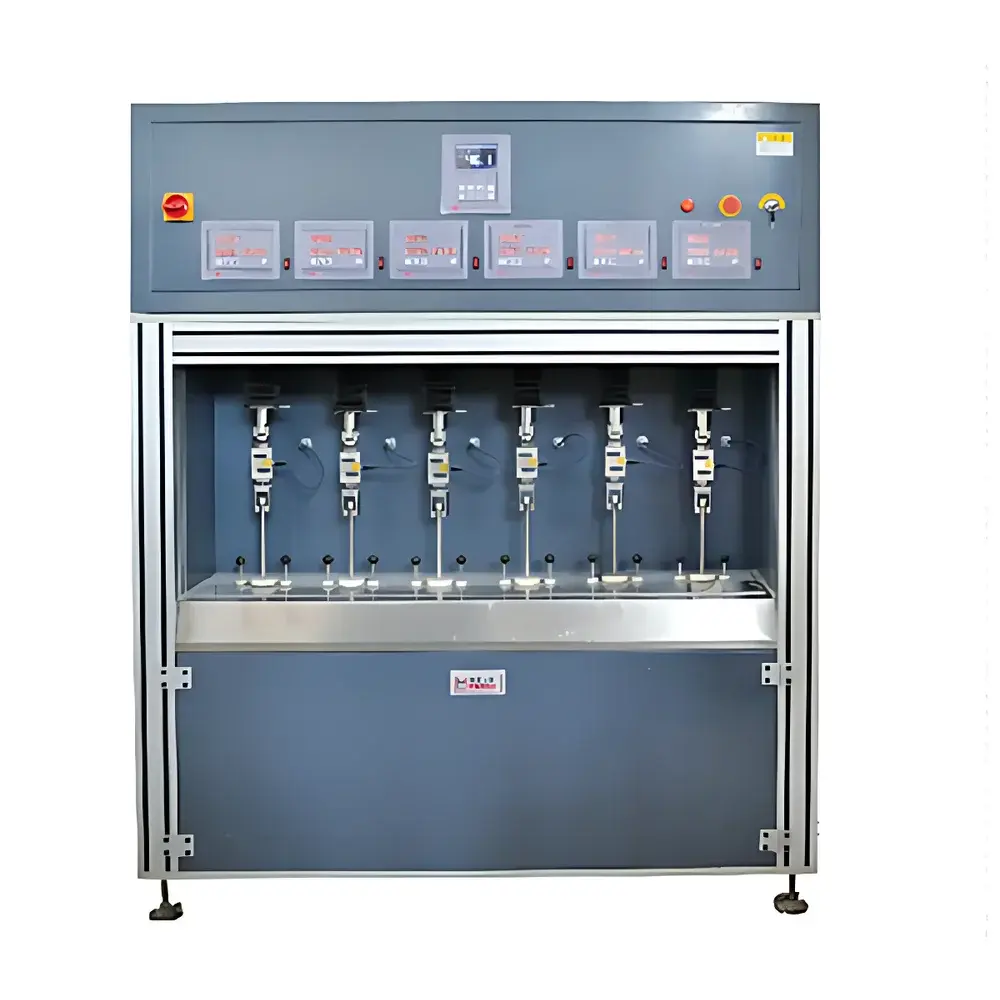
Hengyi HY-QKRB FNCT Creep Testing Machine
| Brand | Hengyi / Hengyitest |
|---|---|
| Origin | Shanghai, China |
| Manufacturer Type | Manufacturer |
| Product Origin | Domestic (China) |
| Model | HY-QKRB |
| Quotation | Upon Request |
| Load Capacity | 2000 N (interchangeable load cells ≤2000 N |
| Effective Force Measurement Range | 0.4–100% of full scale |
| Test Width | 120 mm |
| Test Space (Vertical) | 200 mm |
| Test Speed | 0.001–100 mm/min (adjustable) |
| Speed Accuracy | ±1% of indicated value |
| Displacement Measurement Accuracy | ±1% of indicated value |
| Strain/Deformation Measurement Accuracy | ±1% of indicated value |
| Test Stations | 6 or 12 independent stations |
| Temperature Control Range (Constant-Temp Bath) | Ambient to 95 °C |
| Temperature Stability | ±0.5 °C |
| Control Interface | PC-based software |
| Power Requirement | 220 V AC, 10 kW |
| Machine Weight | 850 kg |
| Dimensions (W×D×H) | 1620 × 850 × 1750 mm |
| Compliance Standards | GB/T 15820–1995, GB/T 11546, GB/T 32682–2016, ISO 899-1, ISO 3501, ISO 16770 |
Overview
The Hengyi HY-QKRB FNCT Creep Testing Machine is a precision-engineered, multi-station static loading system designed for long-term environmental stress cracking (ESC) and creep behavior evaluation of thermoplastic polymers—particularly polyethylene (PE) pipes, fittings, and composite materials—under controlled thermal and mechanical conditions. It implements the Full Notch Creep Test (FNCT) methodology per ISO 16770 and GB/T 32682–2016, as well as tensile creep per ISO 899-1 and pull-out strength testing per GB/T 15820–1995. The instrument subjects pre-notched specimens to constant tensile load within a thermostatically regulated water bath, enabling quantitative determination of time-to-failure under defined stress and temperature conditions. Its architecture supports accelerated life prediction for PE pressure piping systems used in gas and water distribution infrastructure, aligning with international service-life modeling requirements.
Key Features
- Modular 6- or 12-station configuration with fully independent loading units—each equipped with electromechanical force application and real-time feedback control.
- Isolated elastic support structure minimizes cross-talk between stations, ensuring high reproducibility and eliminating mechanical coupling artifacts during parallel testing.
- Integrated high-stability constant-temperature bath (ambient to 95 °C) with ±0.5 °C uniformity across all test zones, compliant with ISO 16770 immersion depth and thermal homogeneity requirements.
- Load cell interchangeability: Supports multiple calibrated transducers up to 2000 N; optional dual- or triple-sensor setups enable simultaneous low- and high-force range testing without recalibration.
- Computer-controlled actuation with closed-loop speed regulation (0.001–100 mm/min), maintaining ±1% accuracy over the full range per ISO 5893 and ASTM D638 Annex A3.
- Comprehensive self-diagnostic firmware with overload protection, thermal cut-off, and position limit monitoring—ensuring unattended operation for durations exceeding 10,000 hours.
Sample Compatibility & Compliance
The HY-QKRB accommodates standard FNCT specimens (e.g., ISO 16770 Type A, GB/T 32682 rectangular bars with 2-mm full notch), ASTM D1693 B-type notched samples, and custom pipe-section pull-out coupons per GB/T 15820. Specimen mounting fixtures are corrosion-resistant (316 stainless steel) and compatible with aqueous surfactant solutions (e.g., Igepal CO-630) used in ESC acceleration protocols. All mechanical and thermal subsystems conform to ISO/IEC 17025 calibration traceability requirements when operated within accredited laboratory environments. The system satisfies audit readiness for GLP-compliant testing workflows, including electronic signature support and 21 CFR Part 11–compatible data integrity controls via optional software modules.
Software & Data Management
Bundled Windows-native control software provides bilingual (English/Chinese) GUI with configurable test templates, real-time multi-channel plotting (force vs. time, displacement vs. time, stress vs. rupture time), and automated failure detection algorithms. Raw data—including timestamped load, displacement, temperature, and elapsed time—is stored in vendor-neutral CSV and XML formats. Statistical post-processing includes Weibull distribution fitting per ISO 16770 Annex C, median rupture time (t50) calculation, and Arrhenius-based lifetime extrapolation. Audit trails record user actions, parameter changes, and calibration events—fully compliant with ISO/IEC 17025 clause 7.7 and internal QA documentation standards.
Applications
- Environmental stress cracking resistance (ESCR) ranking of PE resins and compounds used in gas distribution pipes.
- Validation of fusion joint integrity in HDPE butt-welded pipelines under sustained tensile stress.
- Comparative assessment of antioxidant package efficacy in polyolefin formulations.
- Long-term creep compliance characterization per ISO 899-1 for structural polymer components.
- Regulatory submission testing for CE marking (PED 2014/68/EU Annex I) and NSF/ANSI 61 certification of potable water systems.
- Research-grade ESC mechanism studies involving surfactant-assisted crack propagation kinetics.
FAQ
What standards does the HY-QKRB explicitly support?
It natively implements test protocols from ISO 16770 (FNCT), ISO 899-1 (tensile creep), ISO 3501 (stress-relaxation correlation), GB/T 32682–2016, GB/T 11546, and GB/T 15820–1995.
Can the system operate unattended for extended durations?
Yes—designed for continuous operation up to 12 months with scheduled maintenance; includes hardware-level thermal and overload safeties plus software-based anomaly detection.
Is third-party calibration documentation available?
Factory calibration certificates (traceable to NIM, China) are supplied; ISO/IEC 17025-accredited calibration services are available through authorized partners.
Does the software support automated report generation for regulatory submissions?
Yes—templates comply with ASTM D638, ISO 16770, and GB/T 32682 reporting structures; outputs include statistical confidence intervals and Weibull shape/scale parameters.
What is the maximum specimen length accommodated at full extension?
With 200 mm effective test space and standard clamping geometry, specimens up to 180 mm in gauge length can be tested without interference from bath walls or fixture constraints.



