
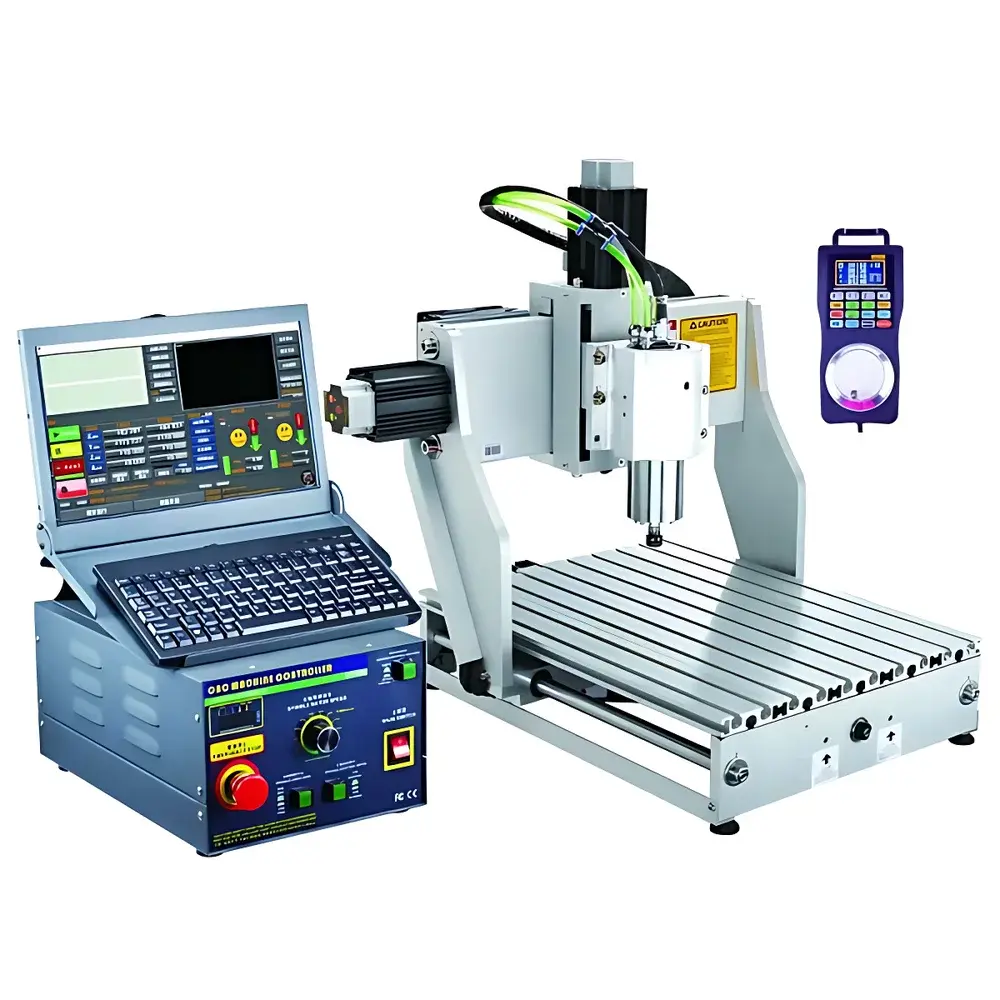
English Product Name
| Brand | Hengyi |
|---|---|
| Origin | Shanghai, China |
| Manufacturer Type | Direct Manufacturer |
| Country of Origin | China |
| Model | HY(DK)TBRTY |
| Spindle Speed | 24,000 rpm |
| Feed Rate | 0–500 mm/min |
| Cutting Depth | 2–20 mm |
| Compatible Pipe Diameter | 50–250 mm |
| Max. Workpiece Length (Pipe/Sheet) | 260 mm |
| X-Axis Travel | 280 mm |
| Y-Axis Travel | 310 mm |
| Z-Axis Travel | 70 mm |
| Frame Material | Aluminum Alloy |
| Stepper Motor & Driver Sets | 3 |
| High-Speed Variable-Frequency Spindle Motor | 1 |
| Precision Linear Guide Rods | 6 |
| Precision Ball Screws | 3 |
| Standard Vise | 1 set |
| Tooling Options | Cylindrical end mill, 20° flat-bottom cutter, slitting blade, 45° chamfering cutter |
| Tool Diameters | Φ3 mm, Φ4 mm, Φ6 mm |
| Max. Machining Envelope | 300 × 150 × 100 mm |
| Power Supply | 220 V AC |
| Total Power Consumption | 1500 W |
| Net Weight | 45 kg |
Overview
The Hengyi HY(DK)TBRTY Computer-Controlled Precision Specimen Preparation System is an industrial-grade CNC machining platform engineered for the reproducible, high-accuracy fabrication of standardized test specimens from metallic and polymeric materials—including alloy steels, thermoplastics, composites, fiberglass-reinforced polymers, and organic glass. Unlike conventional manual or semi-automatic sample cutters, this system integrates motion control, programmable spindle dynamics, and rigid mechanical architecture to meet the dimensional tolerances required by international mechanical testing standards. Its core operation relies on precision milling kinematics—employing three-axis servo-controlled translation (X/Y/Z) coupled with a high-speed, variable-frequency spindle—to execute automated cutting, notching, chamfering, and dumbbell profiling per ASTM D638, ISO 527, ISO 179, ISO 180, GB/T 1040, GB/T 1043, GB/T 1843, and GB/T 8804.2 protocols. Designed for integration into quality assurance labs, national inspection institutes, and R&D centers, the system eliminates operator-induced variability in specimen geometry—a critical factor influencing tensile strength, impact energy, flexural modulus, and fracture toughness measurements.
Key Features
- Three-axis CNC architecture with independent stepper motor drives and preloaded ball screws (3 sets) ensuring sub-0.02 mm positional repeatability across full travel ranges (X: 280 mm, Y: 310 mm, Z: 70 mm)
- High-rigidity aluminum alloy frame with six high-precision linear guide rods, minimizing thermal drift and vibration transmission during high-speed milling (up to 24,000 rpm)
- Programmable feed rate (0–500 mm/min) and adjustable cutting depth (2–20 mm), enabling optimized material removal strategies for ductile metals and brittle polymers alike
- Standardized tooling suite including Φ3 mm, Φ4 mm, and Φ6 mm cylindrical end mills; 20° flat-bottom cutters for notch bottom profiling; 45° chamfer tools compliant with ISO 179/ISO 180 specimen edge requirements
- Dedicated vise fixture with T-slot base and adjustable clamping force, accommodating pipe diameters from 50 mm to 250 mm and sheet lengths up to 260 mm
- Integrated safety interlocks, emergency stop circuitry, and dust extraction interface compatible with ISO 14001-compliant laboratory ventilation systems
Sample Compatibility & Compliance
The HY(DK)TBRTY accommodates a broad spectrum of rigid and semi-rigid engineering materials: low-alloy and stainless steels, ABS, PC, PP, PE, PVC, PMMA, carbon-fiber composites, and glass-reinforced laminates. All specimen geometries—including Charpy/Izod impact notched bars (GB/T 1843, ISO 179), tensile dumbbells (GB/T 1040, ISO 527), flexural test beams (GB/T 9341, ISO 178), and compression discs—are machined within ±0.05 mm dimensional tolerance relative to nominal dimensions specified in referenced standards. The system’s mechanical design and calibration traceability support GLP-compliant operation; routine verification procedures align with ISO/IEC 17025 clause 6.5 (Equipment) and ASTM E29 requirements for significant figures in measurement reporting.
Software & Data Management
Control is executed via embedded industrial motion controller interfaced with Windows-based HMI software supporting G-code import, parametric template libraries (e.g., “ISO 179 Type 1A Notch”, “ASTM D638 Type I Dumbbell”), and real-time axis position monitoring. All machining jobs are timestamped and logged with spindle speed, feed rate, tool ID, and cycle time metadata. Audit trails comply with FDA 21 CFR Part 11 requirements when deployed on validated networked workstations—enabling electronic signature capture, user access levels, and immutable job history archiving. Raw coordinate data and post-processed geometry files (.dxf/.step) export to third-party metrology software (e.g., PolyWorks, Geomagic Control) for GD&T validation.
Applications
- Preparation of standardized tensile specimens for mechanical property certification in pipe manufacturing QA/QC labs
- Notch generation in polymer and composite test bars prior to pendulum impact testing (Charpy, Izod) per ISO 179-1 and ASTM D256
- Routine fabrication of ISO 8004-2-compliant specimens for creep and stress-relaxation studies in thermoplastic piping systems
- Specimen conditioning for accelerated aging trials where geometric consistency directly affects degradation kinetics interpretation
- Research-grade specimen production in university polymer science and metallurgy laboratories requiring traceable, repeatable microstructural sampling
FAQ
Does the HY(DK)TBRTY support custom G-code programming for non-standard specimen geometries?
Yes—the system accepts standard ISO 6983-compliant G-code files; users may define arbitrary toolpaths using CAM software such as Fusion 360 or Mastercam, provided they remain within the machine’s physical envelope (300 × 150 × 100 mm) and dynamic torque limits.
Is calibration documentation provided with shipment?
Each unit ships with a factory calibration certificate verifying axis linearity, squareness, and spindle runout per ISO 230-2 Annex B, traceable to CNAS-accredited national metrology institutes.
Can the system be integrated into a LIMS environment?
Via optional OPC UA server module, specimen preparation logs—including operator ID, material lot number, and QC pass/fail flags—can be pushed to enterprise LIMS platforms supporting IEC 62264-2 data models.
What maintenance intervals are recommended for long-term accuracy retention?
Lubrication of ball screws and linear guides every 500 operational hours; annual recalibration of encoder feedback loops and spindle speed feedback sensors is advised under ISO 10012 guidelines.



