
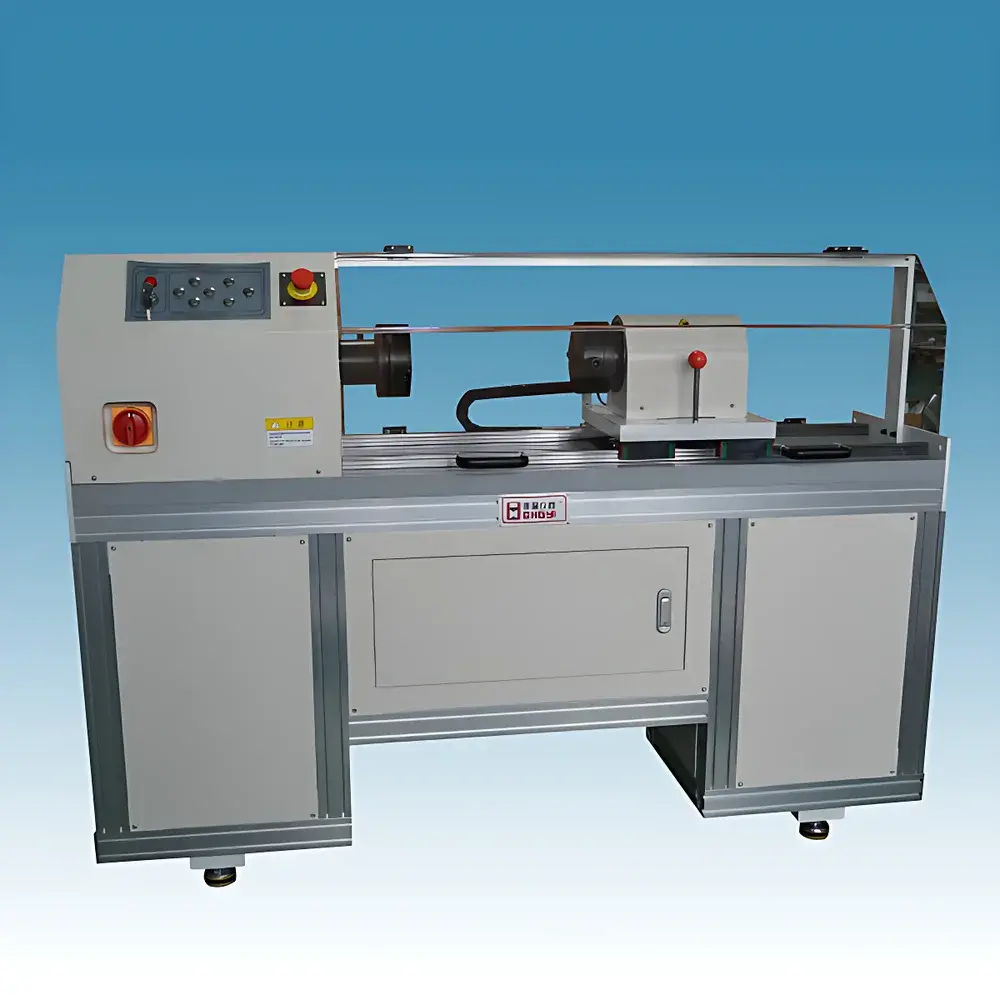
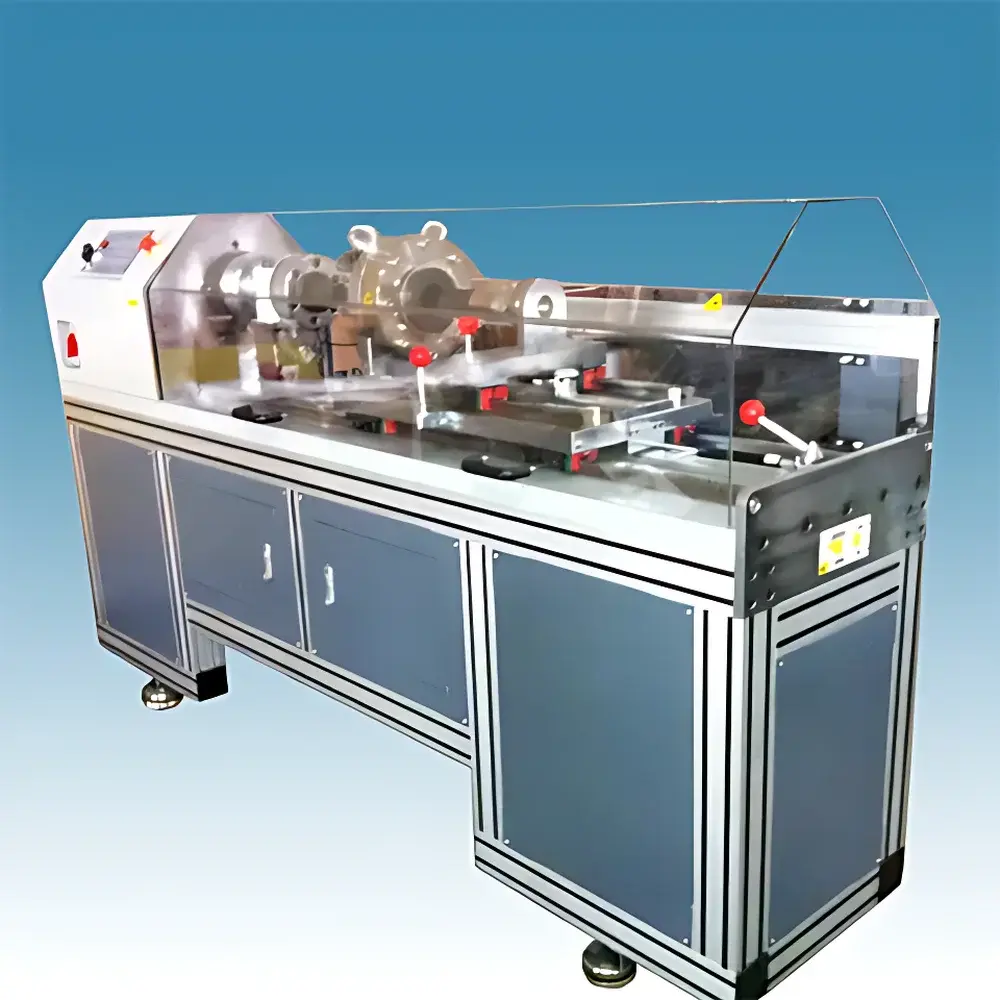
Hengyi HY-2000N·m Automotive Shock Absorber Torsion Testing Machine
| Brand | Hengyi |
|---|---|
| Origin | Shanghai, China |
| Manufacturer Type | Direct Manufacturer |
| Model | HY-2000N·mNMUIIO |
| Max Torque | 2000 N·m |
| Torque Measurement Range | 2–2000 N·m |
| Torque Resolution | 1/500,000 FS |
| Torsion Angle Range | 0–100,000° (or continuous rotation) |
| Motor Power | 2 kW |
| Torque Accuracy | ±0.5% FS (typical) |
| Angular Position Accuracy | ±0.5% FS (typical) |
| Speed Control Ratio | 1:2,000,000 |
| Sampling Rate | ~100 Hz |
| Communication Rate | 115.2 kbps |
| Test Space (Grip Separation) | 550 mm |
| Specimen Clamping Range | M8–M32 threads (customizable) |
| Dimensions (L×W×H) | 2800 × 540 × 1250 mm |
| Weight | 1700 kg |
| Power Supply | Single-phase 2 kW, 220 V AC |
Overview
The Hengyi HY-2000N·m Automotive Shock Absorber Torsion Testing Machine is a precision-engineered, horizontal-axis torsion testing system designed for static and quasi-static mechanical characterization of automotive suspension components—particularly shock absorber pivot joints, steering gear bushings, and torsional elastomeric mounts. It operates on the principle of controlled torque application via a high-resolution servo-driven actuation system, coupled with real-time measurement of angular displacement and reaction torque. The machine complies with fundamental mechanical test methodologies defined in ISO 7500-1 (static calibration of force-measuring systems), ASTM E143 (shear modulus determination), and ISO 527-4 (tensile properties of plastics—torsional loading variants). Its architecture supports both open-loop angular velocity control and closed-loop torque/angle regulation, enabling standardized evaluation of torsional stiffness, yield behavior, hysteresis, and fatigue precursor metrics under controlled environmental conditions.
Key Features
- High-torque capacity (2000 N·m maximum) with extended low-end sensitivity (2 N·m minimum), delivering full-scale resolution of 1 part in 500,000—enabling precise detection of micro-yield events in rubber-metal bonded interfaces.
- Dual-sensor metrology: calibrated strain-gauge torque transducer (±0.5% FS accuracy) and high-fidelity optical encoder (±0.5% angular position error) ensure traceable, repeatable data acquisition across the entire dynamic range.
- Integrated Panasonic AC servo drive system with 1:2,000,000 speed regulation ratio and 115.2 kbps RS-422 communication interface ensures stable, jitter-free rotational control from 0.001°/min to 30°/min.
- Modular grip assembly accommodates threaded specimens from M8 to M32; custom collet and jaw configurations are available for non-standard geometries including hollow shafts, flanged hubs, and multi-point mounting brackets.
- ARM32-based embedded controller running at 56 MIPS enables local real-time processing of up to 100 samples per second—supporting transient event capture, cyclic ramp-hold sequences, and stepwise torque-angle mapping without host PC dependency.
- Full compliance with GLP documentation requirements: audit-trail enabled software logs operator ID, timestamp, calibration status, environmental metadata (optional ambient sensor integration), and raw channel data in binary + CSV dual format.
Sample Compatibility & Compliance
The HY-2000N·m system is validated for use with metallic (steel, aluminum, magnesium alloys), elastomeric (natural rubber, polyurethane, silicone composites), and hybrid assemblies common in Tier-1 automotive suspension modules. It supports specimen lengths up to 550 mm between grips and accommodates axial preload application (via optional hydraulic or pneumatic auxiliary fixtures) to simulate in-service compressive pre-stress conditions. Test protocols conform to ISO 1798 (rubber—determination of tensile strength and elongation), DIN 53521 (torsional stiffness of elastomer bearings), SAE J2440 (steering column torsional durability), and GB/T 10128 (metallic materials—torsion testing). All firmware and calibration certificates are issued with NIST-traceable reference standards and include uncertainty budgets per ISO/IEC 17025.
Software & Data Management
The proprietary Hengyi TorsionControl v4.x software suite runs on Windows OS and provides ISO 17025-compliant test sequencing, real-time curve overlay, and automated report generation per ASTM E122-22 (sample size determination) and USP (analytical instrument qualification). Raw data streams are stored in HDF5 format with embedded metadata tags (test ID, operator, calibration due date, environmental log). Export options include PDF reports with digital signatures, Excel-compatible .csv, and XML for LIMS integration. Role-based access control (RBAC), electronic signature support, and 21 CFR Part 11-compliant audit trails—including immutable records of parameter edits, data deletion attempts, and recalibration events—are fully implemented.
Applications
- Quantification of torsional stiffness and damping loss angle (tan δ) in hydraulic and magnetorheological shock absorber pivot joints.
- Evaluation of cold-temperature torque hysteresis in EPDM bushings per SAE J2233.
- Determination of non-proportional shear stress (τp) and modulus of rigidity (G) in steering gear input shafts using small-angle torsion methodology.
- Validation of fastener preload relaxation under cyclic torsion (ISO 16130).
- Verification of design margin against ISO 22758 (automotive suspension component functional safety requirements).
- Support for R&D validation of new elastomer formulations in collaboration with OEM material specification teams (e.g., Ford WSS-M4D751-A2, GM GMW15825).
FAQ
What standards does this machine support for automotive torsion testing?
It natively supports test method configuration for ISO 527-4, ASTM E143, DIN 53521, SAE J2440, GB/T 10128, and JIS K 6251—with customizable parameter templates for each.
Can the system perform cyclic torsion fatigue tests?
Yes—when equipped with optional high-cycle drive firmware and thermal management accessories, it supports sinusoidal, trapezoidal, and random-profile torque cycling up to 10⁶ cycles at frequencies ≤5 Hz.
Is third-party calibration certification included?
Each unit ships with factory calibration certificate traceable to CNAS-accredited laboratories; ISO/IEC 17025-certified field recalibration services are available globally.
How is data integrity ensured during long-duration tests?
Continuous checksum verification, redundant flash memory buffering, and automatic recovery after power interruption prevent data corruption—even during 72+ hour endurance protocols.
Does the software support multi-user environments with permission tiers?
Yes—administrator, technician, and reviewer roles enforce separation of duties, with configurable limits on method editing, report approval, and calibration access.



