
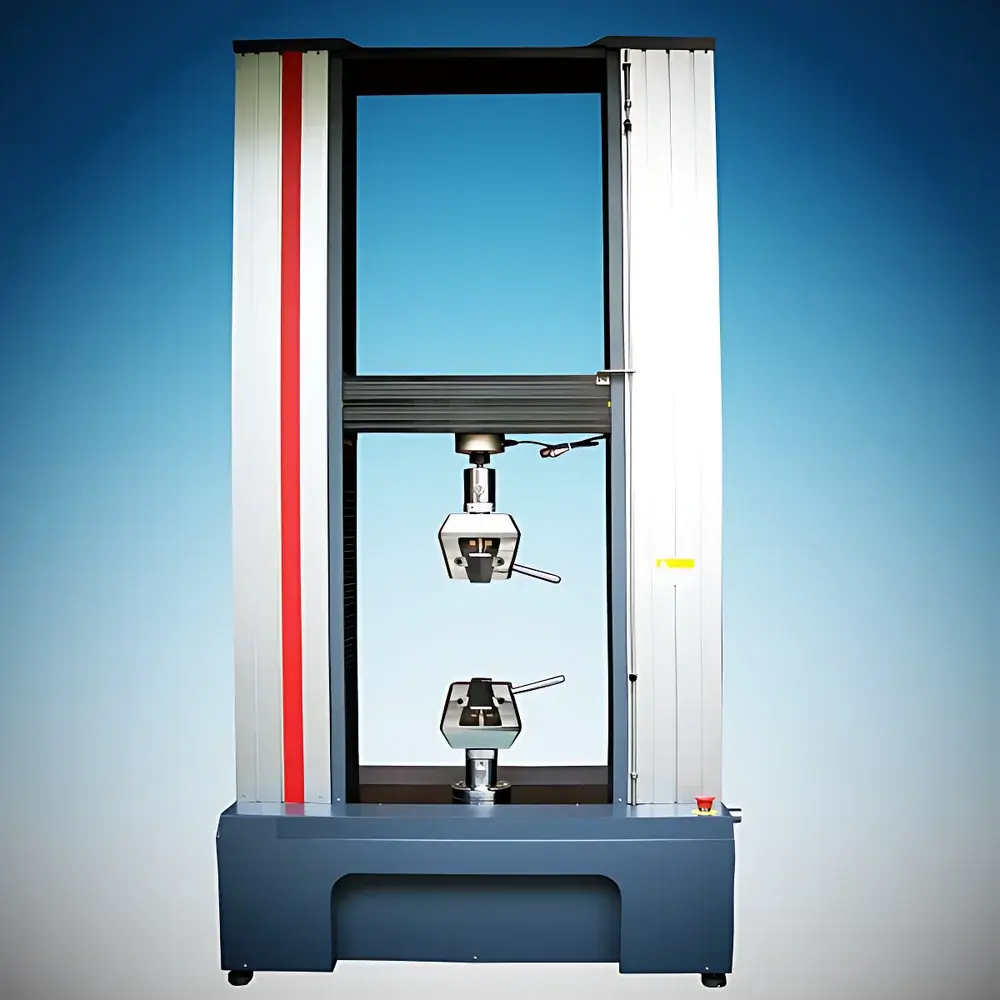
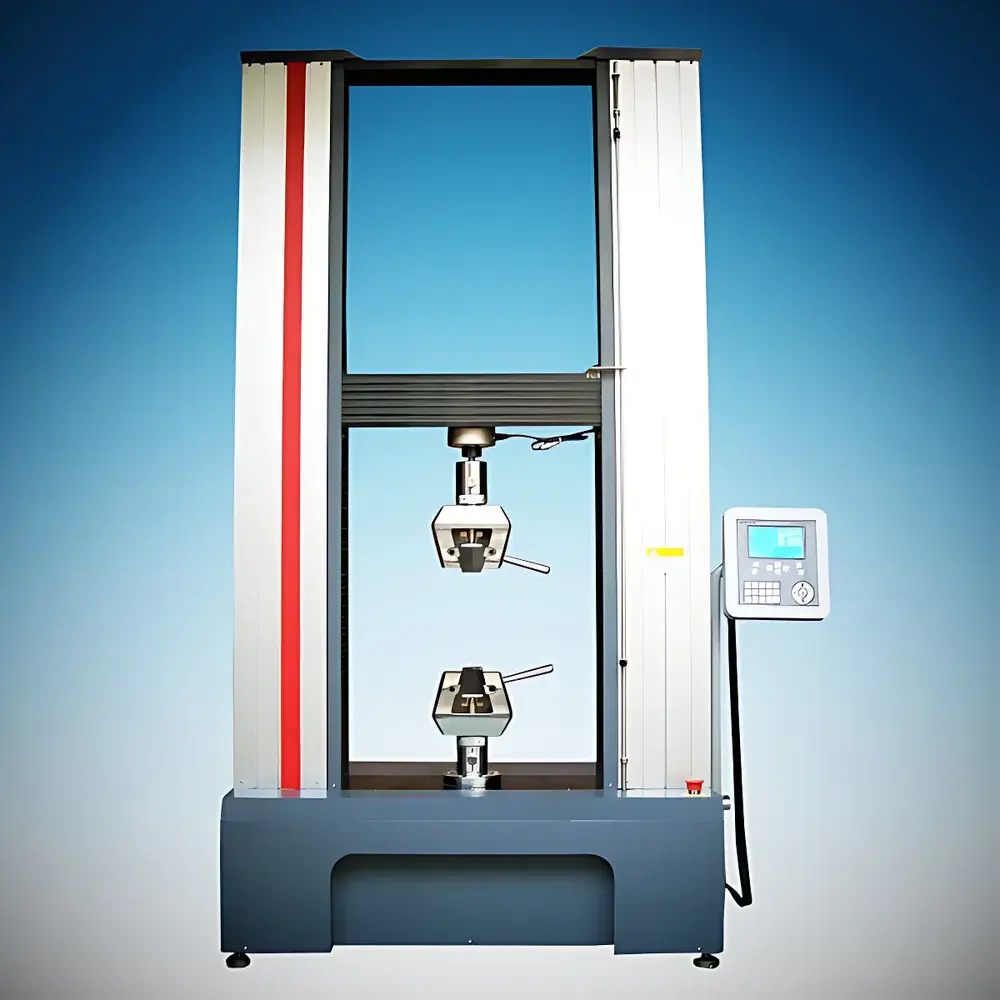
Hengyi HY-30080RTU Stainless Steel Tensile Testing Machine
| Key | Brand: Hengyi |
|---|---|
| Origin | Shanghai, China |
| Manufacturer Type | Direct Manufacturer |
| Instrument Type | Electromechanical Universal Testing Machine |
| Max Test Load | 300 kN |
| Force Measurement Range | 0.001–100% FS |
| Force Accuracy | ±0.5% of reading |
| Test Stroke | 800 mm |
| Displacement Resolution | 0.001 mm |
| Speed Range | 0.001–500 mm/min |
| Speed Accuracy | ±0.5% of set value |
| Position Accuracy | ±0.5% of reading |
| Deformation Measurement Accuracy | ±0.5% of reading |
| Control Modes | Stress, Strain, Displacement, and Load Control |
| Compliance Standards | GB/T 16491, GB/T 228, ISO 6892-1, ASTM E8/E21, DIN 50125, JIS Z 2241 |
Overview
The Hengyi HY-30080RTU Stainless Steel Tensile Testing Machine is a high-capacity, electromechanical universal testing system engineered for precision static mechanical characterization of metallic and non-metallic materials—including alloys, composites, polymers, and ceramics. Operating on the principle of servo-controlled axial force application with closed-loop feedback, the system delivers repeatable, traceable, and standards-compliant mechanical property data under uniaxial loading conditions. With a maximum load capacity of 300 kN (≈30.6 metric tons), it supports full-range tensile, compression, bending, shear, peel, tear, creep, relaxation, and cyclic loading protocols. Its rigid龙门 (gantry) frame—constructed from high-strength steel with precision-machined crossheads and linear guides—ensures minimal deflection and optimal load train alignment, critical for accurate modulus and yield point determination in structural metals and high-performance alloys.
Key Features
- High-fidelity force measurement via dual-range, temperature-compensated load cells with internal 500,000-count A/D resolution—no range switching required across the full 0.001–100% FS span.
- Advanced digital servo control enabling precise stress-rate (0.005–6% FS/s), strain-rate (0.002–6% FS/s), and displacement-rate (0.001–500 mm/min) regulation with real-time adaptive compensation.
- Integrated electronic limit protection, overload cutoff (≥110% FS), and automatic diagnostic self-checks for drive system voltage, current, pressure, and thermal anomalies.
- Modular test space: 600 mm effective width (expandable), 800 mm vertical travel (extendable), and programmable crosshead positioning with dual-speed manual jog and automated return-to-start functionality.
- Comprehensive safety architecture including emergency stop circuitry, hardware-based position interlocks, and software-enforced operational boundaries compliant with EN ISO 13857 and IEC 61508 functional safety principles.
Sample Compatibility & Compliance
The HY-30080RTU accommodates specimens from thin foils (<0.1 mm) to heavy-section structural steel (up to Ø80 mm round or 60×40 mm rectangular). Standard configurations support ASTM E8/E21, ISO 6892-1, GB/T 228.1–2021, DIN 50125, and JIS Z 2241 specimen geometries. Optional accessories include clip-on extensometers (for ASTM E83 Class B-1 compliance), large-strain video extensometry, pneumatic wedge grips, hydraulic side-acting clamps, and environmental chambers (−70°C to +300°C). All force and displacement measurements are traceable to national metrology institutes (e.g., NIM China, NIST USA) and certified per ISO/IEC 17025 requirements. The system satisfies mechanical verification criteria outlined in ISO 7500-1 (Class 0.5), ASTM E4, and GB/T 12160 for extensometer calibration.
Software & Data Management
Equipped with Hengyi’s proprietary TestMaster Pro v5.2 software, the system provides fully configurable test sequences, real-time multi-channel plotting (force–displacement, stress–strain, load–time), and automated parameter extraction—including ReH, ReL, Rp0.2, Rm, A%, Z%, E, n, and m values. Raw data export is supported in CSV, Excel (.xlsx), and universal .tdms formats. Audit trail functionality complies with FDA 21 CFR Part 11 requirements: user authentication, electronic signatures, immutable log records, and version-controlled method templates. Data integrity safeguards include cyclic redundancy checksums, automatic backup to network drives, and optional integration with LIMS platforms via OPC UA or RESTful API.
Applications
- Quality control of stainless steels, aluminum alloys, titanium grades, and high-strength low-alloy (HSLA) steels per ASTM A240, EN 10088, and GB/T 4237.
- Mechanical validation of reinforcing bars (rebar), fasteners, weld joints, and cast components in civil and automotive engineering.
- R&D of advanced materials including metal matrix composites (MMCs), shape memory alloys (SMAs), and additive-manufactured (AM) metal parts.
- Third-party certification testing for CE marking, ASME BPVC Section II, and ISO 9001:2015 quality system audits.
- Educational use in university materials science laboratories for hands-on instruction in solid mechanics and fracture behavior.
FAQ
What international standards does the HY-30080RTU comply with for force calibration?
It meets ISO 7500-1 Class 0.5, ASTM E4, and GB/T 12160 for verification of static uniaxial testing machines.
Can the system perform creep and stress-relaxation tests?
Yes—via closed-loop stress or load hold modes with programmable dwell times up to 1,000 hours and time-dependent data logging at user-defined intervals.
Is the software validated for regulated environments (e.g., pharmaceutical or aerospace QA/QC)?
TestMaster Pro v5.2 includes 21 CFR Part 11 compliance features: role-based access control, electronic signatures, and audit-trail generation with tamper-proof timestamps.
What grip options are available for high-strength steel specimens?
Hydraulic wedge grips (up to 300 kN clamping force), serrated V-groove mechanical grips, and custom-designed thread-specific fixtures for bolts and studs.
Does the machine support real-time modulus calculation during testing?
Yes—using dual-channel synchronous acquisition of load and extensometer displacement, Young’s modulus (E), tangent modulus, and secant modulus are computed dynamically per ISO 527-2 and ASTM D638 protocols.



