
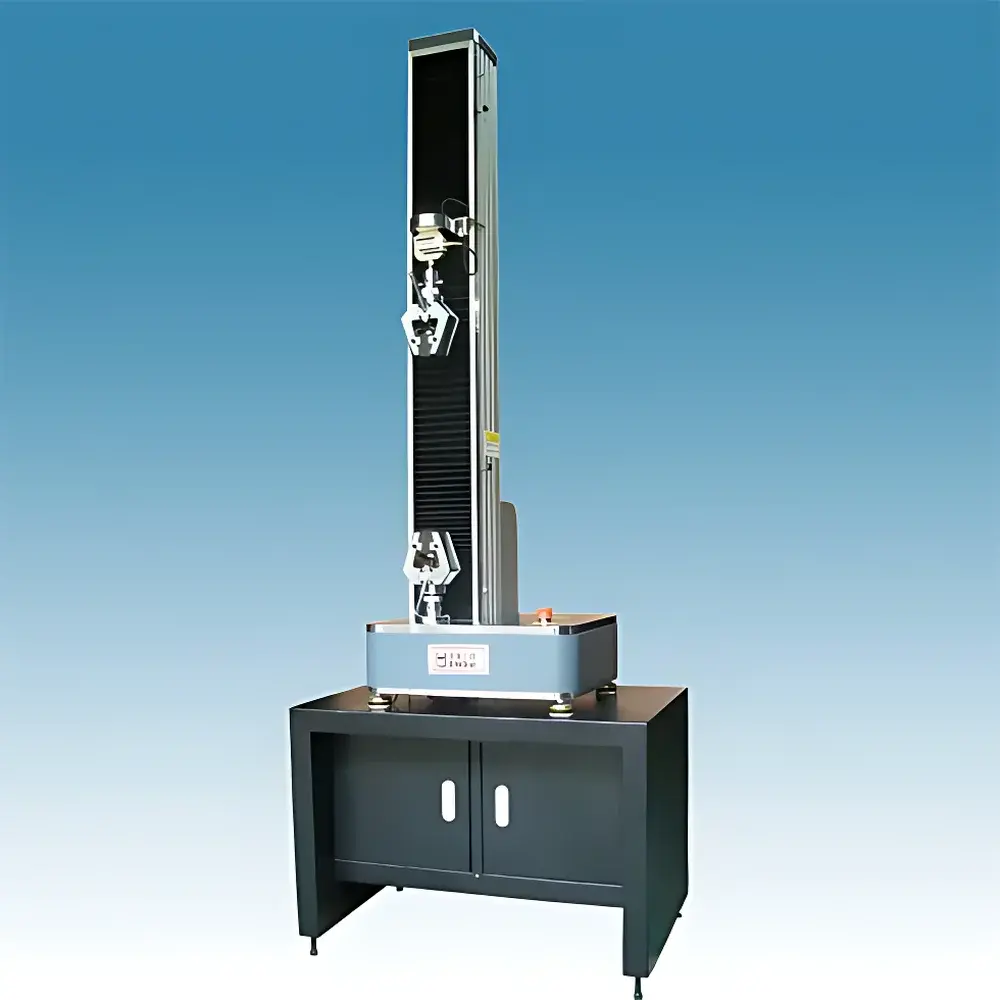
Hengyi HY-0580YSDETT Creep Testing Machine for Compressed Straw Briquettes
| Brand | Hengyi |
|---|---|
| Origin | Shanghai, China |
| Manufacturer Type | Direct Manufacturer |
| Regional Classification | Domestic (China) |
| Model | HY-0580YSDETT |
| Price Range | USD 1,400 – 7,000 |
| Maximum Test Load | 5 kN |
| Load Application Rate | 0.001–500 N/s |
| Platen Spacing | 80 mm |
| Platen Dimensions | 80 mm × 80 mm |
| Compression Sleeve ID | 60 mm |
| Sleeve Height | 140 mm |
| Crosshead Travel | 800 mm |
| Effective Test Width | 120 mm |
| Speed Accuracy | ±0.5% of set value |
| Displacement Measurement Accuracy | ±0.5% of reading |
| Strain Measurement Accuracy | ±0.5% of reading |
| Load Resolution | ±500,000 counts (full-scale, no range switching) |
| Stress Control Rate Range | 0.005–6% FS/s |
| Strain Control Rate Range | 0.002–6% FS/s |
| Constant-Load/Displacement/Strain Accuracy | ±0.1% FS (≥10% FS), ±1% FS (<10% FS) |
| Overload Protection | +10% of full scale |
| Power Supply | 220 V AC, 750 W |
| Net Weight | 95 kg |
| Footprint | 470 × 400 × 1510 mm (H) |
| Total System Mass | 135 kg |
Overview
The Hengyi HY-0580YSDETT Creep Testing Machine for Compressed Straw Briquettes is a single-column electromechanical testing system engineered for time-dependent mechanical characterization of biomass compacts under sustained compressive loading. It operates on the principle of controlled-force or controlled-displacement compression, enabling precise quantification of creep deformation, stress relaxation, and viscoelastic response in agricultural residue briquettes—specifically rice, wheat, and corn straw—compressed to densities up to 300 kg/m³. The system conforms to fundamental mechanics-of-materials frameworks for quasi-static compression testing and integrates calibrated load cell feedback, high-resolution displacement transduction, and synchronized temporal acquisition to capture force–displacement–time histories with traceable metrological integrity. Its rigid frame architecture, low-inertia crosshead drive, and real-time closed-loop control ensure high reproducibility across extended-duration tests (up to several hours), essential for evaluating long-term structural stability of biofuel feedstocks.
Key Features
- Single-column modular design optimized for compression-dominant static and time-dependent testing, with optional tensile capability via accessory grips
- High-precision 5 kN load cell (0.5-class accuracy per ISO 7500-1) featuring ±500,000-count resolution and no internal range switching
- Programmable load application rate from 0.001 to 500 N/s, supporting both ramped and step-load protocols for creep and stress relaxation studies
- Dedicated compression fixture with 60 mm inner-diameter cylindrical sleeve (140 mm height) and 80 mm × 80 mm parallel platens for standardized briquette confinement
- Closed-loop control architecture enabling stress-controlled, strain-controlled, or displacement-controlled test modes with configurable ramp/hold profiles
- Integrated safety systems including electronic travel limits, overload cutoff (+10% FS), automatic return-to-start, and real-time diagnostic monitoring of drive electronics and sensor health
- Thermally stable mechanical structure with aluminum alloy load train and precision-ground linear guides to minimize thermal drift during prolonged tests
Sample Compatibility & Compliance
The HY-0580YSDETT accommodates cylindrical straw briquettes (Ø60 mm × ≤140 mm) and rectangular specimens up to 80 mm wide × 80 mm deep × 800 mm tall. It supports standardized test configurations aligned with ASTM D143 (Wood Compression), ISO 13061-12 (Density and Mechanical Properties of Solid Biofuels), and GB/T 21923-2008 (Testing Methods for Solid Biofuels). Data output complies with GLP documentation requirements, including timestamped raw data export (CSV, Excel), audit-trail-enabled test logs, and user-defined report templates. While not FDA 21 CFR Part 11 certified out-of-the-box, the system’s deterministic data capture and non-modifiable binary acquisition logs support validation pathways for regulated R&D environments.
Software & Data Management
Bundled Hengyi TestSuite v3.x provides intuitive test method configuration, real-time curve overlay (force vs. time, displacement vs. time, stress vs. strain), and automated parameter extraction—including creep compliance (J(t)), relaxation modulus (E(t)), initial elastic modulus, steady-state creep rate, and time-to-failure. All curves are mathematically derivable (e.g., first-order differentiation for strain rate), and datasets retain native 1 kHz sampling fidelity. Export formats include CSV, PDF, and XML for integration into LIMS or statistical analysis platforms (e.g., JMP, MATLAB). Software enforces user-level access control (admin/operator/guest), password-protected method libraries, and immutable test records with embedded instrument metadata (serial number, calibration date, firmware version).
Applications
- Creep behavior analysis of densified biomass briquettes under simulated storage or transport loads
- Stress relaxation quantification for predicting binder efficacy and inter-particle bond durability
- Compression modulus determination per ISO 13061-12 for quality grading of solid biofuels
- Validation of numerical models (e.g., Maxwell–Wiechert viscoelastic models) using experimental J(t) or E(t) functions
- Comparative evaluation of pretreatment effects (e.g., steam explosion, lignin modification) on mechanical stability
- Supporting ASTM E1369 (Guide for Conducting Creep Tests on Structural Materials) and ISO 899-1 (Plastics — Creep Behavior)
FAQ
What standards does this machine support for straw briquette testing?
It aligns with ISO 13061-12, GB/T 21923-2008, and ASTM D143 methodologies; custom test methods can be scripted to meet project-specific protocols.
Can the system perform both creep and stress relaxation tests?
Yes—via programmable hold phases in either load-control (for stress relaxation) or displacement-control (for creep) modes, with automatic transition logic and dwell duration precision to ±0.1 s.
Is third-party calibration documentation provided?
Each unit ships with a factory calibration certificate traceable to CNAS-accredited standards; optional UKAS/NIST-traceable recalibration services are available.
What is the maximum recommended test duration for continuous creep runs?
The system is validated for uninterrupted operation up to 120 hours at constant load, with thermal management ensuring <±0.5 °C ambient drift in the load train.
Does the software support automated pass/fail criteria against specification limits?
Yes—user-defined acceptance thresholds (e.g., “creep strain < 2.5% at 60 min”) trigger color-coded alerts and exportable compliance summaries within reports.



