
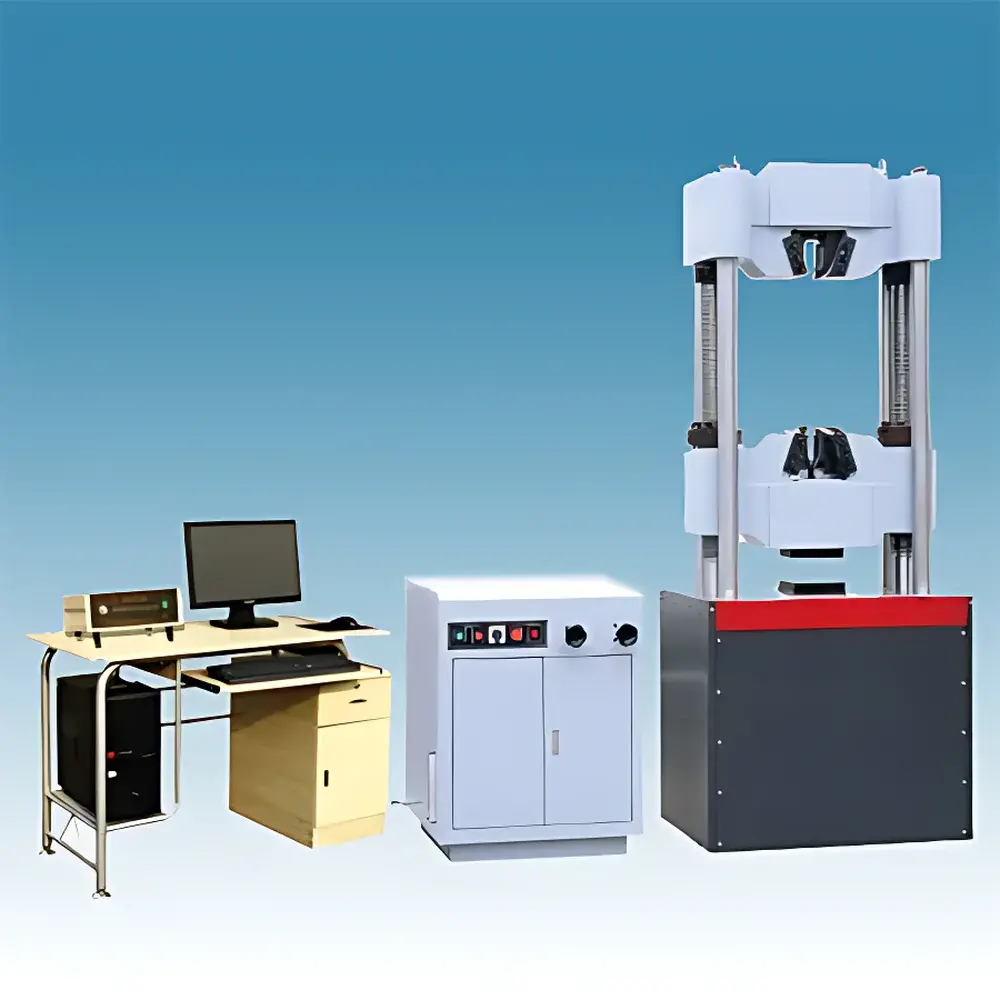
Hengyi HY(WE)100060TY Electro-Hydraulic Servo Universal Testing Machine
| Brand | Hengyi |
|---|---|
| Origin | Shanghai, China |
| Manufacturer Type | Direct Manufacturer |
| Model | HY(WE)100060TY |
| Max Test Load | 1000 kN |
| Load Measurement Range | 0.001–100% FS |
| Load Accuracy | ±0.5% of reading |
| Crosshead Travel | 600 mm |
| Displacement Resolution | 0.001 mm |
| Compression Space | 600 mm |
| Tensile Space | 600 mm |
| Round Specimen Grip Range | Φ20–Φ60 mm |
| Flat Specimen Thickness Capacity | 0–40 mm |
| Piston Stroke | 150 mm |
| Bend Support Span Adjustment | 100–600 mm |
| Shear Specimen Diameter | Φ10 mm |
| Deformation Measurement Accuracy | ±0.5% of reading |
| Displacement Measurement Error | ±0.5% of reading |
| Stress Rate Control Range | 1–60 N/mm²/s |
| Strain Rate Control Range | 0.00025–0.0025 s⁻¹ |
| Closed-Loop Control Accuracy (Force/Deformation/Displacement) | ±1% of setpoint |
| Frame Dimensions (W×D×H) | 880 × 580 × 2260 mm |
| Motor Power | 1.5 kW, 3-phase |
| Weight | 3500 kg |
Overview
The Hengyi HY(WE)100060TY Electro-Hydraulic Servo Universal Testing Machine is a high-capacity, dual-space materials testing system engineered for precision mechanical characterization of metallic and non-metallic materials under static and quasi-static loading conditions. Based on the principles of servo-controlled hydraulic actuation and closed-loop feedback regulation, the system delivers stable, repeatable force application across tension, compression, bending, and shear configurations. Its four-column rigid frame architecture ensures minimal deflection under full-load operation (up to 1000 kN), while integrated high-accuracy load cells (±0.5% FS), displacement transducers (0.001 mm resolution), and optional extensometers support compliance with ISO 6892-1, ASTM E8/E21, and GB/T 228.1–2021 standards for tensile testing of metals. Designed for laboratory and industrial QA/QC environments, the machine operates within defined stress and strain rate ranges (1–60 N/mm²/s and 0.00025–0.0025 s⁻¹ respectively), enabling standardized evaluation of elastic modulus (E), yield strengths (ReH, ReL), ultimate tensile strength (Rm), total elongation (A), and proof strengths (Rp0.2, Rt0.5).
Key Features
- Electro-hydraulic servo control architecture with high-bandwidth proportional servo valve for dynamic response and load stability
- Dual-test-space configuration: independent upper (tension) and lower (compression/bending) zones with 600 mm usable travel in both directions
- Self-tightening hydraulic wedge grips for round (Φ20–Φ60 mm) and flat (0–40 mm thick) specimens, minimizing slippage and stress concentration
- PCI bus-based real-time control system running on Windows XP platform, supporting deterministic sampling at ≥1 kHz
- Multi-mode closed-loop control: constant force, constant stress, constant displacement, constant strain, constant crosshead speed, and low-cycle fatigue protocols
- Real-time acquisition and overlay of multiple synchronized curves: Force–Displacement, Force–Extension, Stress–Strain, and Force–Time
- Automated parameter calculation per GB/T 228.1 and ISO 6892-1, including E, ReH, ReL, Rp0.2, Rm, Agt, Ag, At, and uniform elongation
- Optional touchscreen interface for simplified operator interaction and reduced training overhead in production lab settings
Sample Compatibility & Compliance
The HY(WE)100060TY accommodates standard and custom geometries across diverse material classes: structural steels, aluminum alloys, titanium grades, polymer composites, concrete cores, and ceramic tiles. Grip configurations support ASTM E8M, ISO 6892-1, GB/T 228.1, and EN 10002-1 specimen types—including round, flat, notched, and sheet forms. Bending fixtures meet ISO 7438 and ASTM E290 requirements (support span adjustable from 100–600 mm); shear testing adheres to ISO 3785 using Φ10 mm cylindrical specimens. All measurement subsystems are traceably calibrated to national metrological standards; force verification follows ISO 7500-1 Class 1, displacement per ISO 6892-1 Annex C, and strain measurement per ISO 9513 Class 1 when equipped with clip-on or video extensometry.
Software & Data Management
The embedded control and analysis software provides full GLP-compliant data handling: user-level access control, electronic signature support, audit trail logging (per FDA 21 CFR Part 11 requirements), and encrypted raw data storage in vendor-neutral ASCII or XML formats. Test methods are programmable via intuitive script editor or template library, allowing replication of standardized procedures (e.g., ISO 6892-1 Method A or B). Post-test analysis includes curve smoothing, yield point detection via 0.2% offset method, tangent modulus derivation, and fracture surface coordinate mapping. Export options include PDF reports with embedded metadata (operator ID, calibration date, environmental conditions), CSV for statistical process control (SPC), and image sequences for failure mode correlation.
Applications
- Mechanical validation of aerospace-grade fasteners and landing gear components under combined tension-compression cycles
- Quality conformance testing of welded joints per AWS D1.1 and ISO 15614-1
- Constitutive modeling input generation for finite element simulation (e.g., Johnson-Cook, Ludwik-Hollomon parameters)
- Routine certification of reinforcing bars (rebar) and prestressed concrete tendons to ASTM A615/A416
- Research-scale investigation of creep behavior in high-temperature alloys using stepped-load protocols
- Failure analysis laboratories performing root cause assessment of brittle fracture in pipeline steels
- Academic materials science labs conducting comparative studies on additive-manufactured vs. wrought microstructures
FAQ
What standards does this system fully comply with for metal tensile testing?
It meets the hardware, control, and reporting requirements of GB/T 228.1–2021, ISO 6892-1:2019, ASTM E8/E21, and EN ISO 6892-1.
Can the system perform low-cycle fatigue testing?
Yes—via programmable load-controlled or strain-controlled waveforms with cycle counting, dwell time definition, and automatic termination on crack initiation or force drop.
Is third-party calibration documentation provided with shipment?
Each unit ships with a factory calibration certificate traceable to CNAS-accredited reference standards; optional UKAS/NIST-traceable certification is available upon request.
What maintenance intervals are recommended for hydraulic system integrity?
Oil filtration and level check every 500 operating hours; full hydraulic fluid replacement and servo valve inspection every 2,000 hours or annually, whichever occurs first.
Does the software support integration with LIMS or MES platforms?
Yes—via TCP/IP API and configurable ODBC drivers for bidirectional data exchange with LabVantage, Thermo Fisher SampleManager, and Siemens Opcenter.



