
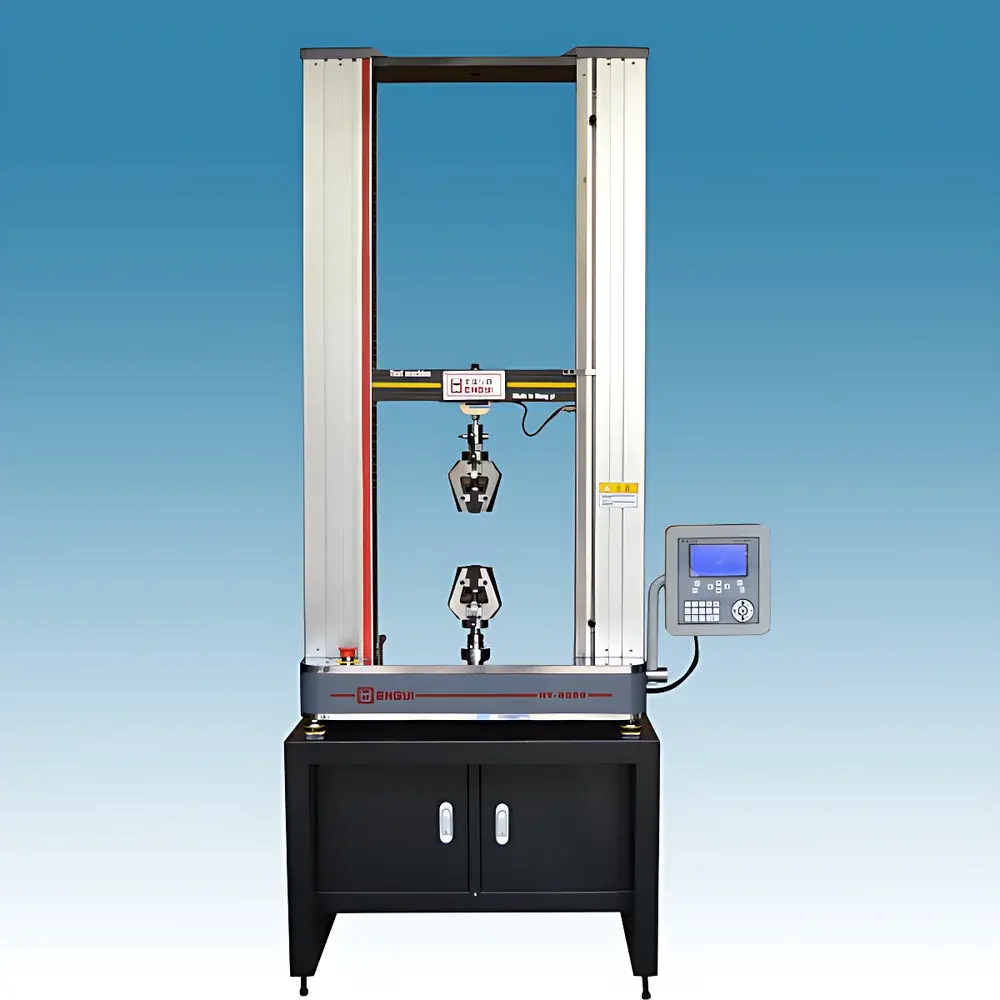
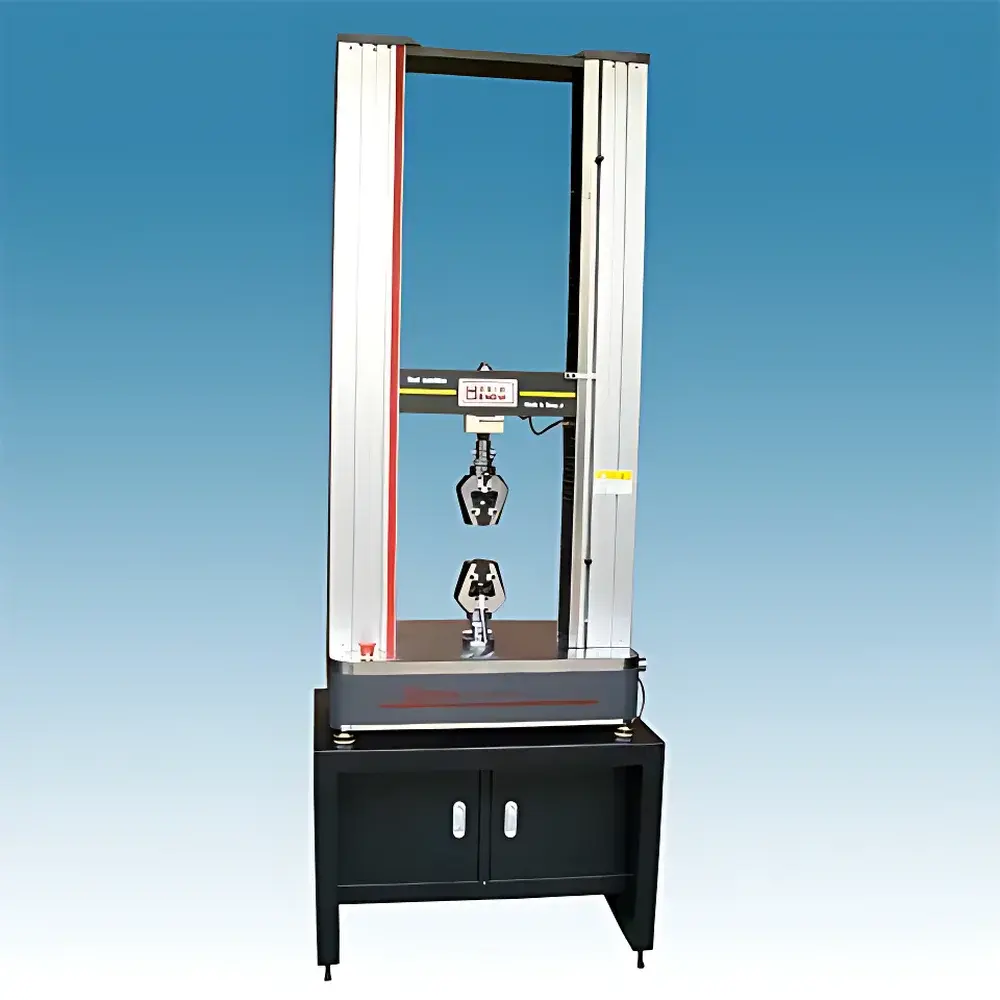
Hengyi HY-3080ERTGBV Cable Sheath Tensile Testing Machine
| Brand | Hengyi |
|---|---|
| Origin | Shanghai, China |
| Manufacturer Type | Direct Manufacturer |
| Regional Category | Domestic (China) |
| Model | HY-3080ERTGBV |
| Instrument Type | Electromechanical Universal Testing Machine |
| Load Capacity Options | 1 N to 30 kN (multiple transducers available) |
| Accuracy Class | ≤0.5% of reading |
| Effective Test Width | 380 mm (expandable) |
| Effective Test Height | 800 mm (extendable) |
| Speed Range | 0.001–1000 mm/min |
| Speed Accuracy | ±0.5% of set value |
| Force Resolution | ±500,000 counts (full-scale, no range switching) |
| Force Measurement Accuracy | ±0.5% of reading (0.1–99.999% FS) |
| Displacement Accuracy | ±0.5% of reading |
| Strain Control Rate Range | 0.002–6% FS/s |
| Stress Control Rate Range | 0.005–6% FS/s |
| Constant-Load/Displacement/Strain Accuracy | ±0.1% FS (≥10% FS) |
| Safety Protection | Electronic limit switches, overload protection (110% FS), real-time system diagnostics |
| Power Supply | 220 V AC, single-phase, 0.75 kW |
| Host Dimensions | 700 × 420 × 1600 mm |
| Net Weight | 210 kg |
Overview
The Hengyi HY-3080ERTGBV Cable Sheath Tensile Testing Machine is an electromechanical universal testing system engineered for high-reproducibility mechanical characterization of polymeric, metallic, and composite materials used in cable insulation, sheathing, and related power transmission components. Based on closed-loop servo-controlled displacement actuation and high-fidelity load measurement via precision dual-column frame architecture, the system complies with fundamental principles defined in ISO 527-1, ASTM D638, IEC 60811-501, and GB/T 2951.11 for tensile property evaluation of electrical insulating materials. Its modular design supports standardized test methods across R&D, quality control, and third-party certification workflows—particularly where regulatory traceability, repeatability under variable environmental conditions, and long-term stability are critical requirements.
Key Features
- Rigid dual-column steel frame with preloaded high-precision ball screws and maintenance-free AC servo motor drive—ensuring minimal deflection (<0.02 mm under 30 kN) and consistent axial alignment over extended service life.
- High-resolution bidirectional load cell (up to 30 kN capacity, optional multi-range configuration) with ±500,000 internal resolution and no auto-ranging—delivering uniform force sensitivity across full scale per ISO 7500-1 Class 0.5 compliance.
- Digital controller supporting open- or closed-loop operation, programmable test profiles, and real-time parameter feedback—including simultaneous acquisition of force, displacement, large/small deformation (via extensometer interface), and time-stamped event markers.
- Intuitive handheld remote control unit enabling rapid setup, jog positioning, emergency stop, and manual return—optimized for operator safety and workflow efficiency in shared lab environments.
- Comprehensive safety architecture: electronic travel limits, hardware-based overload cutoff (110% FS), automatic diagnostic self-check at power-on and during idle cycles, and software-enforced test termination conditions (load, displacement, strain, or time-based).
- Configurable test speed range from 0.001 to 1000 mm/min with ±0.5% speed accuracy—validated per ASTM E2309 for rate-sensitive material behavior assessment, including creep and stress-relaxation protocols.
Sample Compatibility & Compliance
The HY-3080ERTGBV accommodates a broad spectrum of specimens relevant to wire and cable manufacturing, including but not limited to: cross-linked polyethylene (XLPE), thermoplastic elastomers (TPE), PVC, rubber compounds, aluminum/copper foils, photovoltaic interconnect ribbons, biomedical tubing, polymer films, fiber yarns, thin metal wires (≤3 mm diameter), and composite laminates. Its 380 mm test width and 800 mm vertical clearance allow standard dumbbell-shaped, dog-bone, or strip specimens per ISO 527, ASTM D882, and IEC 60811 series standards. The system supports GLP/GMP-aligned data integrity through audit-trail-enabled test method storage, user access control, and exportable raw data files compatible with FDA 21 CFR Part 11-compliant review systems when paired with validated software modules.
Software & Data Management
Control and analysis are executed via embedded firmware with optional PC-based extension using VB.NET + SQL Server backend architecture—enabling deterministic data logging at ≥100 Hz sampling rate, customizable report templates (PDF/Excel), and parametric curve annotation (yield point, modulus, elongation at break, necking onset). All test parameters—including control mode (stress/strain/displacement), ramp rates, hold durations, and pass/fail criteria—are stored as reusable method files with version timestamps and user attribution. Raw datasets include synchronized force-displacement-time arrays with metadata tags (operator ID, calibration date, environmental ambient readings if integrated), facilitating ISO/IEC 17025 accreditation documentation and inter-laboratory comparison studies.
Applications
- Quality assurance of extruded cable jackets and insulation layers per IEC 60502 and UL 1581 mechanical specifications.
- Tensile strength and elongation mapping for halogen-free flame-retardant (HFFR) compounds during formulation development.
- Creep resistance validation of thermoset polymers under sustained loading at elevated temperatures (when integrated with environmental chamber).
- Mechanical screening of recycled polymer blends intended for low-voltage cable reuse applications.
- Comparative evaluation of biodegradable sheath materials against petroleum-based benchmarks under controlled humidity conditions.
- Teaching laboratories: standardized experiments in material science curricula covering Hooke’s law, plastic deformation, and fracture mechanics fundamentals.
FAQ
What standards does the HY-3080ERTGBV comply with for cable sheath testing?
It supports test execution per IEC 60811-501, ASTM D638, ISO 527-2, GB/T 2951.11, and UL 1581 Section 1060—covering tensile strength, elongation at break, and modulus determination for polymeric insulations.
Can the system be calibrated to meet ISO/IEC 17025 requirements?
Yes—load cells and displacement encoders are supplied with NIST-traceable calibration certificates; periodic verification follows ISO 7500-1 procedures using certified reference standards.
Is extensometer integration supported for modulus measurement?
The machine features analog and digital interfaces for clip-on, video, or non-contact extensometers—enabling accurate strain measurement compliant with ASTM E83 Class B-1 requirements.
Does the controller support automated batch testing?
Yes—programmable test sequences with conditional branching (e.g., “if failure load < X, repeat with adjusted gauge length”) can be defined and scheduled without host PC intervention.
What maintenance intervals are recommended for long-term reliability?
Ball screw lubrication every 2,000 operational hours; annual verification of encoder linearity and load cell zero drift; no routine motor servicing required due to brushless servo design.



