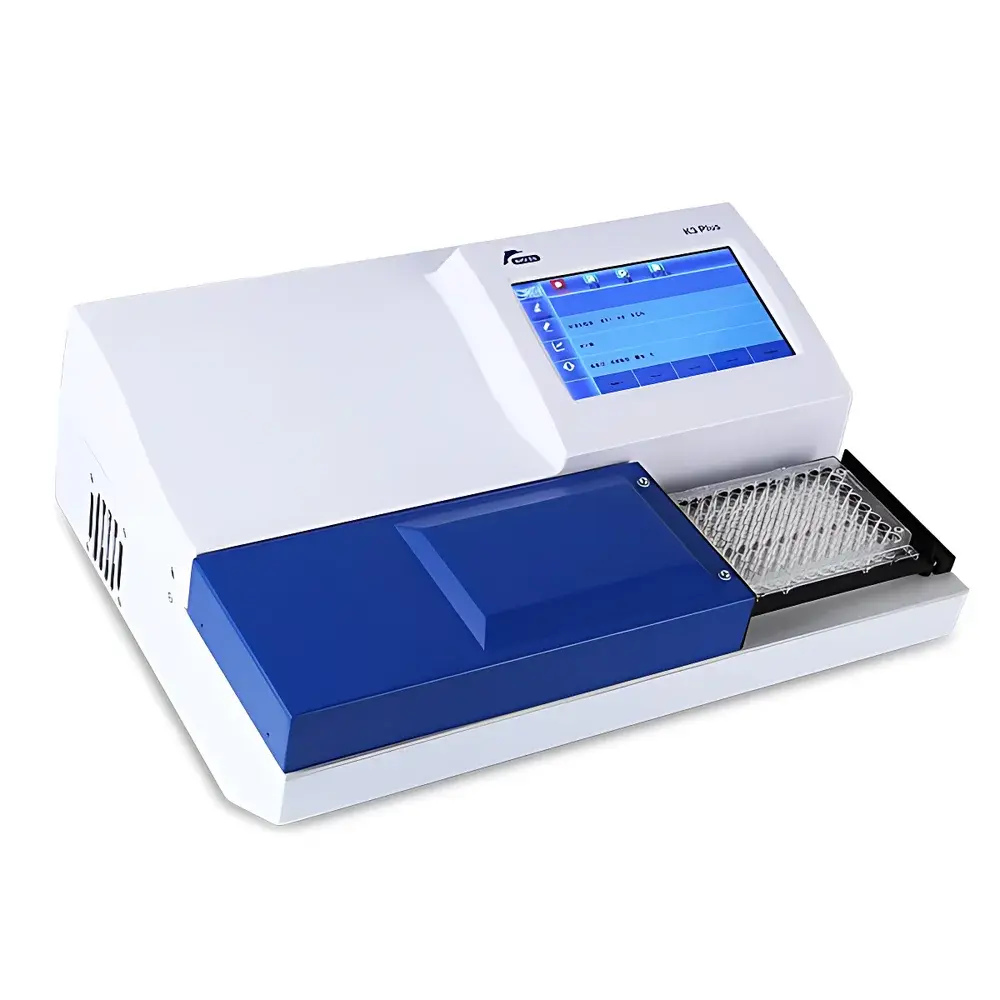
BIO-DL K3 Plus Microplate Reader
| Brand | BIO-DL |
|---|---|
| Origin | Shanghai, China |
| Manufacturer Type | Authorized Distributor |
| Product Origin | Domestic (China) |
| Model | K3 Plus Microplate Reader |
| Detection Method | Absorbance (Optical Density) |
| Function Type | Single-Mode Absorbance Reader |
| Wavelength Range | 400–750 nm |
| Absorbance Linearity | 0–3.0 A at 450 nm (r² ≥ 0.995) |
| Accuracy | ±0.007 Abs (0–0.3 A) |
Overview
The BIO-DL K3 Plus Microplate Reader is a dedicated absorbance-based microplate detection system engineered for precision, reproducibility, and operational efficiency in life science laboratories. It operates on the principle of photometric measurement via vertical optical path geometry—eight independent detection channels aligned perpendicularly to the microplate surface—ensuring uniform illumination and minimized well-to-well crosstalk. Designed specifically for standard 96-well microplates, the instrument delivers rapid, high-fidelity optical density (OD) readings across the visible spectrum (400–750 nm), making it suitable for endpoint ELISA, cell viability assays (e.g., MTT, CCK-8), protein quantification (Bradford, BCA), and nucleic acid analysis. Its architecture emphasizes stability over time: built-in self-diagnostic routines execute automatically at power-on, verifying lamp intensity, filter positioning accuracy, detector response, and baseline drift compensation—critical for longitudinal studies and regulated environments requiring traceable performance verification.
Key Features
- 8-channel vertical optical path design enabling simultaneous multi-well acquisition with minimal path-length variation and high inter-well consistency
- Configurable filter-based wavelength selection: up to eight interference filters can be pre-installed, supporting discrete wavelength targeting within 400–750 nm range
- High-speed readout: completes full 96-well plate measurement in ≤8 seconds under continuous mode; stepwise scanning available for kinetic or low-signal applications
- Three programmable linear shaking speeds (low/medium/high) integrated directly into assay protocols—enabling controlled mixing prior to or during measurement without external hardware
- 7-inch full-color capacitive touchscreen with intuitive graphical user interface (GUI), supporting both English and Chinese language modes for global lab accessibility
- Onboard data storage (≥10,000 plate records) with timestamped metadata, including operator ID, protocol name, date/time, and environmental parameters (if connected to optional ambient sensor)
Sample Compatibility & Compliance
The K3 Plus is validated for use with standard ANSI/SBS-compliant 96-well polystyrene, PVC, and UV-transparent microplates—including flat-bottom, U-bottom, and V-bottom formats. It supports common assay chemistries requiring absorbance detection at wavelengths critical for chromogenic substrates (e.g., pNPP at 405 nm, TMB at 450/650 nm, ABTS at 405/492 nm). While not certified for IVD or clinical diagnostics under FDA 510(k) or CE-IVD, the instrument meets general laboratory equipment requirements per ISO/IEC 17025:2017 for testing and calibration laboratories. Its firmware includes audit-trail-capable operation logs (user actions, parameter changes, error events), aligning with GLP principles for non-clinical research documentation. All optical components are calibrated using NIST-traceable neutral density standards prior to shipment.
Software & Data Management
The K3 Plus operates natively via its embedded firmware and optionally integrates with BIO-DL’s PC-based Microplate Analysis Suite (MPAS v3.2+), a Windows-compatible application supporting method creation, real-time kinetic plotting, curve fitting (4PL, linear, log-log), plate mapping, and automated QC flagging (e.g., outlier detection, coefficient of variation thresholds). Raw absorbance values are exportable in CSV, Excel (.xlsx), and XML formats—compatible with LIMS systems and statistical platforms such as GraphPad Prism or R. MPAS enforces role-based access control (admin/operator/user), enforces password-protected method locking, and maintains electronic signatures compliant with FDA 21 CFR Part 11 when configured with digital certificate authentication and secure audit trail activation.
Applications
- Quantitative immunoassays: ELISA, competitive binding assays, and sandwich assays using chromogenic substrates
- Cell-based assays: proliferation (MTT, XTT), cytotoxicity (LDH release), metabolic activity (resazurin reduction)
- Biochemical quantitation: total protein (Bradford, Lowry), enzyme activity (alkaline phosphatase, horseradish peroxidase), and DNA/RNA concentration (260 nm surrogate via dye-binding)
- Quality control in biomanufacturing: lot-release testing of reagents, buffer validation, and raw material screening
- Academic and pharmaceutical research labs requiring robust, entry-level absorbance readers with scalable software integration and regulatory-ready documentation features
FAQ
What is the maximum number of filters supported simultaneously?
The K3 Plus accommodates up to eight fixed-wavelength interference filters installed in its internal filter wheel. Users select active wavelengths via the touchscreen or software interface.
Does the instrument support dual-wavelength correction (e.g., reference subtraction)?
Yes—dual-wavelength mode allows primary and reference wavelength selection (e.g., 450 nm/650 nm), with automatic background subtraction applied per well during data acquisition.
Is temperature control available?
No—the K3 Plus does not include onboard incubation or temperature regulation. For kinetic assays requiring thermal stabilization, external plate warmers or environmental chambers must be used.
Can measurement data be exported directly to a network drive or LIMS?
Yes—when connected via USB or Ethernet (with optional adapter), the instrument supports scheduled auto-export to mapped network locations or FTP servers, configurable through MPAS software.
What maintenance is required to ensure long-term photometric accuracy?
Annual recalibration using BIO-DL-certified OD standards is recommended. Daily verification with a supplied 0.5 A and 2.0 A neutral density reference plate is advised before critical experiments.