
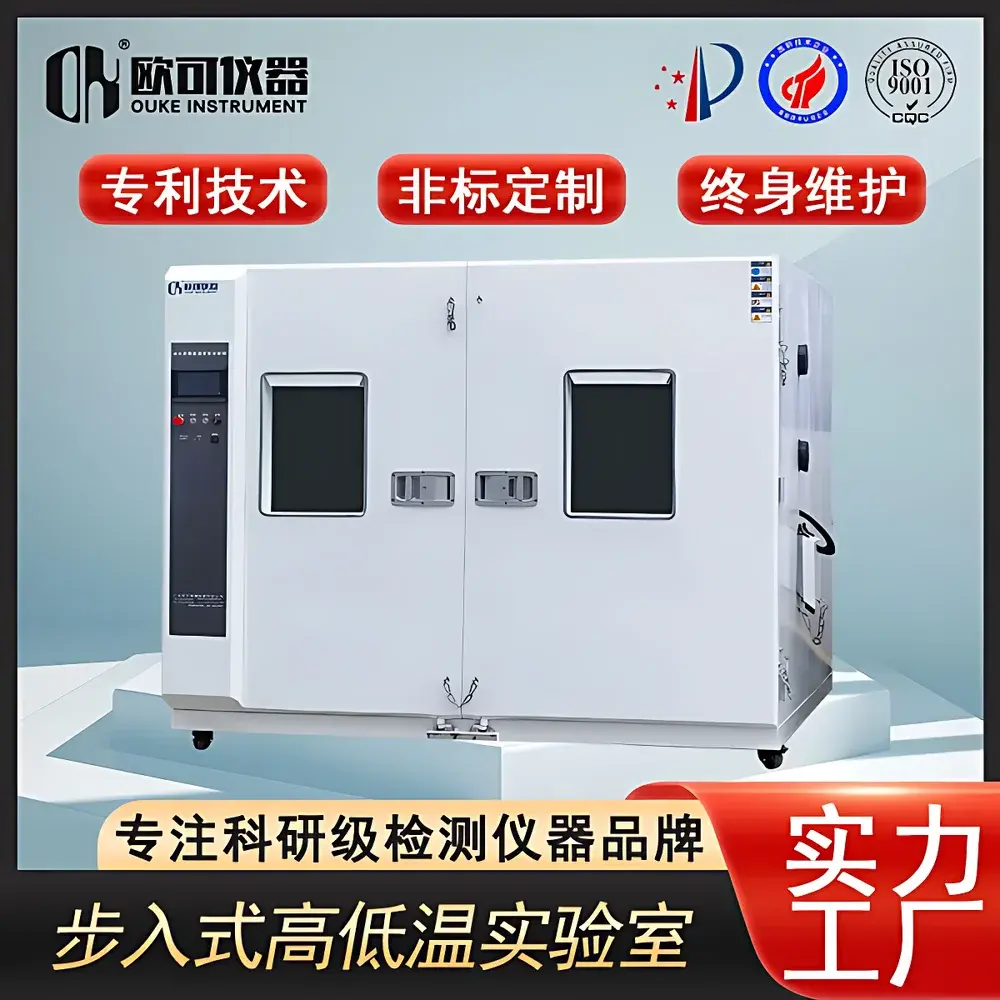
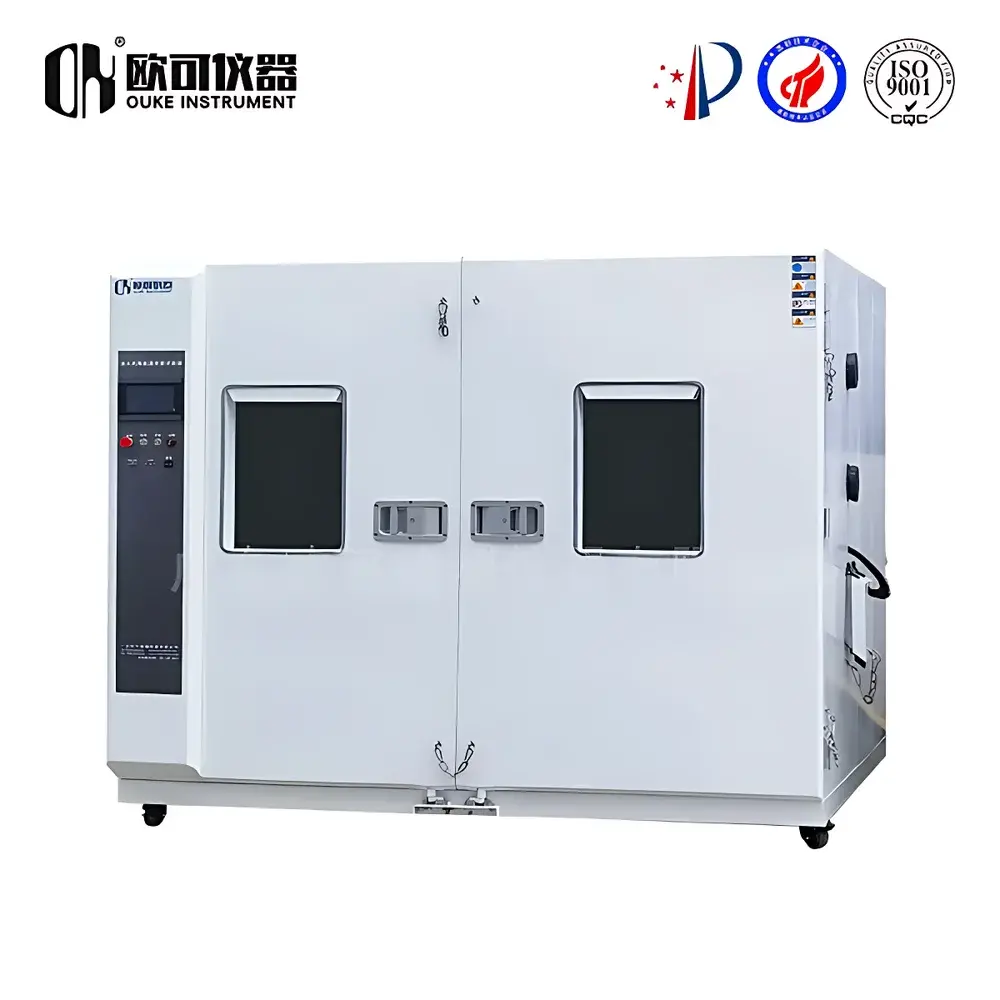
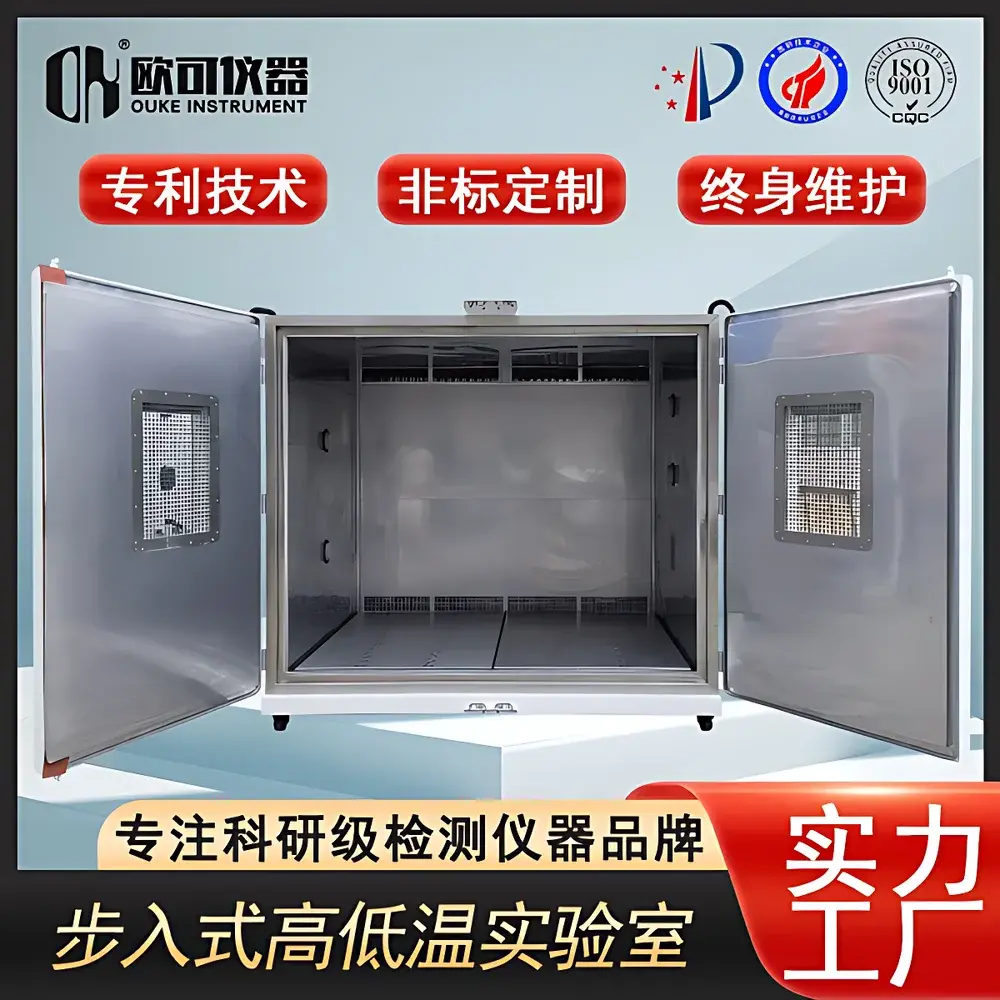
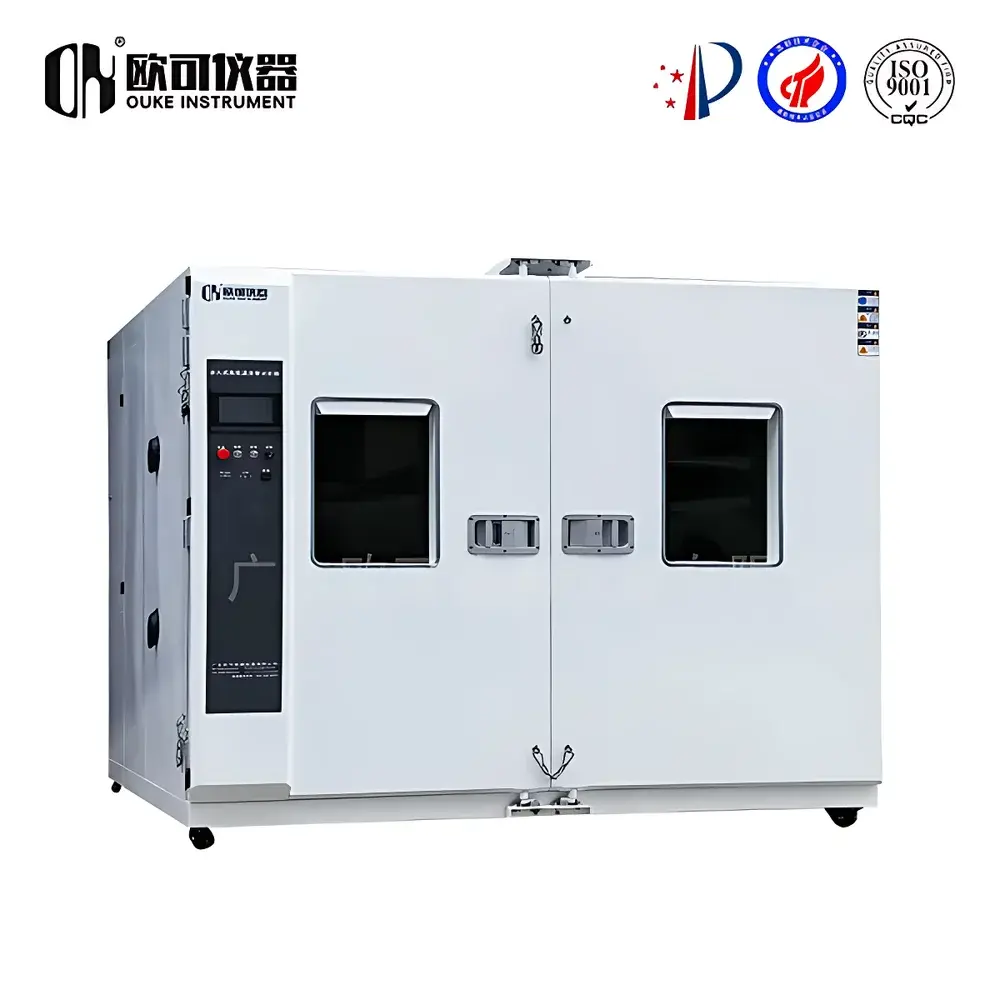
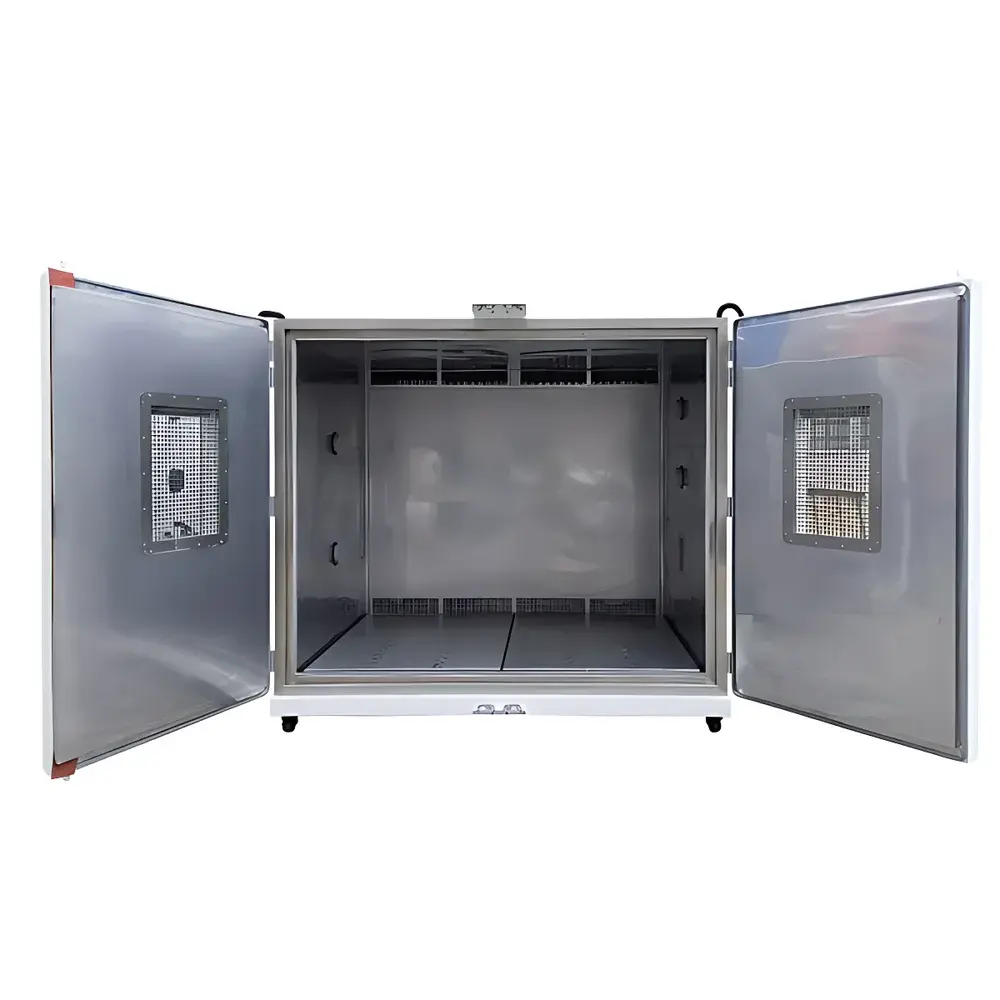
OK STAH-4m2.0101 Walk-in Solar Dual 85 Environmental Test Chamber
| Brand | OK Instruments |
|---|---|
| Origin | Guangdong, China |
| Manufacturer Type | Direct Manufacturer |
| Product Category | Domestic |
| Model | OK-STH-4m2.0101 |
| Internal Dimensions (D×W×H) | 1500 × 1800 × 1500 mm |
| Temperature Range | −40 °C to +150 °C |
| Temperature Uniformity | ±2 °C |
| Temperature Control Accuracy | ±1 °C |
| Heating Rate | 3 °C/min |
| Cooling Rate | 1 °C/min |
Overview
The OK STAH-4m2.0101 Walk-in Solar Dual 85 Environmental Test Chamber is an engineered solution for accelerated reliability testing of photovoltaic modules and related components under standardized “dual 85” conditions—85 °C temperature and 85 % relative humidity—per IEC 61215-2, IEC 61730, and UL 1703 requirements. Designed as a walk-in chamber with a usable internal volume of 4.05 m³ (1500 × 1800 × 1500 mm), it supports full-size solar panels (up to 2.2 m in length) and enables long-duration, unattended exposure testing under tightly controlled thermal and hygrothermal stress profiles. The system employs dynamic PID-based temperature and humidity control architecture, utilizing water vapor partial pressure regulation for high-fidelity RH management across the full operating range (−40 °C to +150 °C). Its robust structural design integrates double-wall insulated stainless steel construction, high-efficiency air circulation with laminar flow optimization, and redundant safety interlocks compliant with IEC 60529 (IP54 enclosure rating) and EN 61000-6-3 EMC standards.
Key Features
- Compliance-ready dual 85 test capability: stable operation at 85 °C / 85 % RH for ≥1000 hours per IEC 61215-2 MQT 11
- Four-segment independent sensor calibration: eliminates nonlinearity-induced drift across low-, mid-, and high-temperature zones (−40 °C, 25 °C, 85 °C, 150 °C)
- Intelligent power interruption recovery: resumes from exact breakpoint upon grid restoration—no data or cycle loss
- Programmable test sequences: 120 user-defined profiles; up to 99 segments per program; nested looping (up to 4 levels); inter-program chaining
- Dual-language HMI interface: seamless toggle between English and Chinese firmware UI without reboot
- Hardware-level specimen protection: automatic main heating circuit cutoff when chamber temperature exceeds setpoint by >5 °C—prevents thermal runaway damage to PV samples
- Fault-diagnostic display: real-time graphical alerts for overpressure, phase loss, refrigerant low-pressure, humidifier dry-run, and water reservoir depletion
- Energy-optimized refrigeration: hermetic Tecumseh/Tecumseh-derived compressors with R-407C refrigerant; 6-stage adaptive PID load modulation
Sample Compatibility & Compliance
The chamber accommodates standard and oversized photovoltaic modules (including bifacial, TOPCon, and perovskite-based prototypes), junction boxes, encapsulant materials (EVA, POE), backsheets, and frame adhesives. It meets mechanical and environmental requirements for qualification per IEC 61215-2 (MQT 01–18), IEC 61730-2, JIS C 8910, and UL 1703 Section 24. Humidity control accuracy (±2 % RH at 85 % RH, 85 °C) is verified per ISO 17025-accredited calibration protocols. Structural integrity conforms to ASME BPVC Section VIII Div. 1 for pressure boundary components. Optional integrated UV irradiance monitoring (300–400 nm) and DC bias feedthroughs support combined light-heat-humidity stress testing per IEC TS 63209.
Software & Data Management
The embedded controller logs timestamped temperature and humidity data at 1-second intervals to internal flash memory (≥30 days retention). Optional RS-485/Modbus RTU or Ethernet TCP/IP connectivity enables integration with LabVIEW, MATLAB, or enterprise MES platforms. With OK’s optional DataLink Pro software (Windows-compatible), users export CSV/Excel reports with traceable metadata—including operator ID, calibration certificate IDs, and audit trail timestamps. All electronic records comply with ALCOA+ principles and support 21 CFR Part 11-compliant electronic signatures when deployed with validated Windows Server environments. Raw data files include SHA-256 checksums for integrity verification during GLP/GMP audits.
Applications
- Accelerated damp heat testing of crystalline silicon and thin-film PV modules per IEC 61215-2 MQT 11
- Encapsulant delamination and discoloration studies under sustained 85/85 stress
- Backsheet hydrolysis resistance evaluation for fluoropolymer and PET-based systems
- Qualification of solder joint reliability in module interconnects under thermal-hygral cycling
- Pre-compliance screening for UL 1703 fire propagation and electrical insulation tests
- Material aging trials for adhesives, sealants, and edge protectants used in bifacial mounting systems
- Supporting R&D of next-generation encapsulants (e.g., silicone gels, ionomer films) under extended 85/85 exposure
FAQ
What does “Dual 85” refer to in solar testing context?
It denotes the standardized stress condition of 85 °C temperature and 85 % relative humidity, mandated for damp heat qualification of photovoltaic modules under IEC 61215-2 and UL 1703.
Can this chamber perform temperature cycling in addition to steady-state 85/85?
Yes—the controller supports programmable ramp-and-soak profiles, including −40 °C ↔ +85 °C cycles with variable dwell times and transition rates (1–3 °C/min), compliant with IEC 61215-2 MQT 10.
Is calibration documentation provided with the system?
Each unit ships with a factory-as-built calibration report covering temperature uniformity, humidity accuracy, and ramp rate verification—traceable to NIM (China National Institute of Metrology) standards.
Does the chamber meet CE or UKCA marking requirements?
The system complies with EU Machinery Directive 2006/42/EC, EMC Directive 2014/30/EU, and Low Voltage Directive 2014/35/EU; CE marking is applied following third-party notified body assessment (TÜV Rheinland NB#0197).
What maintenance intervals are recommended for long-term 85/85 operation?
Humidifier electrodes require quarterly descaling; refrigerant circuit oil analysis is advised annually; temperature/humidity sensor recalibration is recommended every 12 months or after 2000 operational hours—whichever occurs first.



