
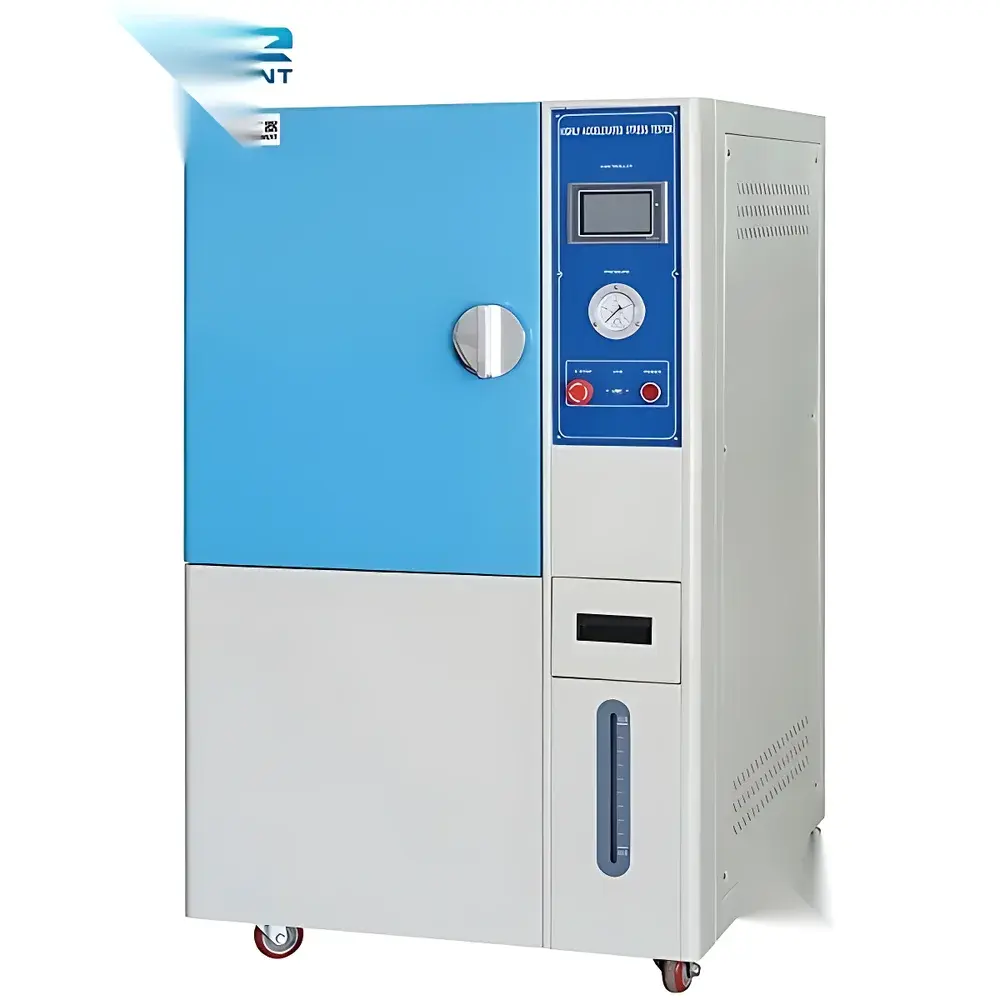
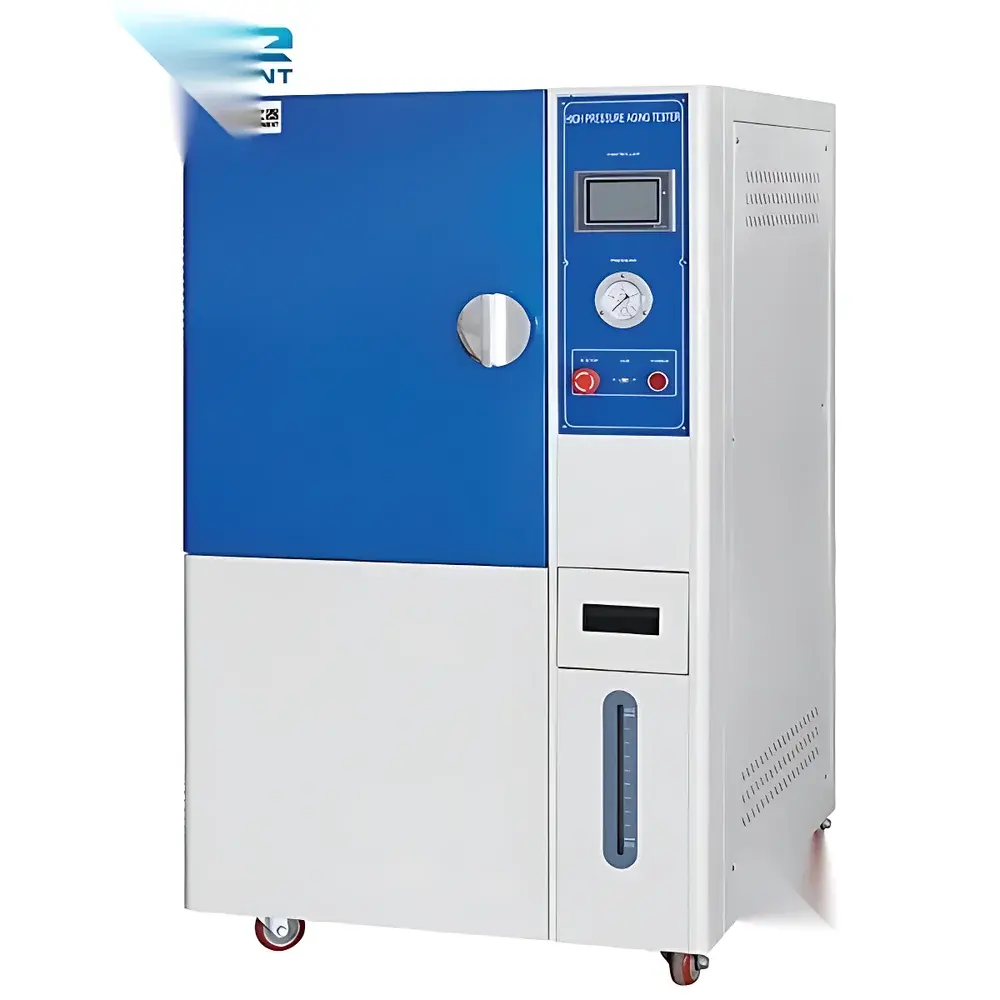
HAST Saturation Aging Test Chamber
| Brand | Other Brands |
|---|---|
| Origin | Imported |
| Manufacturer Type | General Distributor |
| Price | USD 14,000 (approx.) |
| Temperature Range | 105–132 °C (control point) |
| Temperature Uniformity | ±2.0 °C |
| Temperature Fluctuation | ±0.5 °C |
| Humidity Range | 75–100 % RH (control point) |
| Humidity Fluctuation | ±2.5 % RH |
| Humidity Uniformity | ±5.0 % RH |
| Pressure Range | 0.05–0.196 MPa (0.5–2 kgf/cm²) |
| Ramp Time (Ambient to 132 °C) | ≤35 min |
| Pressure Ramp Time (Ambient to 2 kgf/cm²) | ≤40 min |
| Water Level Auto-Replenishment | Yes |
| Post-Test Drying Function | Electric Heating Dry Mode |
| Compliance | ASTM B809, JESD22-A102, JEDEC JESD22-A110, IEC 60068-2-66 |
Overview
The HAST Saturation Aging Test Chamber is a precision environmental stress test system engineered for highly accelerated stress testing (HAST) of hermetically sealed and plastic-encapsulated microelectronic devices. Unlike conventional temperature-humidity-life (THL) or damp heat tests, this chamber operates under saturated steam conditions at elevated temperature and pressure—enabling rapid diffusion of moisture through polymer encapsulants, mold compound interfaces, and leadframe bondlines. It implements the fundamental principle of accelerated physics-of-failure modeling: by increasing partial vapor pressure and thermal energy, it shortens time-to-failure for latent defects such as intermetallic corrosion, wire bond degradation, die attach delamination, and conductive anodic filament (CAF) formation. Designed for laboratory-grade reproducibility and process traceability, the chamber supports qualification per industry-critical standards including JEDEC JESD22-A102 (Unbiased HAST), JESD22-A110 (Biased HAST), and IEC 60068-2-66. Its operational envelope targets failure mechanisms prevalent in automotive-grade ICs, power modules, LED packages, and medical-grade PCBAs—where long-term reliability under humid tropical or high-bias operating conditions is mission-critical.
Key Features
- Real-time sensor-based monitoring of chamber temperature, relative humidity, and absolute pressure—no reliance on theoretical saturation vapor pressure tables; ensures metrological fidelity across all test cycles.
- Automatic water level replenishment system maintains uninterrupted test continuity during extended-duration HAST runs (e.g., 96 h, 168 h, or 1000 h profiles).
- Integrated electric-heating dry mode activates post-test to evacuate residual moisture from test specimens and internal chamber surfaces—reducing cross-contamination risk and enabling immediate post-test electrical inspection.
- Precise pressure–temperature correlation mapping aligned with ASTM B809 Annex A and JEDEC-defined HAST reference curves—verified via NIST-traceable calibration protocols.
- Robust stainless-steel inner chamber construction with double-wall insulation and PID-controlled heating/pressurization loops for ±0.5 °C temperature stability and ±2.5 % RH humidity repeatability.
Sample Compatibility & Compliance
This chamber is intended exclusively for non-hazardous, non-corrosive, and non-EMI-emitting electronic assemblies. Prohibited samples include flammable solvents, volatile organic compounds (VOCs), halogenated materials, strong acids/bases, and RF-active components operating above 1 GHz. All test configurations comply with safety requirements per IEC 61010-1 and EN 60529 (IPX2 ingress protection). Data integrity meets GLP and GMP audit readiness criteria: test logs include timestamped sensor values, setpoint deviations, alarm events, and user-initiated interventions—fully exportable in CSV or XML format. Optional 21 CFR Part 11-compliant software module available for FDA-regulated medical device validation.
Software & Data Management
The embedded controller features a 7-inch capacitive touchscreen HMI with multilingual UI (English, Japanese, Korean, simplified Chinese). Real-time trending graphs display simultaneous traces of T, RH, and P; historical data is stored locally for ≥30 days and can be exported via USB or Ethernet. Optional PC-based software enables remote supervision, automated report generation (PDF/Excel), and integration with MES or LIMS platforms via Modbus TCP or OPC UA. Audit trail functionality records operator login/logout, parameter changes, and emergency stop events—with immutable timestamps and digital signature support.
Applications
- Qualification of QFN, BGA, and Wafer-Level Chip-Scale Packages (WLCSP) per JESD22-A102.
- Failure analysis root-cause screening for moisture-induced popcorning, lid lift, or mold compound cracking.
- Design verification of conformal coatings and underfill materials used in automotive ADAS modules.
- Reliability assessment of flexible printed circuits (FPCs) and rigid-flex PCBAs exposed to high-humidity service environments.
- Process capability studies for transfer molding, die attach, and wire bonding in semiconductor packaging lines.
FAQ
What is the difference between unbiased and biased HAST?
Unbiased HAST applies only environmental stress (T, RH, P) without electrical bias; biased HAST superimposes DC voltage or functional signal stress to accelerate electrochemical failure modes such as CAF or electromigration.
Can this chamber perform standard 85/85 testing?
Yes—by deactivating pressurization and setting T = 85 °C / RH = 85 % RH, the system functions as a high-stability THB chamber compliant with JEDEC JESD22-A101.
Is third-party calibration certification included?
Factory calibration is performed using NIST-traceable reference sensors; ISO/IEC 17025-accredited calibration certificates are available upon request.
What maintenance intervals are recommended?
Water reservoir cleaning every 30 days; pressure relief valve verification semiannually; full system performance validation annually per ASTM E2234.



