
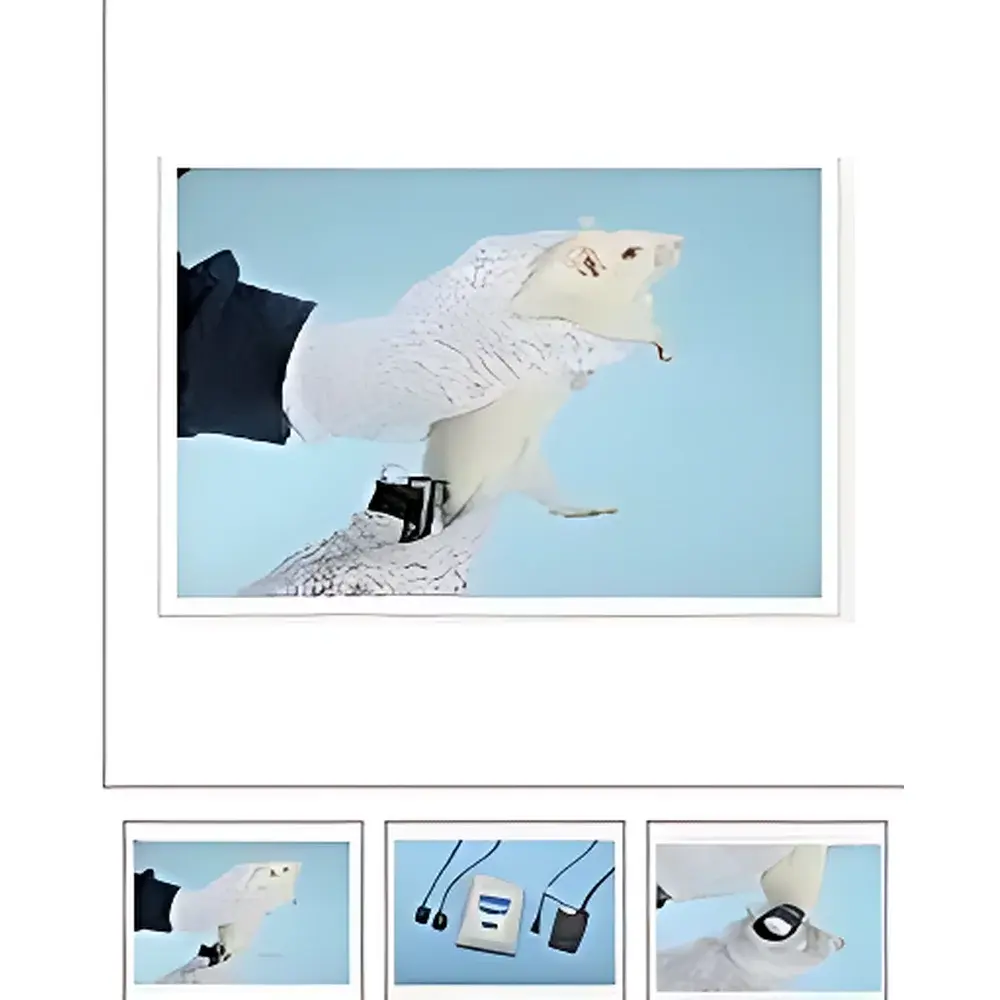
Ugo Basile 38500 Pressure Application Measurement (PAM) System for Rodent Joint Nociception Analysis
| Brand | Ugo Basile |
|---|---|
| Origin | Italy |
| Model | 38500 |
| Force Resolution | 0.1 g |
| Maximum Applied Force | 1500 gf |
| Species-Specific Sensors | Rat & Mouse |
| Optional Accessory | Paw Pressure Sensor Module |
| Compliance | Designed for ASTM F2796-21–aligned behavioral nociception protocols |
| Software Interface | USB-connected digital readout with real-time force curve export (CSV/TXT) |
Overview
The Ugo Basile 38500 Pressure Application Measurement (PAM) System is a calibrated, hand-held mechanical allodynia and hyperalgesia assessment instrument engineered for quantitative evaluation of joint-related mechanical pain thresholds in rodent models. It operates on the principle of controlled, linearly increasing compressive force applied directly to anatomically defined joint sites—primarily the knee or tibiotarsal (ankle) articulation—while objectively capturing the withdrawal reflex threshold. Unlike thermal or chemical nociceptive assays, the PAM system delivers reproducible mechanical stimulation grounded in validated biomechanical loading profiles, making it especially suited for longitudinal studies of inflammatory and degenerative joint pathology, including antigen-induced arthritis, collagen-induced arthritis (CIA), and monoiodoacetate (MIA)-mediated osteoarthritis models. The device integrates two interchangeable, species-optimized force transducers (one for rats, one for mice), each calibrated to ISO/IEC 17025–traceable standards and designed with a contact geometry conforming to the curvature and surface area of the target joint. Its operation adheres to the core tenets of the NIH Office of Laboratory Animal Welfare (OLAW) and European Directive 2010/63/EU guidelines for humane endpoint determination in pain research.
Key Features
- High-resolution digital force measurement (0.1 g resolution, up to 1500 gf full scale) with real-time analog-to-digital conversion and low-drift strain gauge architecture
- Dual-species transducer set: rat-specific sensor (larger contact surface, optimized for ~250–500 g body weight range) and mouse-specific sensor (reduced footprint, suitable for 18–35 g subjects)
- Ergonomic thumb-mounted actuation design enabling operator-controlled, consistent application velocity and directionality—minimizing inter-observer variability
- Integrated LED display with peak-hold function and automatic zero-reset; supports immediate visual feedback during live testing
- USB 2.0 interface for direct data streaming to Windows-based acquisition software, enabling synchronized timestamped force–time curve recording
- Modular accessory compatibility: optional paw pressure sensor module (Model 38510) extends functionality to plantar mechanical sensitivity assessment using von Frey–compatible stimulus geometry
Sample Compatibility & Compliance
The 38500 PAM System is validated for use in Sprague-Dawley and Wistar rats (180–300 g), C57BL/6, BALB/c, and DBA/1 mice (18–30 g), under standard housing and acclimation conditions per ARRIVE 2.0 guidelines. All transducers are constructed from medical-grade stainless steel and autoclavable polymer housings compliant with ISO 10993-5 cytotoxicity requirements. Data acquisition workflows support GLP-compliant documentation: exported CSV files include metadata fields for operator ID, animal ID, session timestamp, sensor calibration ID, and environmental parameters (ambient temperature/humidity logged externally). The system’s force application protocol aligns with ASTM F2796-21 (“Standard Practice for Assessment of Mechanical Hyperalgesia in Rodent Models”) and has been cited in peer-reviewed validation studies meeting ICH S5(R3) and FDA Guidance for Industry on Preclinical Safety Evaluation of Biotechnology-Derived Pharmaceuticals.
Software & Data Management
The included PAM Control Suite (v3.2+) provides a lightweight, installer-free Windows application supporting real-time visualization of force–time curves, automated threshold detection (defined as the first sustained >500 ms force plateau followed by abrupt drop ≥10% indicating withdrawal), and batch export to CSV or Excel-compatible formats. Audit trail functionality logs user login events, parameter changes, and export actions in accordance with FDA 21 CFR Part 11 requirements when paired with institutional network authentication. Raw data files retain native 1 kHz sampling fidelity and embed sensor serial numbers and factory calibration coefficients for traceability. Third-party integration is supported via COM port emulation for LabVIEW, MATLAB, or Python (PySerial) scripting environments.
Applications
- Longitudinal monitoring of mechanical hypersensitivity in antigen-induced or collagen-induced arthritis models
- Pharmacodynamic profiling of NSAIDs, COX-2 inhibitors, TRPV1 antagonists, and intra-articular biologics
- Genetic screening of nociceptor ion channel mutants (e.g., Piezo2 KO, Nav1.7 conditional knockouts)
- Validation of novel joint-targeted drug delivery systems (nanoparticles, hydrogels, microneedles)
- Correlative analysis with histopathology (OARSI scoring), micro-CT bone erosion metrics, and synovial cytokine profiling
- Training platform for standardized technician competency assessment in preclinical pain labs
FAQ
Is the 38500 PAM System compatible with both rats and mice?
Yes—the system ships with two physically distinct, pre-calibrated force transducers: one optimized for rat knee joint geometry and load range (200–1500 gf), and another for mouse joints (10–500 gf). Each includes independent calibration certificates.
Does the device meet regulatory requirements for GLP-compliant studies?
When used with the optional audit trail license and institutional IT controls, the PAM Control Suite satisfies core elements of FDA 21 CFR Part 11 and OECD Principles of Good Laboratory Practice for electronic records and signatures.
Can force application velocity be controlled or recorded?
While the system does not motorize actuation, its high-speed sampling (1 kHz) enables post-hoc calculation of mean application rate (gf/s) from the initial linear ramp phase, supporting normalization across operators per published methodology (Barton et al., J Neurosci Methods 2007).
What maintenance is required for long-term accuracy?
Annual recalibration against NIST-traceable deadweight standards is recommended; transducers feature sealed strain gauges with <0.05% full-scale drift/year under typical lab conditions.
Is training provided with purchase?
Ugo Basile offers remote video-based SOP implementation support and hosts biannual webinars on joint nociception assay harmonization, co-developed with EUPSA (European Pain Federation) preclinical working group.
Related Products




