
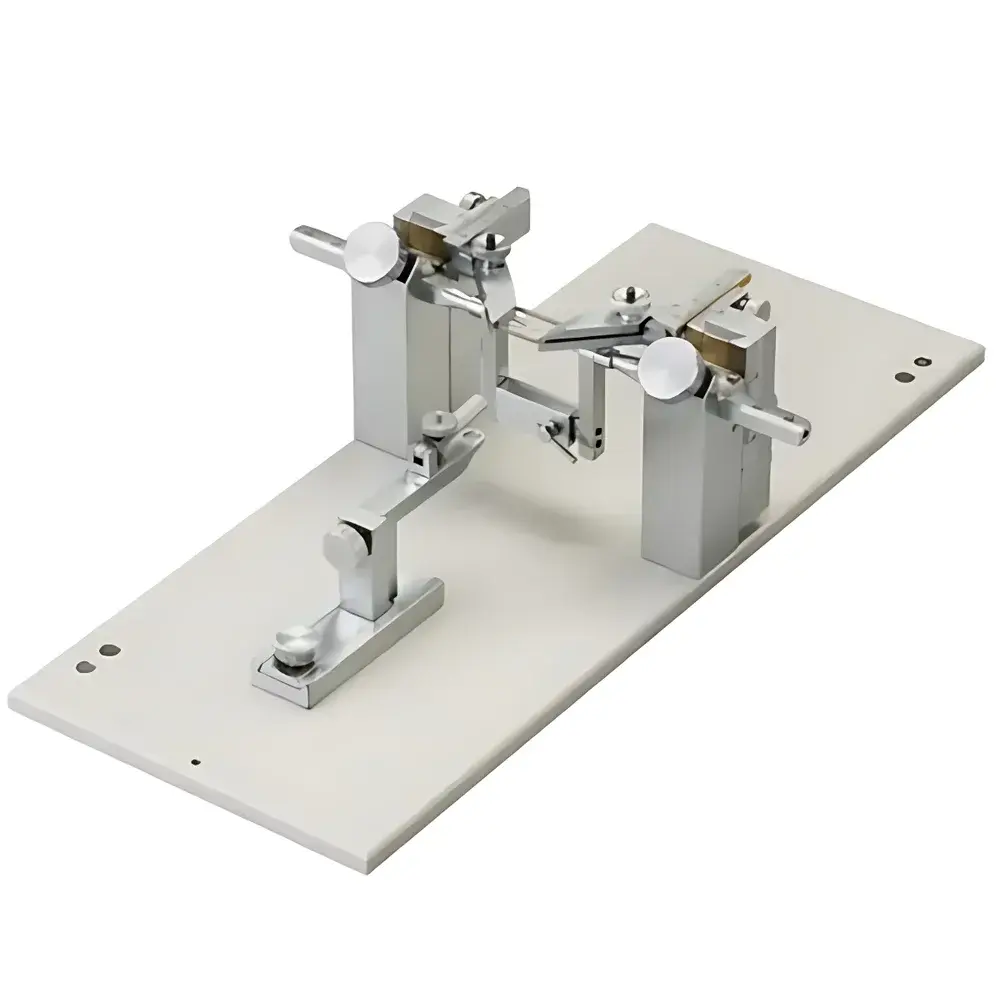
Narishige MAG-3 / MAG-2 / MAG-1 / SR-9AM / MA-6N / SRP-AM2 Mouse and Rat Head Fixation Systems for Stereotaxic Surgery and In Vivo Imaging
| Origin | Japan |
|---|---|
| Manufacturer Type | Authorized Distributor |
| Origin Category | Imported |
| Models | MAG-3, MAG-2, MAG-1, SR-9AM, MA-6N, SRP-AM2, SR-AM |
| Load Capacity | 0.5–2 kg |
| Tilt Range (Longitudinal/Lateral) | ±10°–±15° / ±15°–±20° |
| Material | Anodized Aluminum, Medical-Grade Acrylic, MRI-Compatible Non-Metallic Polymers |
| Compliance | Designed for ISO 13485-aligned laboratory environments |
Overview
The Narishige MAG-series and SR-series head fixation systems are precision-engineered stereotaxic accessories designed for chronic, non-invasive head restraint of mice and rats in neuroscience research. These devices operate on the principle of rigid mechanical immobilization—leveraging standardized stereotaxic coordinate frameworks (e.g., Paxinos & Franklin atlas) to maintain consistent anatomical alignment across repeated experimental sessions. Unlike acute anesthesia-dependent setups, models such as the SR-9AM and SRP-AM2 enable awake-behavioral paradigms—including visual, auditory, and sensorimotor tasks—by securing animals via custom-fitted chamber frames affixed to the skull during recovery surgery. This eliminates inter-session positional drift and minimizes physiological stress artifacts commonly introduced by repeated anesthetic exposure. The modular architecture integrates seamlessly with Narishige’s SR-9M-HT, SR-10AR, and other SR-series stereotaxic instruments, supporting both surgical implantation and post-operative longitudinal imaging (e.g., two-photon microscopy, epifluorescence, or functional MRI).
Key Features
- Modular compatibility: All units mount directly onto Narishige SR-series base plates (e.g., SR-9M-HT) using standardized dovetail interfaces and locking screws.
- Adjustable angular positioning: MAG-3 supports ±15° longitudinal and ±20° lateral tilt for optimized access to temporal lobe structures and deep cortical layers under stereomicroscopy.
- MRI-safe configuration: SRP-AM2 is constructed entirely from non-ferromagnetic, RF-transparent polymers; detachable from its base for in-scanner fixation without compromising animal stability.
- Chronic-use engineering: SR-9AM incorporates low-profile chamber-frame clamping mechanisms that allow repeated, anesthesia-free repositioning—validated for ≥7-day behavioral training protocols.
- Interchangeable rod systems: MA-6N adapter enables conversion of rat-sized ear bars (EB-3A) to mouse-compatible geometry via dovetail-guided nasal/mouth clamp translation.
- Weight-optimized design: MAG-1 weighs only 102 g and fits within confined optical paths of two-photon microscopes; SR-AM accommodates full-head stabilization up to 1.2 kg total mass.
Sample Compatibility & Compliance
These fixation systems are validated for C57BL/6, BALB/c, CD-1, and Sprague-Dawley mice and rats (20–35 g and 250–450 g, respectively). Chamber frame interfaces support custom-machined CF-10, CP, CP-1, and CP-2 variants—enabling integration with implanted cranial windows, optogenetic cannulas, or electrophysiology pedestals. All metallic components undergo anodization per ASTM B580 Class II specifications to prevent corrosion during prolonged saline or drug infusion experiments. While not FDA-cleared medical devices, the systems conform to ISO 13485 quality management principles applicable to preclinical instrumentation. Their mechanical repeatability (≤5 µm positional variance over 50 cycles) meets internal validation standards aligned with NIH Guide for Care and Use of Laboratory Animals and EU Directive 2010/63/EU requirements for humane restraint.
Software & Data Management
No embedded firmware or proprietary software is included—consistent with industry-standard open-hardware philosophy for stereotaxic accessories. Coordinate reproducibility relies on mechanical indexing rather than digital feedback. However, all models are fully compatible with third-party acquisition platforms including MATLAB-based Bonsai, Python-controlled MicroManager, and commercial packages such as NIS-Elements or Prairie View. Audit trails for chamber placement can be documented via calibrated stage micrometers or integrated with digital caliper APIs for GLP/GMP-aligned labs requiring 21 CFR Part 11-compliant metadata logging.
Applications
- In vivo two-photon calcium imaging of layer V pyramidal neurons during operant conditioning.
- Chronic fiber photometry in awake, head-fixed mice performing Go/No-Go auditory discrimination.
- High-resolution structural MRI of hippocampal subfields following contextual fear conditioning.
- Simultaneous extracellular single-unit recording and optogenetic inhibition in barrel cortex during whisker stimulation.
- Longitudinal assessment of blood-brain barrier permeability using intravital confocal microscopy.
- Calibration of stereotaxic coordinates for bilateral AAV injection targeting nucleus accumbens shell.
FAQ
Can MAG-2 be used with a two-photon microscope?
Yes—its compact footprint (W87 × D136 × H58–72 mm) and low center of gravity permit stable mounting beneath upright two-photon systems with limited working distance.
Is SRP-AM2 certified for 7T MRI use?
It has been empirically tested at 7T in rodent scanners; however, users must verify RF heating profiles and image artifact thresholds per their institutional MRI safety protocol.
Does MA-6N support interchangeable ear bar diameters?
Yes—the燕尾 (dovetail) adjustment mechanism accommodates EB-3A (rat, 1.2 mm) and EB-3B (mouse, 0.8 mm) ear bars when paired with appropriate auxiliary rods (EB-5N or EB-6).
Are chamber frames autoclavable?
CP-1 and CP-2 acrylic chambers are heat-resistant up to 80°C but not autoclavable; CF-10 polycarbonate frames tolerate steam sterilization at 121°C for 15 minutes.
Can SR-9AM be retrofitted to older SR-5 series bases?
Mechanical compatibility requires SR-9M-HT or newer base plates due to updated dovetail pitch and torque specifications; retrofitting is not recommended without dimensional verification.
Related Products




