
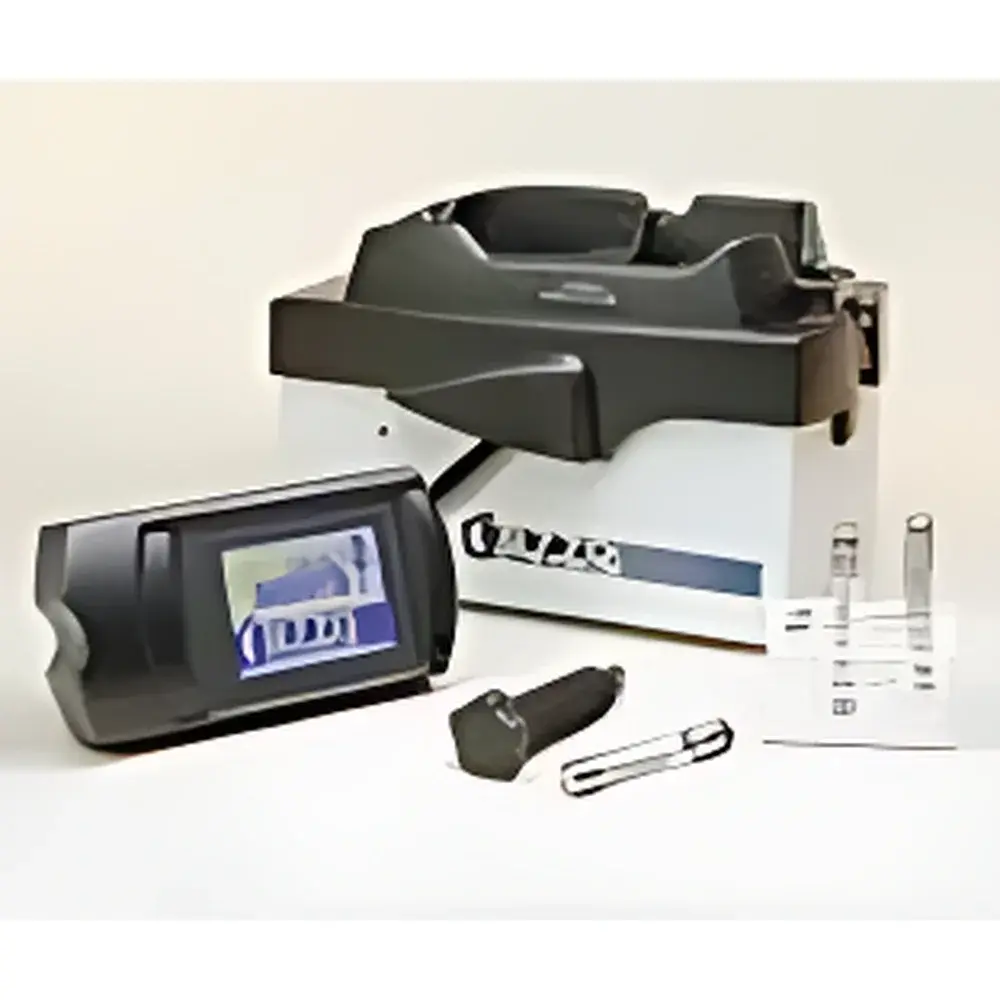
QM-F Cryogenic Grinder
| Origin | Jiangsu, China |
|---|---|
| Manufacturer Type | Distributor |
| Origin Category | Domestic |
| Model | QM-F |
| Pricing | Upon Request |
Overview
The QM-F Cryogenic Grinder is a precision-engineered laboratory instrument designed for the controlled, low-temperature mechanical disruption of temperature-sensitive and brittle samples. It operates on the principle of magnetic-driven impact grinding under cryogenic conditions—specifically, liquid nitrogen immersion at −196 °C—to preserve sample integrity, inhibit enzymatic degradation, and prevent thermal denaturation or volatile loss. Unlike ambient or refrigerated grinders, the QM-F maintains samples in a fully frozen state throughout the entire grinding cycle, making it indispensable for applications requiring molecular stability, such as nucleic acid extraction, protein conformational analysis, and trace elemental preservation. Its compact footprint, programmable operation, and sealed-sample architecture align with modern lab requirements for reproducibility, contamination control, and regulatory traceability.
Key Features
- Magnetic actuation system: A single moving component—the impact bead inside the sealed sample vial—minimizes mechanical vibration, reduces maintenance frequency, and extends service life.
- Programmable cryo-grinding protocol: Independent adjustment of pre-cooling duration, grinding time (1–20 Hz frequency range), and inter-pulse freezing intervals ensures method optimization across diverse matrices.
- Hermetically sealed vial-based processing: Each 5 mL sample is processed in a dedicated, reusable cryo-vial, eliminating cross-contamination and enabling full containment of hazardous, bioactive, or regulated materials.
- Full cryogenic fidelity: Sample vials are submerged directly in liquid nitrogen during grinding, maintaining continuous thermal equilibrium at −196 °C without intermediate warming stages.
- Electronic process control: All operational parameters—including timing, frequency, and sequence—are digitally defined and executed, supporting SOP compliance and audit-ready documentation.
Sample Compatibility & Compliance
The QM-F accommodates a broad spectrum of biological, polymeric, pharmaceutical, and geological specimens—including soft tissues, plant matter, bacterial pellets, synthetic polymers, pharmaceutical tablets, mineral ores, and textile fibers—without compromising structural or chemical fidelity. Its design conforms to CE marking requirements for electrical safety and electromagnetic compatibility (EMC Directive 2014/30/EU). While not intrinsically certified to ISO/IEC 17025 or GLP/GMP standards, the device supports compliant workflows when integrated into validated laboratory procedures; its programmable logic, parameter logging capability, and sealed-vial architecture facilitate alignment with FDA 21 CFR Part 11 data integrity expectations when paired with compliant LIMS or ELN systems.
Software & Data Management
The QM-F utilizes an embedded microcontroller interface with tactile keypad navigation and LCD status display. Though it does not feature network connectivity or proprietary software, all user-defined protocols—including frequency setpoints, timing sequences, and freeze-grind cycles—are stored in non-volatile memory with timestamped execution logs. These logs can be manually recorded or integrated into external electronic lab notebooks (ELNs) for audit trails. The absence of cloud dependency ensures data sovereignty and simplifies validation in regulated environments where cybersecurity controls restrict external data transmission.
Applications
- Genomic and proteomic sample prep: Preservation of RNA integrity and native protein folding during tissue homogenization prior to qPCR or mass spectrometry.
- Pharmaceutical QA/QC: Uniform particle size reduction of active pharmaceutical ingredients (APIs) and excipients for dissolution testing per USP & Ph. Eur. guidelines.
- Environmental and food safety testing: Homogenization of heterogeneous food matrices (e.g., spices, dairy products, meat composites) for accurate heavy metal or pesticide residue analysis (ASTM D5683, ISO 17294).
- Materials science: Preparation of cryo-milled polymer blends and composite powders for SEM-EDS or XRD characterization without thermal phase segregation.
- Clinical diagnostics: Processing of frozen biopsy specimens under chain-of-custody conditions for histopathological or molecular pathology workflows.
FAQ
What is the maximum sample volume per vial?
Each standard cryo-vial accommodates up to 5 mL of sample material, optimized for efficient heat transfer and impact energy distribution under liquid nitrogen immersion.
Can the QM-F be used for hazardous or pathogenic samples?
Yes—the fully sealed vial system provides primary containment, and the absence of exposed moving parts or open grinding chambers minimizes aerosol generation and operator exposure risk.
Is cleaning and validation supported between runs?
All vials and impact beads are autoclavable or solvent-cleanable; their physical separation from the main unit enables full decontamination and verification per laboratory SOPs.
Does the device require external cooling beyond liquid nitrogen?
No—liquid nitrogen serves as both coolant and thermal medium; no additional chiller, compressor, or dry ice supplementation is necessary.
How is method reproducibility ensured?
By fixing mechanical variables (vial geometry, bead mass, frequency, and thermal history) and eliminating manual handling variability, the QM-F delivers high inter-run repeatability—critical for GLP-compliant analytical workflows.



