
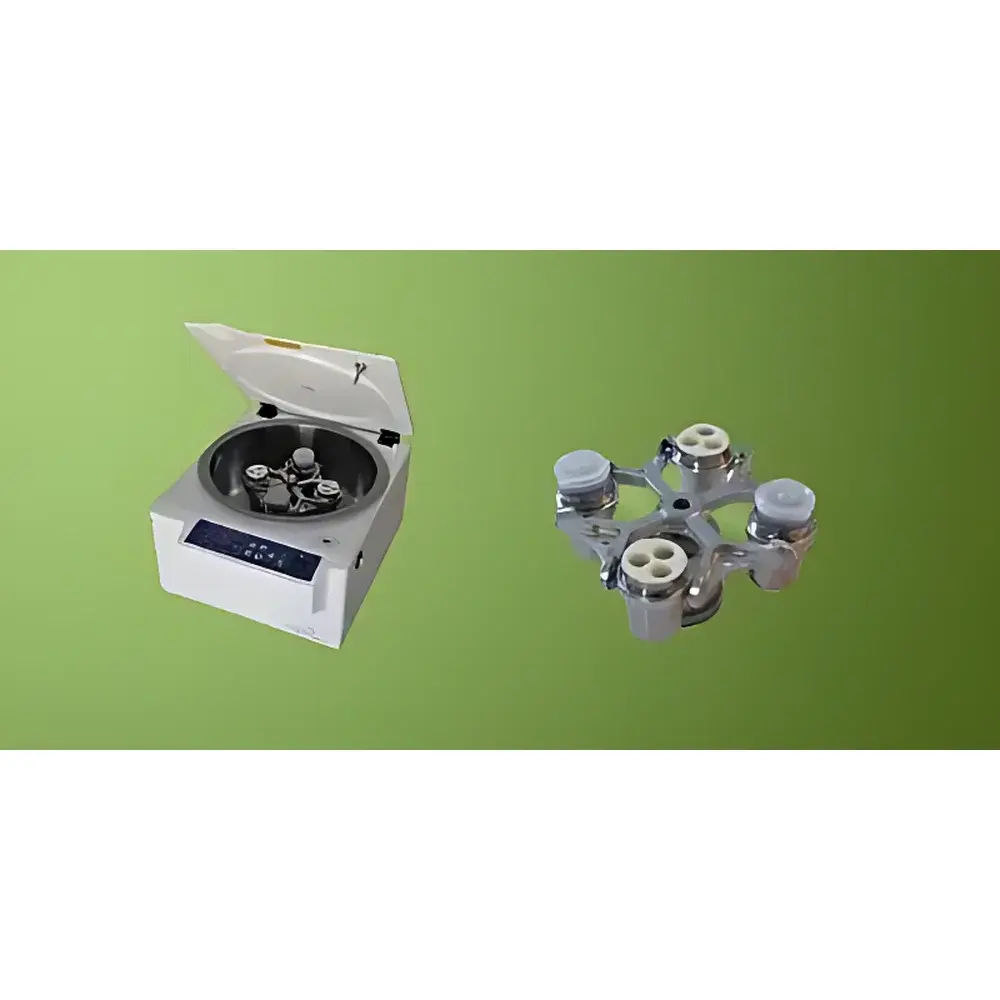
DT5-2 Benchtop Low-Speed Centrifuge
| Max Speed | 5000 rpm |
|---|---|
| Max RCF | 4360 ×g |
| Timer Range | 0–999 min |
| Power Supply | AC 220 V, 50 Hz, 8 A |
| Dimensions | 51 × 41 × 31 cm |
| Weight | 32 kg |
| Capacity Options | 100 mL × 4 |
| Motor Type | Brushless DC |
| Control System | Microprocessor-based fuzzy logic control |
| Display | LCD with full-touch interface |
| Safety Features | Over-speed, over-temperature, imbalance, and door-lock monitoring with audible/visual alerts |
Overview
The DT5-2 Benchtop Low-Speed Centrifuge is an engineered solution for routine sedimentation, phase separation, and particle pelleting in clinical, academic, food safety, environmental, and industrial quality control laboratories. Designed around a brushless DC motor architecture, it eliminates carbon brush wear and associated maintenance—ensuring long-term rotational stability, consistent torque delivery, and high reproducibility across repeated runs. Its operational principle relies on radial acceleration to separate suspended particles or immiscible phases based on density differentials, with centrifugal force (RCF) precisely calculated and displayed in real time. The unit operates within a validated low-speed regime (up to 5000 rpm / 4360 ×g), making it ideal for fragile biological samples—including whole blood, cell suspensions, milk homogenates, wastewater sludge, and food emulsions—where high g-forces could induce unwanted lysis or phase degradation.
Key Features
- Brushless DC motor with integrated thermal protection and dynamic braking—enabling rapid acceleration (<15 s to 5000 rpm) and deceleration (<20 s to standstill) without rotor coasting.
- Microprocessor-controlled fuzzy logic system ensures precise speed regulation (<±10 rpm accuracy) and time-based termination with ±1 s resolution.
- Full-touch LCD interface with intuitive icon-driven navigation—no physical buttons to degrade or jam; supports multi-language firmware (English, Spanish, French, German).
- Comprehensive safety architecture: automatic rotor recognition (via mechanical coding), lid interlock with force-sensing switch, real-time imbalance detection (±2 g threshold), and dual-stage over-temperature cutoff (motor winding + chamber).
- Modular rotor carrier design accommodates interchangeable swing-out and fixed-angle configurations—each certified to ISO 15189 Annex C and IEC 61010-2-020 for Class II laboratory equipment.
- Wide-input power conditioning (220 V ±10%, 50 Hz) with active PFC circuitry—stable operation under fluctuating grid conditions common in field-deployed or older facility environments.
- Acoustic optimization: sound-dampened housing and balanced rotor dynamics limit operational noise to ≤58 dB(A) at 1 m distance—meeting WHO occupational exposure guidelines for continuous lab use.
Sample Compatibility & Compliance
The DT5-2 supports a broad spectrum of sample containers—from standard 10–100 mL conical polypropylene tubes to specialized glass centrifuge bottles and custom-fit microtiter plate carriers (optional). All rotors are manufactured from aerospace-grade aluminum alloy (6061-T6), anodized to ASTM B580 Class II, and dynamically balanced per ISO 1940-1 G2.5 grade. The system complies with essential international safety and electromagnetic compatibility standards, including IEC 61010-1 (Ed. 3), IEC 61326-1 (for EMC), and UL 61010-1. For regulated environments, audit-ready operation is supported via optional GLP/GMP-compliant data logging (timestamped speed, time, RCF, temperature, error codes) aligned with FDA 21 CFR Part 11 requirements when paired with validated software.
Software & Data Management
While the DT5-2 operates as a standalone instrument, its embedded firmware supports RS-232 and USB-B connectivity for integration into centralized lab management systems. Optional PC software (CentriLink v3.2) provides remote parameter setting, method storage (up to 99 protocols), real-time run monitoring, PDF report generation (including digital signature fields), and CSV export compatible with LIMS platforms such as LabWare, STARLIMS, and Thermo Fisher SampleManager. All data logs include cryptographic hash verification to ensure integrity—critical for ISO/IEC 17025 accredited testing laboratories.
Applications
- Clinical diagnostics: hematocrit determination, serum/plasma separation from whole blood, urinalysis sediment concentration.
- Food & beverage QA: fat globule separation in dairy products, yeast harvesting in fermentation broth, pesticide residue extraction in fruit juice matrices.
- Environmental testing: suspended solids recovery from surface water, microbial pellet collection from activated sludge, heavy metal precipitation in soil leachates.
- Academic research: preliminary fractionation prior to ultracentrifugation, polymer precipitate recovery, enzyme assay sample clarification.
- Pharmaceutical manufacturing: excipient blending homogeneity checks, filtration aid recovery, stability study sample preparation under cGMP-aligned workflows.
FAQ
What rotor configurations are factory-certified for the DT5-2?
Four primary configurations are supplied with CE/ISO 13485-certified documentation: (1) 4 × 100 mL swing-out bucket, (2) 8 × 50 mL conical tube carrier, (3) 16 × 15 mL conical tube adapter set, and (4) 72 × 10 mL microtube carrier (with optional locking lid). Custom rotor geometry requires re-balancing and recalibration by authorized service centers.
Does the DT5-2 support temperature control?
No—the DT5-2 is a non-refrigerated model optimized for ambient-temperature separations. For temperature-sensitive applications requiring 4 °C or −20 °C operation, consider the companion DT5-2R refrigerated variant (separate product line).
Can the DT5-2 be integrated into a networked lab environment?
Yes—via optional Ethernet-to-RS232 gateway or native USB device mode, enabling SCADA-level monitoring and automated log ingestion into enterprise data lakes using MQTT or OPC UA protocols.
Is rotor lifetime tracked by the system?
Yes—each rotor carries a unique ID tag; the firmware records cumulative run hours, max speed history, and thermal cycles, triggering maintenance alerts at predefined thresholds (e.g., 10,000 h or 50,000 cycles).



