
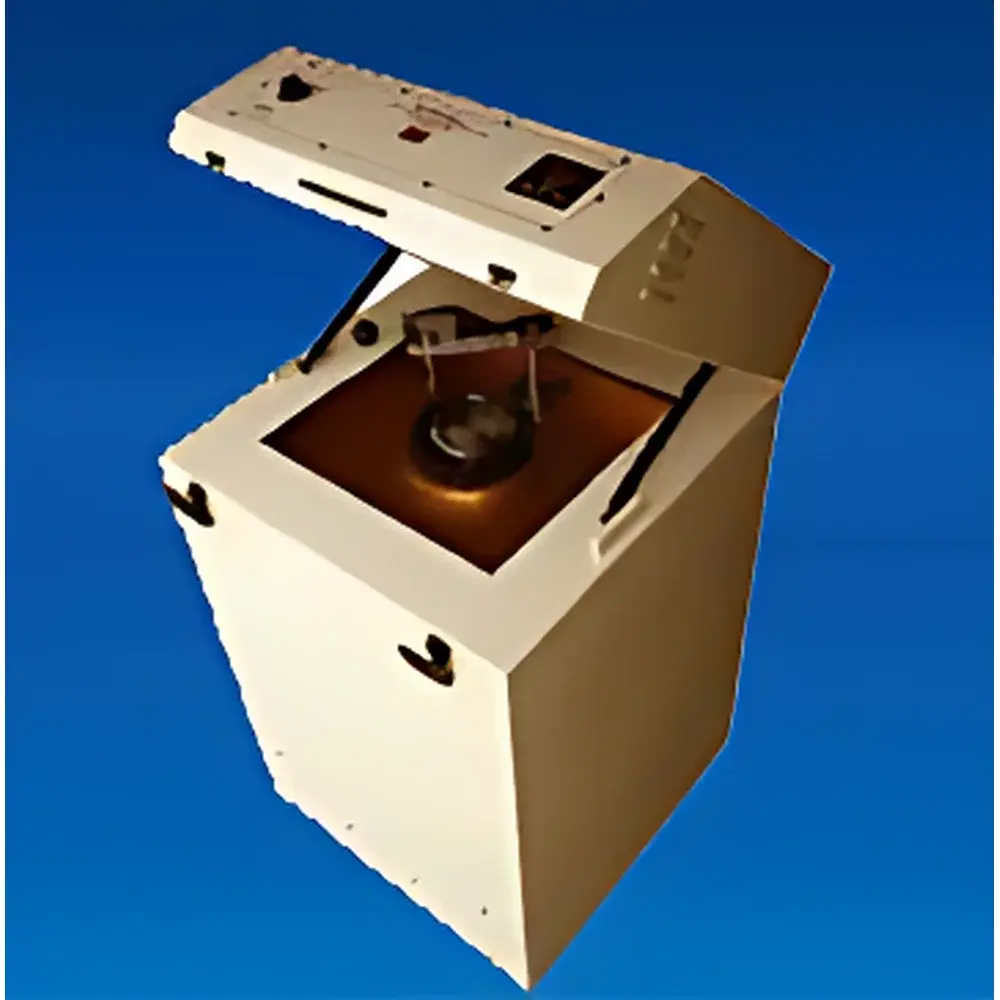
GyralGrinder™ Model 5000 Laboratory High-Energy Planetary Ball Mill
| Brand | Chemplex |
|---|---|
| Origin | USA |
| Model | 5000 |
| Grinding Disc Options | Hardened Steel (5050), Tungsten Carbide (5060), Zirconia Ceramic (5070) |
| Distribution Type | Authorized Distributor |
| Import Status | Imported Equipment |
Overview
The GyralGrinder™ Model 5000 is a high-energy planetary ball mill engineered for reproducible, controlled size reduction of solid samples in analytical, quality control, and materials research laboratories. Operating on the principle of planetary motion—where grinding jars rotate eccentrically around a central axis while simultaneously revolving on their own axes—the system generates intense centrifugal and Coriolis forces that drive efficient particle attrition, impact, and shear. This dual-motion architecture enables rapid, uniform comminution of brittle, fibrous, or moderately tough materials into sub-micron or nanoscale powders without significant thermal degradation, provided appropriate cooling protocols are applied. Designed for routine use in regulated environments, the Model 5000 complies with mechanical safety standards for laboratory milling equipment (IEC 61000-3-2, EN 61000-6-2) and integrates seamlessly into workflows requiring sample homogenization prior to XRD, SEM-EDS, ICP-MS, or elemental analysis.
Key Features
- Planetary drive mechanism delivering up to 70 g acceleration at maximum rotational speed—optimized for scalable energy input across jar volumes (10–250 mL)
- Interchangeable grinding disc assemblies (Model 5050, 5060, 5070) supporting application-specific wear resistance and contamination control
- Hardened steel discs (5050) for general-purpose pulverization of oxides, carbonates, and polymers
- Tungsten carbide discs (5060) for high-hardness materials including silicates, alloys, and refractory ceramics
- Zirconia ceramic discs (5070) ensuring ultra-low metal leaching and chemical inertness during processing of pharmaceutical actives or catalyst precursors
- Programmable digital timer (0.1–999.9 min) with automatic shutdown and audible alert
- Robust cast-aluminum housing with vibration-dampening feet and integrated safety interlock preventing operation with lid unlatched
- Compliance-ready design: CE-marked, RoHS-compliant, and compatible with GLP documentation requirements for audit trails when paired with external logging systems
Sample Compatibility & Compliance
The GyralGrinder™ Model 5000 accommodates dry, wet, and cryogenic grinding protocols. Sample types include but are not limited to: inorganic salts, metal oxides, geological specimens, plant tissues, pharmaceutical tablets, battery cathode materials, and polymer composites. Jar materials (stainless steel, agate, zirconia, PTFE-lined) are selected based on compatibility with disc composition and analyte sensitivity. For regulated applications—including USP , ASTM E1941 (Standard Test Method for Determining Particle Size Distribution of Powders by Laser Diffraction), and ISO 13320—the instrument supports traceable process parameters (time, speed, disc material, jar fill ratio) essential for method validation. While the unit itself does not embed electronic records, its operational consistency meets baseline requirements for FDA 21 CFR Part 11 compliance when operated within validated SOPs and documented manually or via third-party LIMS integration.
Software & Data Management
The Model 5000 operates via an embedded microcontroller interface with no proprietary software dependency. All operating parameters—grinding time, rotation direction (forward/reverse), and pause intervals—are set directly on the front-panel keypad. No firmware updates or cloud connectivity are required; configuration persistence is maintained through non-volatile memory. For laboratories implementing electronic lab notebooks (ELN) or LIMS, parameter logs can be exported manually or captured via optional RS-232/USB data logger modules (sold separately). Audit trail generation follows institutional GLP/GMP policies, with timestamped operator entries recommended for critical batches. Chemplex provides calibration certificates for disc mass tolerance (±0.5 g) and rotational speed verification (±1 rpm) upon request.
Applications
- Preparation of homogeneous powder blanks for X-ray fluorescence (XRF) and wavelength-dispersive spectroscopy (WDS)
- Size reduction of catalyst supports prior to BET surface area analysis
- Homogenization of heterogeneous geological samples for multi-element ICP-OES quantification
- Production of nanostructured precursors for solid-state battery electrode synthesis
- Routine disintegration of pharmaceutical dosage forms for dissolution testing per USP
- Generation of reference standards with certified particle size distributions for laser diffraction instrument qualification
FAQ
What grinding disc material should I select for aluminum alloy samples?
For non-ferrous metals such as aluminum alloys, tungsten carbide discs (Model 5060) are recommended to minimize cross-contamination and ensure consistent wear resistance without excessive abrasion of the sample matrix.
Can the Model 5000 perform cryogenic grinding?
Yes—when used with stainless steel or zirconia jars pre-chilled in liquid nitrogen, the system supports cryo-milling of thermolabile organics and elastomers. Ensure jar sealing integrity and allow for thermal equilibration before initiating rotation.
Is speed calibration traceable to NIST standards?
Chemplex provides factory calibration reports verifying rotational speed accuracy against NIST-traceable tachometric references. Recalibration services are available annually through authorized service centers.
Does the unit meet electrical safety requirements for EU laboratories?
Yes—the Model 5000 carries CE marking under the Machinery Directive 2006/42/EC and Low Voltage Directive 2014/35/EU, with full conformity assessment documentation supplied with each shipment.



