
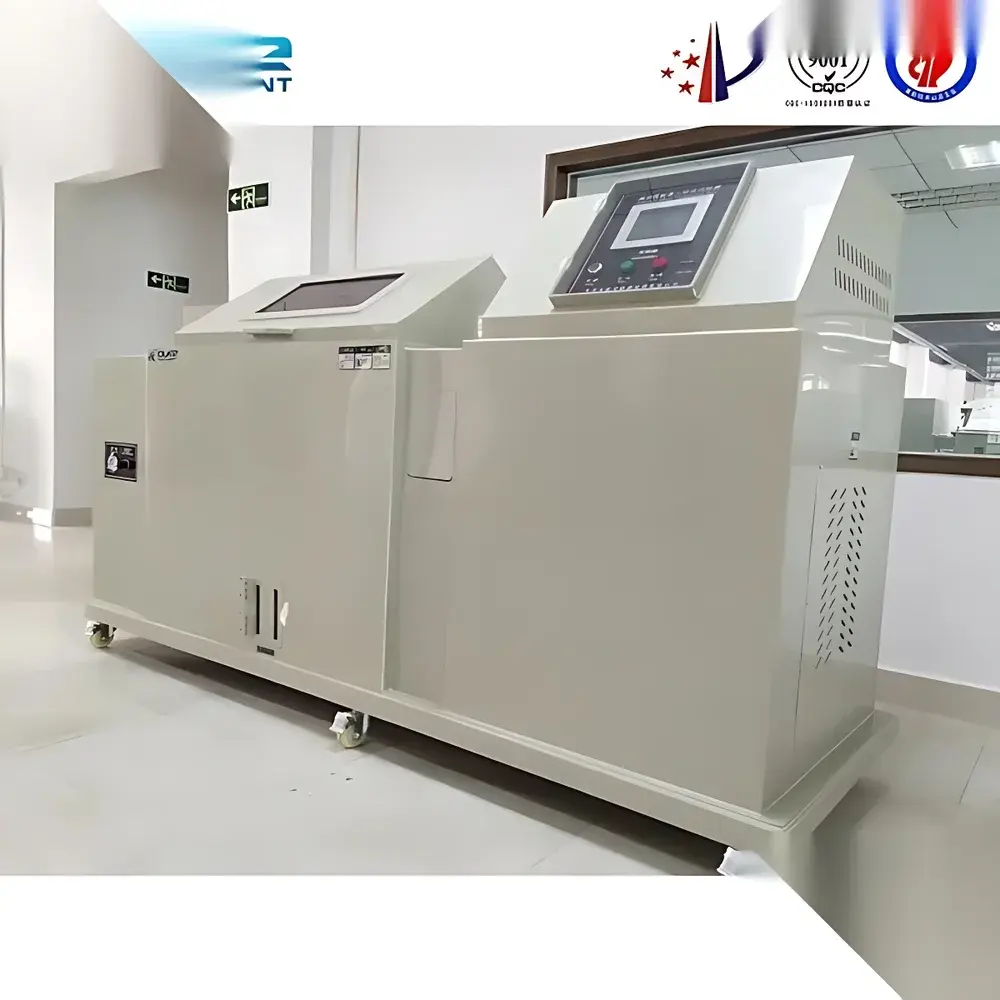
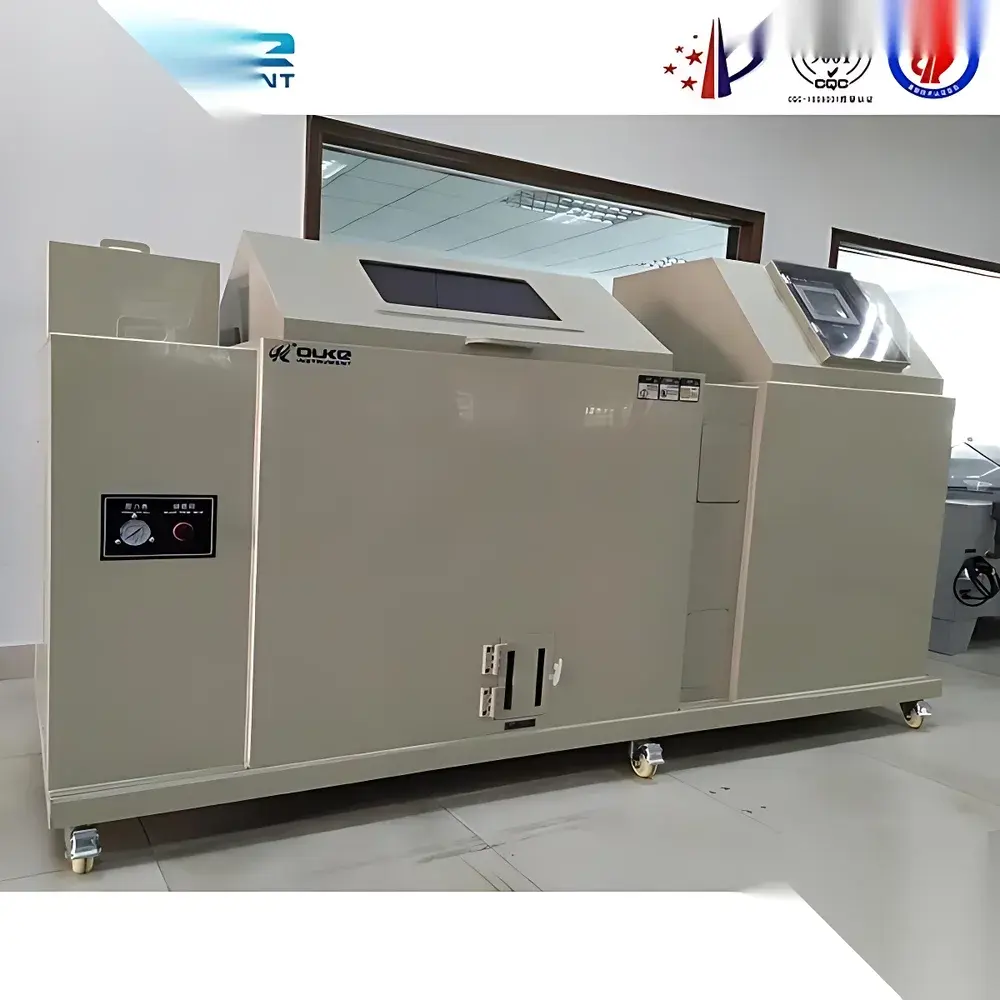
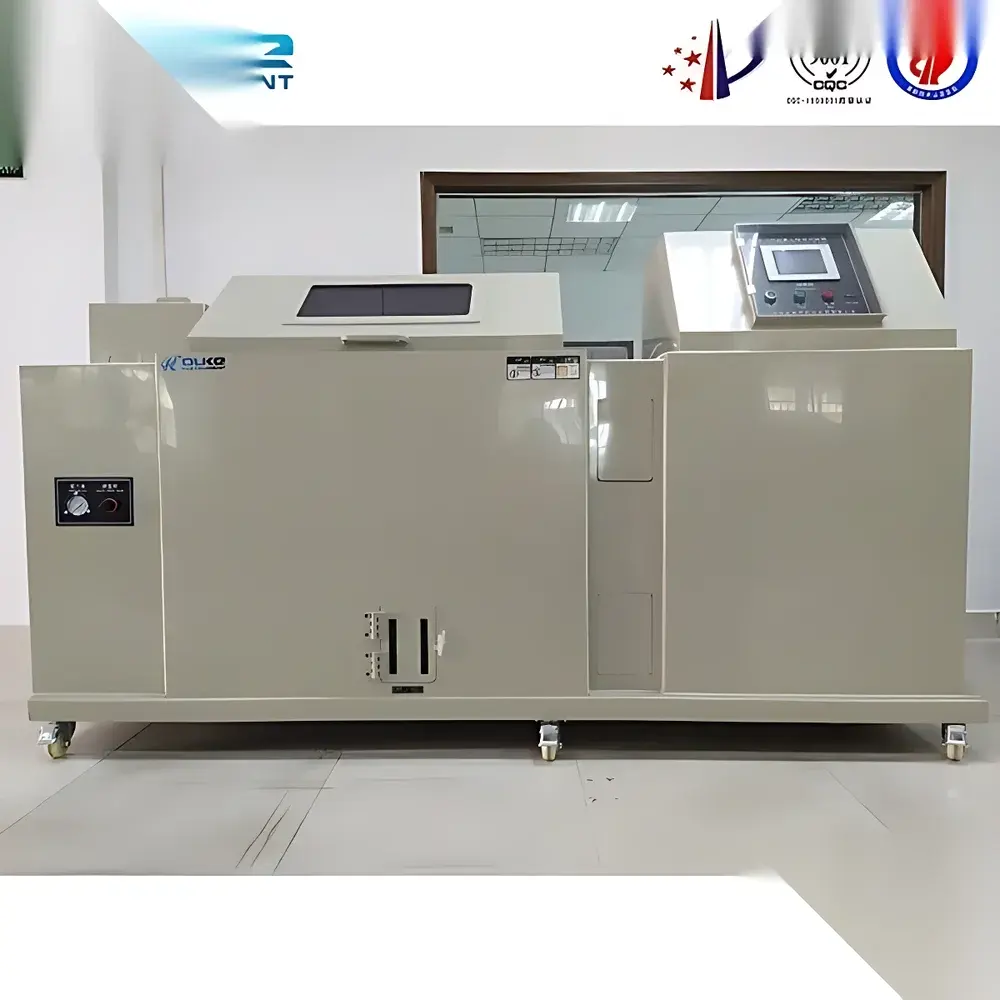
Multi-Environmental Test Chamber for Combined Temperature, Humidity, and Salt Spray Testing
| Brand | OEM / Custom Brand |
|---|---|
| Origin | Imported |
| Supplier Type | Authorized Distributor |
| Price | USD 21,000 (FOB) |
| Power Supply | 380 VAC, 3-phase, 100 A |
| Operating Time Timer | 0–999 hours |
| Control Interface | Touchscreen HMI with RS232 port |
| PID Control | 9 independent sets with auto-tuning |
| Saturation Tower | Heated, oil-removal, humidity-conditioned air supply |
| Spray Mode | Pneumatic atomization (continuous or intermittent) |
| Compressed Air Regulation | Precision pressure-reducing valve + solenoid shutoff valve |
| Safety Protections | Low-water-level, over-temperature, over-current, visual alarm indicators |
Overview
The Multi-Environmental Test Chamber for Combined Temperature, Humidity, and Salt Spray Testing is an integrated corrosion and environmental stress validation system engineered for rigorous compliance testing of metallic coatings, automotive components, aerospace fasteners, and electronic enclosures. It simultaneously or sequentially subjects test specimens to controlled thermal cycling, relative humidity modulation, and neutral salt spray (NSS), acidic salt spray (ASS), or copper-accelerated acetic acid salt spray (CASS) per ASTM B117, ISO 9227, JIS Z2371, and GB/T 2423.17. The chamber employs a dual-loop control architecture: one closed-loop system governs chamber temperature and humidity via refrigeration, steam humidification, and precision PID-driven heating; the second manages salt fog generation through pneumatic atomization of NaCl solution under thermally saturated, oil-free compressed air—ensuring stable droplet size distribution (median diameter ≈ 1–3 µm) and uniform deposition rate (1.0–2.0 mL/80 cm²/h). Its robust stainless-steel interior (SUS316L) and corrosion-resistant insulation eliminate cross-contamination between test phases and support long-term repeatability across thousands of operational hours.
Key Features
- Intuitive touchscreen HMI with bilingual (English/Chinese) interface supporting direct parameter entry, real-time SV/PV monitoring, and graphical program curve visualization
- Programmable multi-segment test profiles with up to 99 cycles, segment-wise ramp/soak control, and remaining time/cycle count display
- Dedicated salt spray subsystem featuring heated saturation tower, automatic oil filtration, and dew-point-matched air conditioning for consistent fog density and pH stability
- Independent PID tuning for temperature, humidity, and spray pressure—each with 9 user-configurable parameter sets and auto-tuning capability
- Comprehensive safety architecture: low-reservoir detection, over-temperature cutoff (dual-stage), phase-loss protection, and visual/audible alarm indicators for all critical faults
- RS232 serial communication port compliant with Modbus RTU protocol for integration into centralized lab management systems and automated data logging
Sample Compatibility & Compliance
This chamber accommodates standard test panels (150 mm × 70 mm), threaded fasteners, PCB assemblies, painted substrates, and sealed housings up to 1,200 L internal volume. All operational modes conform to internationally recognized test standards including ASTM B117 (neutral salt spray), ISO 9227 (corrosion testing in artificial atmospheres), IEC 60068-2-52 (cyclic salt mist), and MIL-STD-810H Method 509.5. The system supports GLP-compliant operation when paired with external audit-trail-capable software—enabling full traceability of setpoints, deviations, alarm events, and operator actions per FDA 21 CFR Part 11 requirements. Calibration certificates for temperature (±0.3°C), humidity (±2% RH), and spray deposition rate are available upon request and traceable to NIST or PTB standards.
Software & Data Management
While the onboard controller provides local data storage for up to 30 days of continuous event logs (including timestamps, setpoint deviations, and alarm triggers), optional PC-based software enables remote supervision, automated report generation (PDF/CSV), and trend analysis of chamber performance metrics. The software supports scheduled backups, role-based user access control, and electronic signature workflows—facilitating alignment with ISO/IEC 17025 accreditation requirements for testing laboratories. All stored data includes immutable metadata: test ID, operator ID, start/end timestamps, firmware revision, and calibration status flags.
Applications
This chamber serves quality assurance labs conducting accelerated corrosion validation for electroplated zinc-nickel coatings on automotive brake calipers; evaluating moisture ingress resistance of IP67-rated LED driver enclosures; verifying coating adhesion durability on marine-grade aluminum alloys per DNV-GL specifications; and performing cyclic environmental stress screening of medical device housings prior to ISO 10993 biocompatibility assessment. It is routinely deployed in Tier-1 supplier validation centers, third-party certification bodies (e.g., SGS, TÜV Rheinland), and R&D departments developing next-generation anti-corrosion surface treatments.
FAQ
What salt spray concentrations can be configured?
Standard configurations support 5% NaCl (NSS), 5% NaCl + 0.26 mL/L glacial acetic acid (ASS), and 5% NaCl + 0.26 mL/L glacial acetic acid + 0.5 g/L CuCl₂·2H₂O (CASS). Custom formulations require verification of nozzle compatibility and saturation tower material limits.
Is the chamber suitable for testing electronics with active power input?
Yes—optional through-wall feedthroughs (IP65-rated) and isolated DC/AC power ports allow powered-in testing under environmental stress, provided specimen thermal dissipation remains within chamber cooling capacity.
How is humidity accuracy maintained during salt spray operation?
The chamber utilizes a dedicated humidity sensor located downstream of the saturation tower but upstream of the fog nozzles, combined with real-time compensation algorithms that adjust steam output based on measured air saturation level and chamber load dynamics.
Can test programs be exported/imported between units?
Yes—via USB memory stick or RS232 transfer, using a proprietary binary format compatible across firmware versions v3.2 and above.
What maintenance intervals are recommended for the saturation tower?
Daily visual inspection of water level and filter integrity; monthly cleaning of heater elements and condensate traps; annual replacement of activated carbon and desiccant media in the air purification module.



