
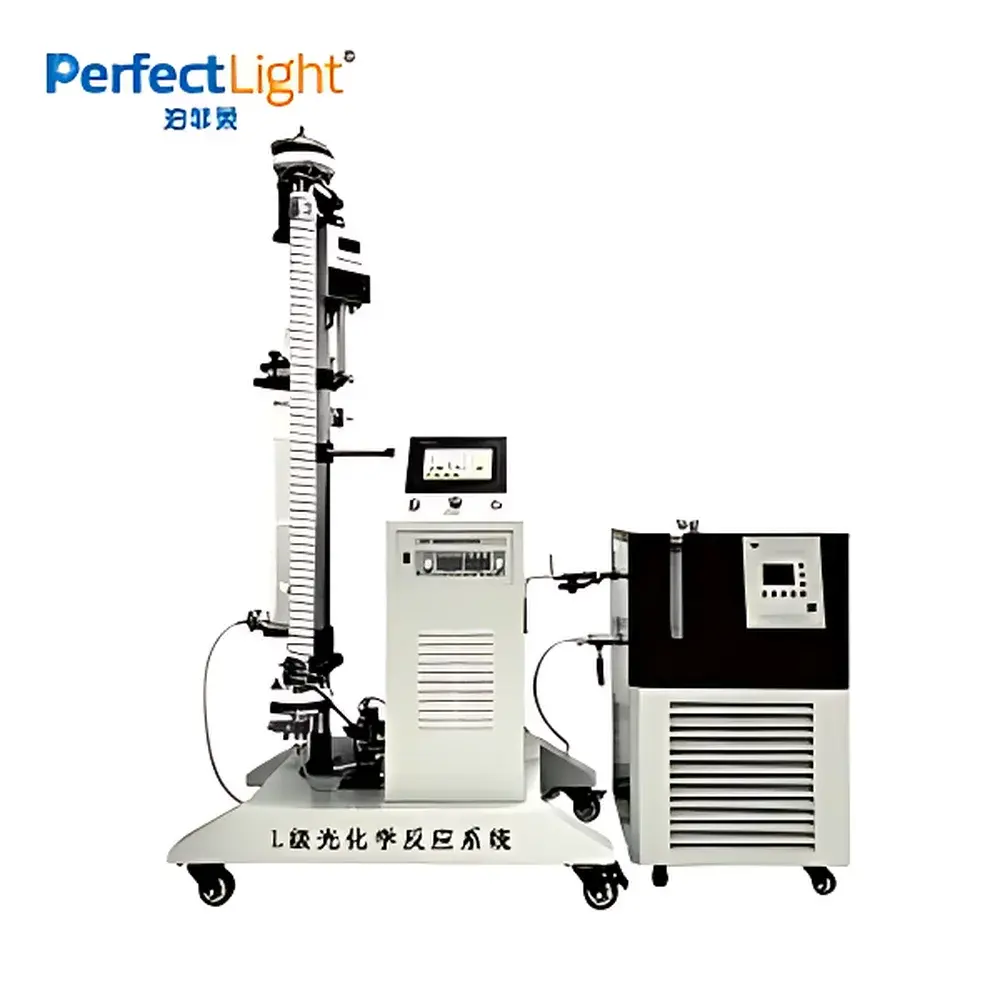
PerfectLight L-Series Photoreactor System
| Brand | PerfectLight |
|---|---|
| Origin | Beijing, China |
| Model | L-Series |
| Reactor Type | Flow-through Photochemical Reactor |
| Construction Material | Borosilicate Glass |
| Operating Pressure | Medium-pressure (up to 0.6 MPa) |
| Reaction Volume | 1.2 L (photoreaction tube), 5 L (feed reservoir) |
| Tube Inner Diameter | 40 mm |
| Standard Wavelength | 240 nm |
| Standard Light Power | 600 W (flexible LED) |
| Max Flow Velocity | ≤0.65 m/s |
| Temperature Range | Ambient (with dual water-jacket cooling) |
| Compliance | Designed for GLP-compliant photoreaction development and scale-up studies |
Overview
The PerfectLight L-Series Photoreactor System is an engineered flow-through photochemical synthesis platform designed for laboratory-to-pilot-scale translation of light-driven chemical transformations. Based on the principles of photon flux-controlled continuous-flow photochemistry, the system enables precise irradiation of reaction mixtures under controlled residence time, temperature, and mass transfer conditions. Unlike batch photochemical reactors—where photon penetration depth, thermal gradients, and mixing inefficiencies limit scalability—the L-Series employs a tubular borosilicate glass photoreaction module with integrated optical coupling and axial flow dynamics to ensure uniform photon delivery and high quantum yield reproducibility. Its design directly addresses key bottlenecks in photomediated C–X bond formation, [2+2] cycloadditions, decarboxylative couplings, and photocatalytic redox processes, making it particularly suitable for process development workflows aligned with ICH Q5, Q8, and Q9 guidelines.
Key Features
- High-intensity, spectrally tunable flexible LED array (standard 240 nm, customizable from 200–780 nm) with >15,000-hour rated lifetime and stable radiant output (±2% over 1,000 h).
- Dual-light-source configuration option: supports independent spectral control for sequential or orthogonal photochemical steps—e.g., primary excitation followed by secondary sensitization—enabling two-stage cascade reactions in a single integrated flow path.
- L-series continuous-flow tubular reactor (1.2 L active volume, 40 mm ID) featuring internal static mixing elements to suppress concentration boundary layers and minimize localized over-irradiation or hot-spot–induced side reactions.
- Modular dual-cooling architecture: simultaneous water-jacketed cooling of both the feed reservoir (5 L capacity, optionally light-equipped) and the photoreaction tube maintains isothermal operation across extended run times (≥24 h).
- Compatibility with heterogeneous reaction media: validated for liquid–liquid biphasic systems (e.g., aqueous/organic), solid-catalyzed suspensions (e.g., TiO₂, Ru(bpy)₃²⁺ immobilized on silica), and gas–liquid interfaces (e.g., O₂- or CO-saturated flows via mass-flow-controlled sparging).
- Real-time process monitoring: integrated flow meters, temperature sensors (PT100), and optional inline UV-Vis absorbance probes enable closed-loop feedback for residence time adjustment and endpoint detection.
Sample Compatibility & Compliance
The L-Series accommodates substrates ranging from small-molecule pharmaceutical intermediates (e.g., aryl halides, diazonium salts) to polymeric photosensitizers and nanoparticle dispersions. All wetted parts are constructed from ASTM E438 Type I, Class A borosilicate glass (e.g., Schott D263 or equivalent), ensuring chemical resistance to strong acids, bases, and halogenated solvents under medium-pressure operation (rated up to 0.6 MPa). The system supports documentation traceability per FDA 21 CFR Part 11 requirements when paired with PerfectLight’s optional audit-trail-enabled control software. It meets ISO 14001 environmental handling standards for solvent containment and complies with CE machinery directive 2006/42/EC for electrical safety and mechanical integrity.
Software & Data Management
Control is executed via a dedicated industrial-grade HMI interface with Ethernet connectivity and OPC UA protocol support. All operational parameters—including LED intensity (%), flow rate (mL/min), jacket temperature (°C), and cumulative irradiation dose (Einstein/L)—are timestamped and stored locally with ≥1-year retention. Export formats include CSV and HDF5 for integration with LIMS platforms (e.g., LabWare, Thermo Fisher SampleManager) and kinetic modeling tools (e.g., MATLAB Reaction Engineering Toolbox, Chemkin-Pro). Audit logs record user login, parameter changes, emergency stops, and calibration events—fully compliant with ALCOA+ data integrity principles.
Applications
- Process development of photoredox-catalyzed API syntheses (e.g., late-stage fluorination, asymmetric α-alkylation).
- Scale-up studies for continuous-flow singlet oxygen ene reactions in fine chemical manufacturing.
- Photocatalytic degradation kinetics of emerging contaminants (e.g., PFAS, pharmaceutical residues) under simulated solar spectra.
- Method qualification for USP photostability testing of drug substances under ICH Q1B conditions.
- Reaction mechanism elucidation via time-resolved spectroscopic coupling (e.g., inline fluorescence quenching assays).
FAQ
What pressure rating does the L-Series photoreactor support?
The system is rated for continuous operation at up to 0.6 MPa (6 bar) with standard borosilicate glass components; higher-pressure configurations require quartz tubing and reinforced fittings (available upon request).
Can the system be integrated with existing automation infrastructure?
Yes—it provides Modbus TCP and analog 4–20 mA I/O for PLC-level integration, and supports custom API endpoints for Python- or LabVIEW-based orchestration.
Is the 240 nm LED source ozone-generating?
At 240 nm, ozone generation is minimal (<0.01 ppm in sealed recirculation mode); optional catalytic ozone destruct units are available for extended operation in confined environments.
How is photon flux calibrated and maintained over time?
Each LED module undergoes NIST-traceable spectral radiometric calibration prior to shipment; users may perform field verification using a calibrated photodiode sensor (e.g., Thorlabs S120VC) mounted at the reactor inlet port.
Does the system meet GMP requirements for clinical trial material synthesis?
While the base configuration supports GLP-aligned development, full GMP compliance requires IQ/OQ/PQ validation packages, URS documentation, and 21 CFR Part 11-compliant software—available as optional service modules.



