
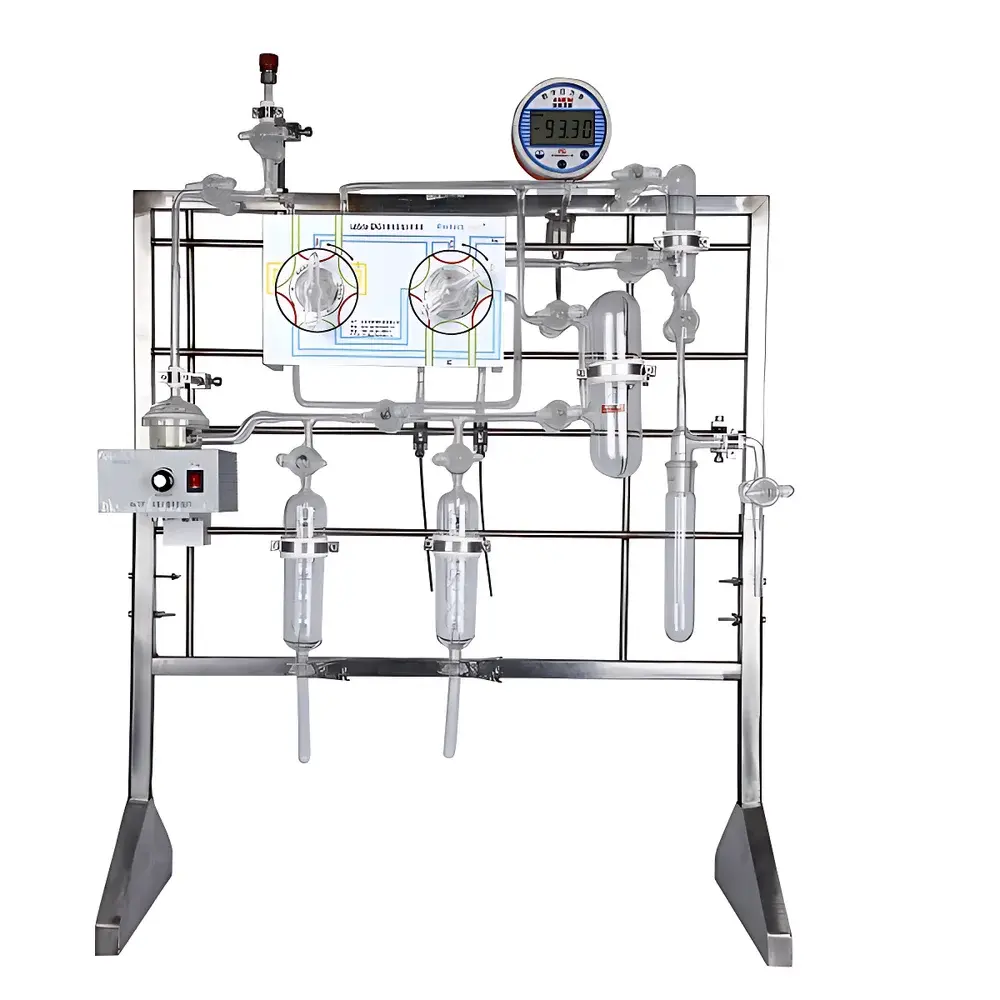
Perfetlight Labsolar-IIIAG Photocatalytic Water Splitting and CO₂ Reduction Reaction System
| Brand | Perfetlight |
|---|---|
| Model | Labsolar-IIIAG |
| Origin | Beijing, China |
| Construction | All-glass vacuum-sealed reactor system |
| Gas Circulation | Passive magnetic-drive high-speed loop (≥4000 rpm) |
| Sampling | Manual online sampling with 1.5 mL borosilicate glass quantitative loop |
| Vacuum Performance | ≤0.1 MPa absolute pressure, leak rate ≤1 kPa/24 h |
| Compliance | Designed for ISO/IEC 17025-aligned photocatalytic testing environments |
| Software Interface | Standalone hardware control (no embedded software) |
| Regulatory Context | Supports GLP-compliant experimental documentation when integrated with audit-trail-enabled chromatography data systems (e.g., Chromeleon, OpenLab CDS) |
Overview
The Perfetlight Labsolar-IIIAG is a fully enclosed, all-glass photocatalytic reaction system engineered for quantitative gas-phase analysis in solar-driven water oxidation and CO₂ reduction studies. It operates on the principle of closed-loop gas recirculation combined with real-time sampling for downstream chromatographic quantification—enabling precise measurement of O₂ evolution, H₂ generation, and hydrocarbon products (e.g., CH₄, CO, C₂H₆) under simulated or natural illumination. Unlike metal-bodied reactors, its monolithic borosilicate glass architecture eliminates catalytic surface adsorption, metal ion leaching, and electrochemical interference—critical for maintaining stoichiometric fidelity in quantum yield calculations and mechanistic studies. The system is not a standalone analytical instrument but a rigorously validated reaction platform designed to interface with gas chromatographs (GC-TCD/FID), mass spectrometers (GC-MS), or infrared gas analyzers (NDIR), supporting both batch and semi-continuous operation modes.
Key Features
- All-borosilicate-glass construction ensures chemical inertness across pH 0–14 and thermal stability from –40 °C to +200 °C; eliminates trace-metal contamination and surface recombination artifacts.
- Passive magnetic-coupled circulation pump: no electrical wiring inside the gas path, eliminating spark hazards in H₂/O₂ atmospheres and preventing electrolytic hydrogen generation during photoelectrochemical operation.
- Dual seven-port sampling manifold enables sequential, non-cross-contaminating gas withdrawal while maintaining system integrity—prevents carrier gas dilution errors during multi-point kinetic profiling.
- Optimized flow dynamics: minimum internal tubing diameter of 3 mm reduces backpressure and laminar resistance, ensuring uniform residence time distribution and minimizing dead-volume-induced dispersion.
- Integrated spherical condenser and cold trap prevent water vapor ingress into GC columns or vacuum pumps, extending column lifetime and improving baseline stability during long-duration experiments (≥72 h).
- 13 precision-ground glass stopcocks with matched bore geometry (tolerance ±0.5 µm) ensure repeatable sealing performance and minimal outgassing—validated per ASTM E1556 for vacuum integrity.
Sample Compatibility & Compliance
The Labsolar-IIIAG accommodates standard quartz or Pyrex photochemical reactors (e.g., top-irradiated cylindrical cells, side-illuminated flat-panel modules) and supports custom electrode integration for photoelectrocatalytic configurations. Its 250 mL expansion reservoir permits controlled CO₂ dosing and pressure modulation up to ambient gauge pressure. System-level compliance includes adherence to ISO 10678:2010 (photocatalytic air purification testing methodology), ASTM E2937-21 (quantum yield determination for water splitting), and USP guidelines for analytical instrument qualification when coupled with validated GC systems. Vacuum integrity (≤1 kPa/24 h drift) meets ICH Q5C stability protocol requirements for inert-atmosphere storage validation.
Software & Data Management
The Labsolar-IIIAG is hardware-centric with no embedded firmware or proprietary control software. All operational parameters—including valve sequencing, sampling timing, and vacuum actuation—are manually executed via tactile glass stopcocks and mechanical vacuum gauges. This design intentionally avoids digital control surfaces to eliminate electromagnetic interference (EMI) with sensitive photodetectors or lock-in amplifiers. For traceable data capture, users integrate the system with externally validated chromatography data systems (CDS) compliant with FDA 21 CFR Part 11 (e.g., Thermo Fisher Chromeleon, Agilent OpenLab CDS), enabling electronic signatures, audit trails, and raw-data archiving. Calibration curves (R² > 0.999 over 100 μL–10 mL H₂ range) are generated using certified NIST-traceable gas standards.
Applications
- Quantitative assessment of apparent quantum yield (AQY) in UV–vis–NIR photoactive materials (e.g., g-C₃N₄, BiVO₄, perovskite oxides) under AM 1.5G illumination.
- Kinetic modeling of CO₂ photoreduction pathways via time-resolved product speciation (CO, CH₄, C₂H₄, CH₃OH) using GC-FID/MS coupling.
- Long-term stability testing of photocatalysts under cyclic illumination/dark conditions, with gas composition monitored at intervals up to 168 hours.
- Isotopic labeling experiments (e.g., H₂¹⁸O, ¹³CO₂) requiring ultra-low background contamination—enabled by zero-metal-path architecture and Dow Corning high-vacuum grease (vapor pressure <1×10⁻⁶ Torr).
- Photoelectrochemical cell evaluation where Faradaic efficiency must be decoupled from parasitic H₂ evolution—achieved via spatial separation of counter-electrode and catalyst bed.
FAQ
Does the Labsolar-IIIAG include integrated gas detection or chromatography capabilities?
No. It is a reaction and gas-handling platform only. Quantitative analysis requires external GC, MS, or NDIR instrumentation.
Can the system operate under positive pressure or elevated temperature?
It is rated for 0 kPa(g) to ambient pressure only. Temperature operation is limited to ambient conditions unless externally jacketed; glass components are rated to 200 °C but vacuum seals and grease limit practical use to ≤80 °C.
What maintenance is required for long-term vacuum integrity?
Dow Corning high-vacuum grease should be reapplied to ground-glass joints every 6 months under continuous use; valve seats require re-lapping after ~500 cycles to maintain ≤1 kPa/24 h leakage specification.
Is customization available for reactor geometry or optical port configuration?
Yes—Perfetlight offers OEM engineering support for bespoke quartz reactor integration, collimated light inlet modifications, and auxiliary thermocouple feedthroughs under NDA.
How is calibration traceability established for gas quantification?
Users perform external calibration using certified reference gases (e.g., Air Liquide CertiGas™) and validate linearity per ISO/IEC 17025 Clause 5.10 prior to each experimental campaign.






