
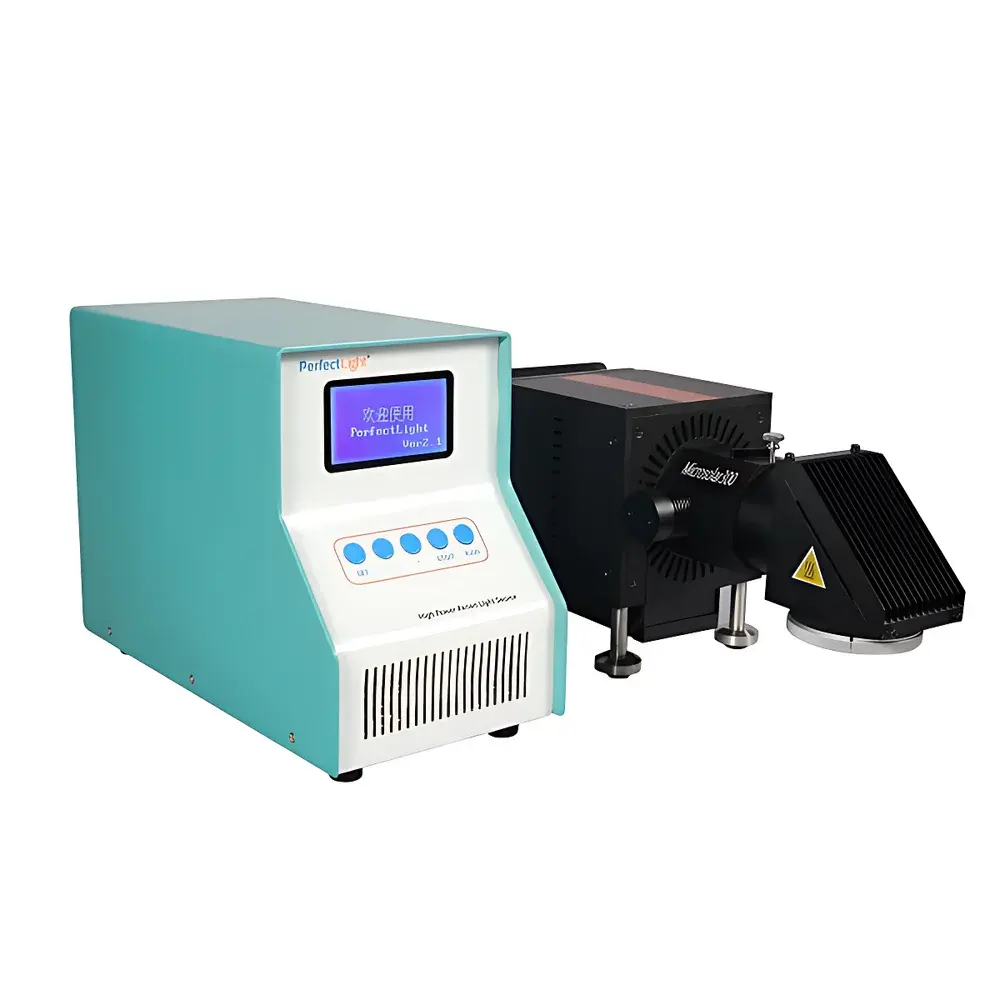
PerfectLight PL-X300D External Illumination Xenon Light Source
| Brand | PerfectLight |
|---|---|
| Origin | Beijing, China |
| Model | PL-X300D |
| Light Source Type | Xenon Arc Lamp |
| Illumination Mode | External (Top-Down or Side-Illumination) |
| Total Optical Power | 50 W (Visible: 19.6 W, UV: 2.6 W) |
| Spectral Range | 320–780 nm (extendable to 2500 nm with optional filters) |
| Beam Divergence | ~6° (average) |
| Spot Diameter | Adjustable between 30–60 mm working distance |
| Long-Term Stability | ≤ ±3% over 8 h (measured via integrated optical feedback) |
| Lamp Lifetime | >1000 h under standard photocatalytic operating conditions |
| Rated Lamp Power | 300 W |
| Power Adjustment Range | 150–300 W |
| Operating Current | 21 A |
| Power Supply Ripple | 200 mVp-p |
| Control Modes | Constant-Current (Programmable) and Constant-Irradiance (Optical Feedback Controlled) |
| Display | LCD showing relative irradiance value and lamp hour counter |
| Safety Features | Fan-fault protection, post-shutdown fan delay, over-current/over-load auto-cutoff, low-voltage lamp-to-power-supply cabling (no high-voltage transmission), patented integrated heat-dissipation structure (Patent No.: CN201320740323.5) |
Overview
The PerfectLight PL-X300D External Illumination Xenon Light Source is a precision-engineered optical instrument designed for reproducible, long-duration illumination in photochemical and photoelectrochemical research. It employs a stabilized 300 W short-arc xenon lamp as its primary emitter, delivering broadband radiation from the near-ultraviolet (320 nm) through the visible spectrum and into the near-infrared (up to 780 nm), with spectral extension capabilities up to 2500 nm when coupled with appropriate monochromators or bandpass filters. Its external illumination configuration enables flexible integration into custom reactor setups—including top-irradiated slurry reactors, side-illuminated PEC cells, gas-phase flow-through photoreactors, and multi-compartment electrochemical cells—without requiring optical access ports or internal lamp housing modifications. The system operates on dual control paradigms: constant-current mode for deterministic power delivery, and constant-irradiance mode enabled by real-time optical feedback via a calibrated photodiode sensor, ensuring minimal drift (< ±3% over 8 h) critical for kinetic studies demanding high temporal fidelity.
Key Features
- Integrated optical feedback loop for active stabilization of irradiance output, eliminating thermal drift and lamp aging effects during extended operation.
- LCD interface displaying real-time relative irradiance (% of nominal), cumulative lamp-on hours, and programmable timer status.
- Dual-mode digital control: programmable current regulation (21 A max) and closed-loop irradiance regulation with user-selectable setpoints.
- Patented forced-air thermal management architecture (CN201320740323.5) enabling sustained 300 W operation with uniform lamp envelope temperature distribution.
- Low-voltage DC interconnection between lamp housing and power supply unit—eliminating hazardous high-voltage cabling and enhancing lab safety compliance.
- Comprehensive electrical protection suite: over-current cutoff, thermal overload shutdown, fan-failure detection, and automatic post-operation cooling delay (≥60 s).
- Adjustable beam collimation optics yielding ~6° average divergence; spot size tunable from Ø30 mm to Ø60 mm at working distances of 30–60 mm.
Sample Compatibility & Compliance
The PL-X300D is compatible with a broad range of sample formats including quartz/glass photoreactor vessels (e.g., top-irradiated Pyrex cylinders, flat-window PEC cells), gas-phase flow reactors with transparent windows, and liquid-phase cuvettes equipped with side-access optical paths. Its external geometry supports alignment with commercial accessories such as fiber-optic couplers, monochromators (e.g., Bentham TMc300), and automated filter wheels. From a regulatory standpoint, the system adheres to IEC 61000-4 electromagnetic compatibility standards and meets UL/CSA Class I electrical safety requirements for laboratory equipment. While not intrinsically rated for explosion-proof environments, it may be deployed in certified fume hoods when used with volatile organic compounds (VOCs) or hydrogen-containing atmospheres. All firmware and control logic are designed to support GLP-compliant data logging when interfaced with external DAQ systems.
Software & Data Management
The PL-X300D operates as a standalone instrument with embedded microcontroller-based regulation—no proprietary PC software is required for basic functionality. However, analog voltage outputs (0–5 V) corresponding to relative irradiance and lamp current are provided for integration into third-party data acquisition platforms (e.g., National Instruments LabVIEW, MATLAB Data Acquisition Toolbox). Digital TTL triggers enable synchronization with shutter controllers, potentiostats, or gas chromatographs. Optional RS-232 or USB-to-serial adapters allow remote command execution (e.g., “SET CURRENT 18.5”, “START TIMER 3600”) using ASCII protocol, facilitating automation in unattended long-term experiments. Audit trails—such as lamp-on duration, mode transitions, and fault events—are stored in non-volatile memory and retrievable via serial query.
Applications
- Photocatalytic water splitting: Stable 8+ hour irradiation for H₂/O₂ evolution quantification under AM 1.5G-simulated conditions (with appropriate optical filtering).
- Photoelectrochemical (PEC) characterization: Compatible with three-electrode configurations using FTO/ITO substrates; supports transient photocurrent measurements and IPCE analysis.
- Gas-phase photocatalysis: Degradation kinetics of VOCs (formaldehyde, toluene), NOₓ, and SOₓ in continuous-flow reactors under controlled humidity and residence time.
- Aqueous-phase pollutant degradation: Monitoring first-order kinetics of dye decolorization (e.g., methylene blue, rhodamine B) and aromatic compound mineralization (e.g., phenol, benzene derivatives).
- Advanced material screening: Comparative evaluation of perovskite, g-C₃N₄, MOF, and plasmonic photocatalysts under standardized irradiance conditions traceable to NIST-calibrated reference detectors.
FAQ
What spectral output does the PL-X300D provide without filters?
The unfiltered output spans 320–780 nm, with peak intensity in the visible region (400–700 nm); UV contribution below 400 nm accounts for ~2.6 W of the total 50 W optical power.
Can the system be used for UV-only experiments?
Yes—when paired with commercially available bandpass filters (e.g., UG11 + WG320 for 320–400 nm), it delivers stable, spectrally isolated UV irradiation suitable for UV-driven photocatalysis.
Is lamp replacement a user-serviceable procedure?
Yes—the xenon lamp module is field-replaceable using standard Torx tools; alignment fixtures ensure repeatable optical coupling without recalibration.
Does the system comply with FDA 21 CFR Part 11 for electronic records?
While the base unit lacks built-in audit trail generation, its analog/digital I/O interfaces support connection to Part 11–compliant LIMS or ELN platforms that manage electronic signatures and record integrity.
What is the recommended maintenance interval?
Fan filters should be cleaned every 200 operational hours; lamp replacement is advised after 1000 h or upon observed irradiance decay exceeding 10% of initial value.






