
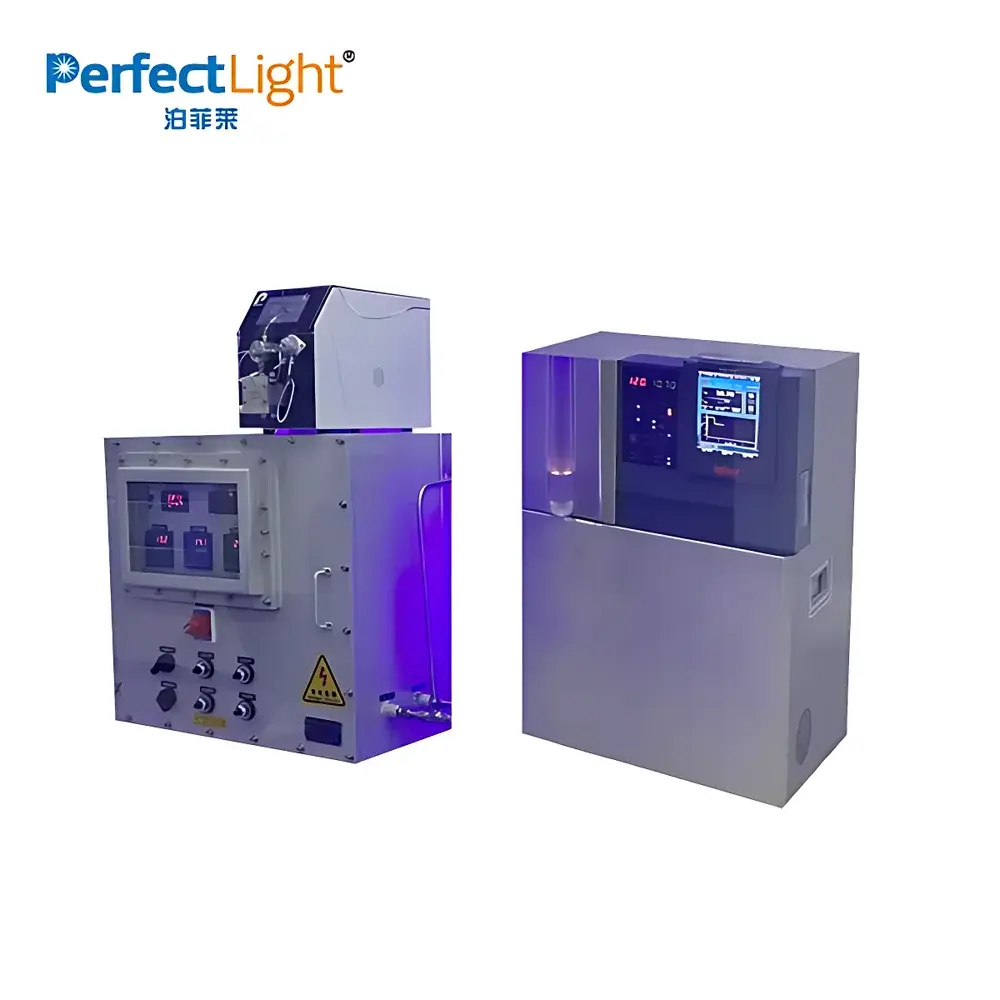
L-C Customizable Pilot-Scale Continuous Flow Photoreactor
| Brand | PerfectLight |
|---|---|
| Origin | Beijing, China |
| Model | L-C |
| Light Source Wavelength Range | 365–760 nm (multi-wavelength selectable) |
| Light Geometry | Planar illumination |
| Illumination Area | Configurable circular or square spot |
| Unit Optical Power | 1–4 kW (adjustable) |
| Temperature Control Range | −20 °C to +80 °C (high-precision PID regulation) |
| Reaction Throughput | 500 mL |
| Compatible Reaction Types | Homogeneous liquid–liquid and liquid–solid photochemical reactions |
| Liquid Channels | 3 independent flow paths |
| Maximum Liquid Flow Rate | 25 mL/min per channel (fully adjustable per reaction kinetics) |
| Dimensions (W×D×H) | 930 mm × 800 mm × 700 mm |
| Compliance | Designed for GLP-compliant photoreaction development and scale-up studies |
Overview
The L-C Customizable Pilot-Scale Continuous Flow Photoreactor is an engineered platform for controlled, reproducible photochemical synthesis under scalable laboratory conditions. Built upon continuous-flow microreactor principles with integrated high-intensity planar illumination, it enables precise spatiotemporal control over photon delivery—critical for radical-mediated transformations initiated by UV or visible light. Unlike batch photochemistry, this system decouples light exposure from residence time via independently regulated flow rates and temperature-controlled reaction zones, minimizing side reactions, thermal gradients, and photon attenuation effects. Its architecture supports systematic process intensification—from screening photocatalysts and optimizing quantum yields to validating kinetic models prior to industrial transfer. The reactor operates within a rigorously maintained thermal envelope (−20 °C to +80 °C), ensuring compatibility with cryogenic photoreductions and thermally sensitive enantioselective photocyclizations.
Key Features
- Modular planar light source delivering uniform irradiance across configurable circular or square illumination zones—eliminating hotspots and enabling direct correlation between photon flux and reaction rate.
- Three independent liquid-phase channels with digitally controlled syringe or gear-pump-driven flow (0.1–25 mL/min per line), supporting parallel reaction screening or multi-step cascade sequences without cross-contamination.
- Adjustable optical power output (1–4 kW total, per channel scalable) with wavelength-selectable LED or broadband lamp modules (365–760 nm), facilitating mechanistic studies across absorption profiles of diverse photocatalysts (e.g., Ir(III), Ru(II), organic dyes, and semiconductor nanoparticles).
- Integrated jacketed reactor cartridges with real-time PT100 temperature monitoring and closed-loop PID control—ensuring ±0.3 °C stability during exothermic photopolymerizations or endothermic C–H activation steps.
- Compact footprint (930 × 800 × 700 mm) designed for Class II biosafety cabinets or fume hood integration, with quick-release fluidic connections compliant with ASTM F2659 standards for lab-scale chemical handling.
Sample Compatibility & Compliance
The L-C photoreactor accommodates standard borosilicate glass and PFA-lined flow cells, supporting solvents ranging from hexane and THF to concentrated aqueous acid/base media (pH 1–13). It is validated for homogeneous photocatalytic oxidations (e.g., alcohol → aldehyde), [2+2] cycloadditions, decarboxylative couplings, and heterogeneous photocatalysis using immobilized TiO₂ or g-C₃N₄. All wetted materials meet USP Class VI biocompatibility requirements. System documentation includes traceable calibration records for temperature sensors and radiometric characterization reports (per ISO/IEC 17025-accredited third-party verification). The platform supports audit-ready operation under GLP and GMP-aligned workflows, including electronic logbooks with FDA 21 CFR Part 11–compliant user authentication and immutable event timestamps.
Software & Data Management
Operation is managed via the PerfectLight FlowControl Suite—a Windows-based application supporting synchronized control of flow rates, irradiance intensity, temperature setpoints, and data logging at 10 Hz resolution. Raw sensor streams (temperature, pressure, UV–Vis absorbance via optional inline spectrometer port) are stored in HDF5 format with embedded metadata (timestamp, operator ID, protocol version). Export options include CSV, MATLAB .mat, and ISA-Tab for integration into ELN systems (e.g., LabArchives, Benchling). Automated method templates allow replication of published photochemical protocols with <5% inter-run coefficient of variation in conversion yield.
Applications
- Photocatalytic C–N bond formation under blue-light irradiation for pharmaceutical intermediate synthesis.
- Scale-down validation of solar-driven water-splitting catalysts using simulated AM1.5G spectra.
- Kinetic modeling of Norrish Type I cleavage reactions via residence time distribution (RTD) analysis.
- Process safety evaluation of photoinduced peroxide accumulation in continuous ozonolysis analogues.
- High-throughput optimization of chiral photocatalyst loading and solvent effects in asymmetric α-alkylation.
FAQ
What photoreaction mechanisms are most effectively studied using the L-C platform?
Radical chain processes initiated by UV (365 nm) or visible light (405–530 nm), including energy-transfer, single-electron transfer (SET), and hydrogen-atom transfer (HAT) pathways—particularly where photon flux, thermal management, and mass transfer limitations govern selectivity.
Can the system interface with external analytical instrumentation?
Yes—standard 0–10 V analog I/O and Modbus TCP ports enable synchronization with HPLC autosamplers, FTIR flow cells, or online Raman probes for real-time reaction monitoring.
Is the reactor suitable for air-sensitive photochemistry?
When coupled with inert gas purging modules and Schlenk-line compatible fluidic manifolds, the L-C maintains O₂/H₂O levels <1 ppm throughout irradiated zones.
How is light intensity calibrated and maintained over time?
Each lamp module ships with NIST-traceable spectral irradiance certificates; onboard photodiode feedback loops auto-compensate for LED lumen depreciation, maintaining ±2% irradiance stability over 5,000 hours of operation.
Does PerfectLight provide support for method transfer to production-scale photoreactors?
Yes—application engineers supply dimensionless scaling parameters (Damköhler number, photon efficiency Φ, and volumetric mass transfer coefficient kLa) alongside DOE-derived operating envelopes for seamless transition to kilo-lab or pilot-plant continuous photoreactors.



