
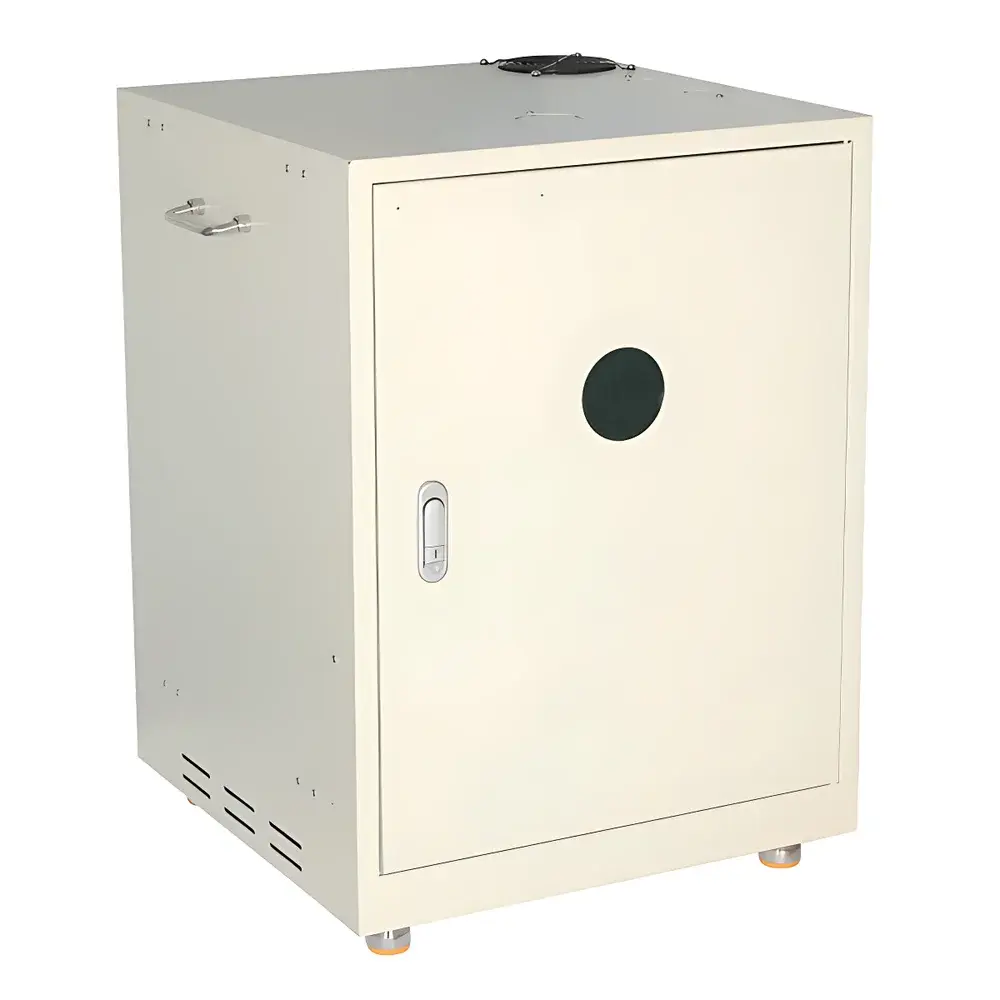
PerfectLight Lightcube2.3 Photocatalytic Reaction Enclosure
| Brand | PerfectLight |
|---|---|
| Origin | Beijing, China |
| Model | Lightcube2.3 Lightcube |
| Construction Material | Stainless Steel |
| External Dimensions | 500 mm (L) × 500 mm (W) × 600 mm (H) |
| Operating Pressure | Low-Pressure Environment |
| Volume Class | Small-Scale Laboratory Enclosure |
| Design Type | Modular, Reconfigurable Enclosure System |
| Light Source Compatibility | Universal Mounting for Internal/External Lamps (LED, Xenon, Mercury, Halogen, UV-Vis-NIR Broadband & Monochromatic Sources) |
| Application Scope | Photocatalysis, Photochemical Synthesis, Photodegradation, Parallel Photoreaction Screening |
Overview
The PerfectLight Lightcube2.3 Photocatalytic Reaction Enclosure is an engineered laboratory containment system designed specifically for safe, reproducible, and flexible execution of light-driven chemical processes under controlled ambient conditions. Unlike conventional fume hoods or open-bench photoreactor setups, the Lightcube2.3 operates as a sealed, low-pressure stainless steel enclosure that isolates photochemical reactions from ambient oxygen, moisture, and operator exposure—critical for oxygen-sensitive photocatalytic mechanisms (e.g., ROS generation, radical chain propagation) and UV-intensive protocols. Its core architecture implements a passive pressure-balanced chamber with gas inlet/outlet ports compatible with inert gas purging (N₂, Ar), enabling strict control over reactive atmospheres during irradiation. The enclosure does not incorporate active illumination; rather, it serves as a universal optical and mechanical platform—integrating seamlessly with external or internal light sources across UV–Vis–NIR spectra (254 nm to 1100 nm), supporting both collimated and diffuse irradiation geometries.
Key Features
- Modular 3D mounting grid system with standardized M6 threaded inserts on all interior vertical and horizontal surfaces—enabling rapid, tool-free positioning and fixation of reactors, stirrers, optical fibers, temperature probes, and gas manifolds.
- Patented telescopic pull-out stainless steel tray with precision linear guides and locking detents—designed for repeatable vertical repositioning (±0.5 mm repeatability) to optimize source-to-sample distance in accordance with the inverse-square law and quantum yield calibration requirements.
- Optically neutral front panel constructed from laminated borosilicate glass with UV-transmission enhancement coating (≥85% T at 365 nm; ≥92% T at 420 nm), providing real-time visual monitoring without spectral distortion or thermal lensing.
- Integrated cable management grommets (IP54-rated) and dual-side utility pass-throughs for electrical, pneumatic, and liquid lines—supporting simultaneous operation of magnetic stirrers, thermocouple feeds, condenser cooling loops, and mass flow controllers.
- Stainless steel (AISI 304) monocoque chassis with electropolished interior surfaces—ensuring corrosion resistance against halogenated solvents, acidic photocatalytic intermediates, and ozone byproducts generated during UV-C irradiation.
Sample Compatibility & Compliance
The Lightcube2.3 accommodates reaction vessels ranging from 2 mL microreactors to 500 mL jacketed photoreactors—including quartz immersion wells, Pyrex batch cells, custom 3D-printed flow reactors, and multi-well plates for high-throughput screening. It supports ISO 17025-aligned experimental workflows through traceable mounting configurations and documented light-field uniformity mapping (per IEC 60825-1 for Class 3R/3B laser safety integration). While not a certified cleanroom device, its sealed design meets GLP-relevant containment criteria for photolysis studies referenced in OECD Test Guideline 316 (Photochemical Transformation in Water) and ASTM E2051 (Standard Practice for Determining Photostability of Organic Chemicals). Gas-tight integrity is verified via helium leak testing (≤1×10⁻⁶ mbar·L/s), satisfying pre-conditioning requirements for anaerobic photocatalytic hydrogen evolution assays.
Software & Data Management
As a hardware platform—not an instrument with embedded firmware—the Lightcube2.3 requires no proprietary software. All integrated peripherals (e.g., LED drivers, gas controllers, temperature loggers) retain native communication protocols (RS-485, Modbus RTU, USB-TTL) for direct integration into LabVIEW, Python-based automation frameworks (PyVISA, pymodbus), or ELN systems such as Benchling and LabArchives. Optional accessories include calibrated irradiance sensors (SiC photodiodes traceable to NIST SRM 2271) with timestamped CSV export, enabling full audit trails compliant with FDA 21 CFR Part 11 when paired with electronic signature-capable acquisition software.
Applications
- Quantitative photocatalytic degradation kinetics of emerging contaminants (e.g., pharmaceuticals, perfluoroalkyl substances) under simulated solar irradiation.
- Screening of heterogeneous photocatalysts (TiO₂, g-C₃N₄, MOFs) under controlled O₂/H₂O partial pressures for CO₂ reduction or NOₓ abatement.
- Photoinduced C–H activation and cross-coupling reactions requiring strict exclusion of atmospheric oxygen to prevent quenching of triplet excited states.
- Parallel photoreactor arrays using modular tray extensions for statistically robust reaction optimization (DoE-compliant parameter sweeps across wavelength, intensity, and residence time).
- UV-mediated polymerization initiation in confined environments where volatile monomers or initiators demand vapor containment.
FAQ
Is the Lightcube2.3 suitable for vacuum applications?
No—it is rated for low-pressure operation only (up to −0.8 bar gauge), not high vacuum. For vacuum photolysis, supplementary vacuum-rated viewports and feedthroughs must be installed by qualified personnel.
Can it be used with pulsed laser sources?
Yes, provided beam delivery optics are mounted externally and pulse energy remains within ISO 20473 Class 3B limits. The borosilicate viewport is not rated for femtosecond pulses or >10 J/cm² fluence.
Does it include light source calibration services?
Calibration is optional and performed off-site by accredited third-party labs (e.g., NIM, PTB) using spectroradiometric methods per CIE S 026/E:2019. Certificate includes spatial irradiance maps at user-specified wavelengths.
What maintenance is required for long-term stainless steel integrity?
Monthly wipe-down with citric acid solution (2% w/v) to remove chloride residues; annual inspection of gasket compression set per ASTM D395. Electropolishing renewal recommended every 36 months in aggressive halogenated solvent environments.



