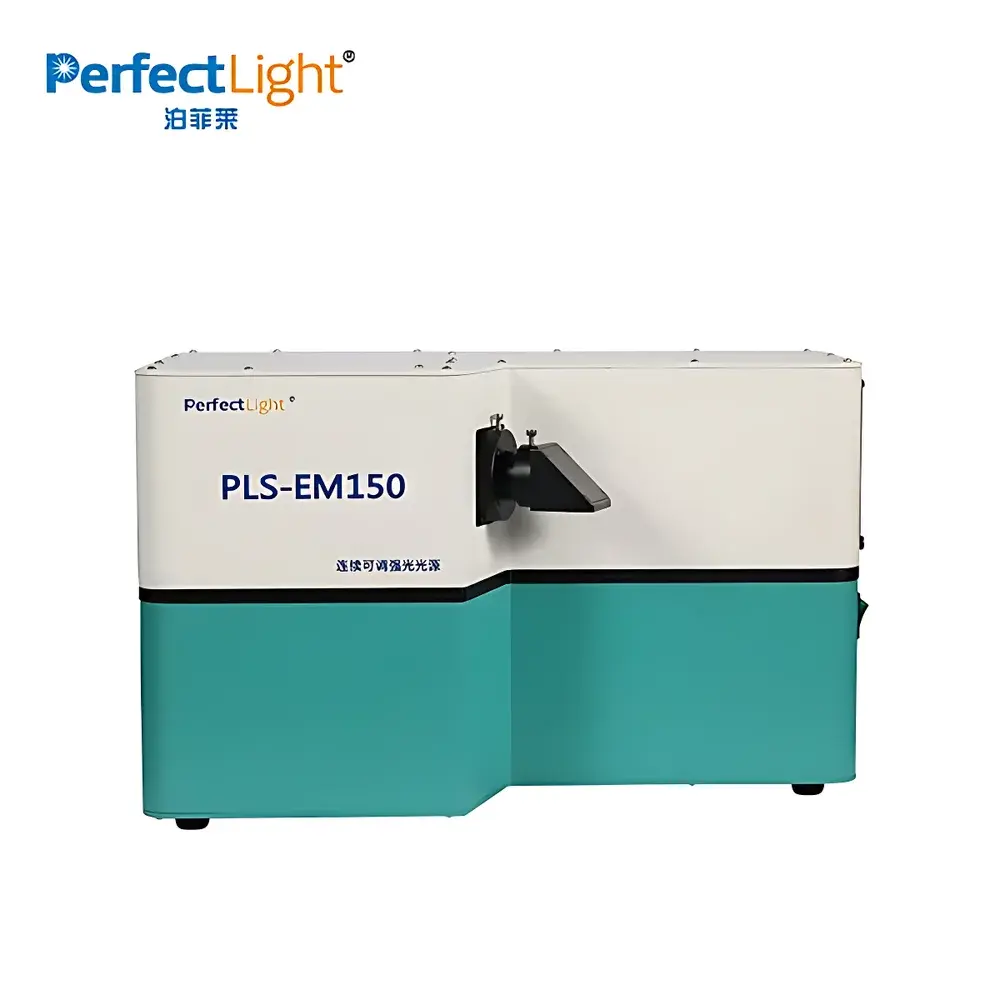
PLS-EM150 Continuous-Wavelength Tunable High-Intensity Xenon Light Source
| Brand | PerfectLight |
|---|---|
| Origin | Beijing, China |
| Model | PLS-EM150 |
| Light Source Type | Xenon Arc Lamp |
| Illumination Mode | External Irradiation |
| Electrical Power | 300 W |
| Focal Length | 150 mm |
| Wavelength Tuning Step | 1 nm |
| Grating Size | 50 × 50 mm² |
| Grating Line Density | 2400 lines/mm (multiple options available) |
| Grating Blaze Wavelength | 300 nm |
| Spectral Output Range | 350–680 nm |
| Irradiance at 470 nm | >40 mW/cm² |
| Optical Design | Integrated monochromator-light source architecture with optimized collimation and throughput |
Overview
The PLS-EM150 is a high-intensity, continuously tunable xenon-based light source engineered for quantitative photochemical and optoelectrochemical research. Unlike conventional monochromators designed for spectroscopic signal detection—where spectral purity and stray-light rejection are prioritized at the expense of irradiance—the PLS-EM150 integrates the lamp, ellipsoidal collector, monochromator optics, and output coupling into a single thermally and mechanically stabilized optical train. This co-designed architecture enables efficient photon delivery across the visible spectrum (350–680 nm), delivering irradiance exceeding 40 mW/cm² at 470 nm—sufficient to drive photocatalytic reactions, enable incident photon-to-current efficiency (IPCE) measurements, and support steady-state quantum yield determinations under controlled monochromatic excitation.
Key Features
- Integrated optical architecture: Combines a 300 W short-arc xenon lamp with a precision 150 mm focal-length ellipsoidal reflector and a high-throughput Czerny–Turner monochromator housing a 50 × 50 mm², 2400 lines/mm blazed grating (blaze at 300 nm).
- Continuous wavelength tuning with 1 nm step resolution across 350–680 nm, enabling precise selection of excitation bands for action-spectrum analysis or wavelength-dependent reaction kinetics.
- Three standardized output configurations: adjustable swivel head for direct sample irradiation, homogenizing diffuser for uniform area illumination, and SMA905 fiber-coupled port for remote or confined-space applications.
- Optimized stray-light suppression: Dual-grating design and internal baffling reduce out-of-band radiation to <10⁻⁴ relative to peak intensity, critical for distinguishing primary photochemical pathways from secondary thermal or broadband effects.
- Thermal management system: Active air cooling with temperature-stabilized housing maintains spectral stability over extended operation (>4 hours at full power), minimizing wavelength drift (<±0.2 nm) and irradiance fluctuation (<±1.5% RMS).
Sample Compatibility & Compliance
The PLS-EM150 is compatible with standard photoelectrochemical cells (e.g., three-electrode quartz cuvettes), gas-phase photoreactors (with quartz viewport integration), and thin-film solar cell test fixtures. Its external irradiation geometry supports in situ and operando configurations without optical interference from cell electrodes or electrolyte interfaces. The system meets mechanical and electrical safety requirements per IEC 61010-1:2010 for laboratory equipment. While not certified for clinical or industrial process control use, its spectral repeatability and irradiance linearity are traceable to NIST-calibrated radiometric standards when used with optional calibrated photodiode sensors (e.g., Thorlabs S120VC). Data acquisition workflows may be aligned with GLP-compliant documentation practices when paired with timestamped software logging and user-accessible audit trails.
Software & Data Management
Control is executed via USB-connected host software supporting Windows 10/11 (64-bit), offering real-time wavelength positioning, motorized slit width adjustment (10–2000 µm), and irradiance monitoring via optional integrated silicon photodiode. All parameter sets—including wavelength, slit width, lamp intensity, and exposure duration—are saved as XML-based protocol files, enabling full experimental reproducibility. Export formats include CSV (time-stamped irradiance logs), ASCII (spectral scans), and PNG (graphical previews). Software architecture supports third-party integration through TCP/IP API endpoints, facilitating synchronization with potentiostats (e.g., BioLogic SP-300), quantum efficiency systems (e.g., Enlitech QE-R), or custom LabVIEW or Python automation frameworks.
Applications
- Quantitative IPCE and external quantum efficiency (EQE) mapping of photoelectrodes and perovskite solar cells.
- Action spectrum determination for photocatalytic H₂ evolution, CO₂ reduction, and organic pollutant degradation.
- Monochromatic photolysis kinetics studies requiring stable, high-flux excitation without thermal artifact accumulation.
- Calibration and validation of spectroradiometers and reference photodetectors in the 350–680 nm range.
- Time-resolved transient absorption pump-probe experiments where tunable, high-peak-power excitation is required.
FAQ
What is the spectral irradiance stability over a 2-hour continuous run?
Irradiance drift remains within ±1.5% RMS at 470 nm under constant operating conditions; active thermal regulation prevents thermal lensing and grating misalignment.
Can the PLS-EM150 be used with liquid nitrogen-cooled detectors?
Yes—its external irradiation configuration allows unobstructed optical access to cryogenic sample stages and vacuum-compatible detector housings, provided appropriate quartz or MgF₂ windows are used for UV extension.
Is the grating interchangeable in the field?
Grating replacement requires factory recalibration due to mechanical alignment sensitivity; however, optional pre-aligned grating modules (e.g., 1200 or 3600 lines/mm variants) can be ordered for specific resolution–throughput trade-offs.
Does the system comply with FDA 21 CFR Part 11 for electronic records?
The base software does not include Part 11 compliance features (e.g., electronic signatures, role-based access control); such functionality must be implemented at the enterprise data management layer using validated third-party LIMS or ELN platforms.
What maintenance intervals are recommended for the xenon lamp?
Lamp lifetime is rated at ≥1000 hours at rated power; performance verification (wavelength accuracy, irradiance output) is recommended every 200 hours or after lamp replacement, using supplied calibration standards.