
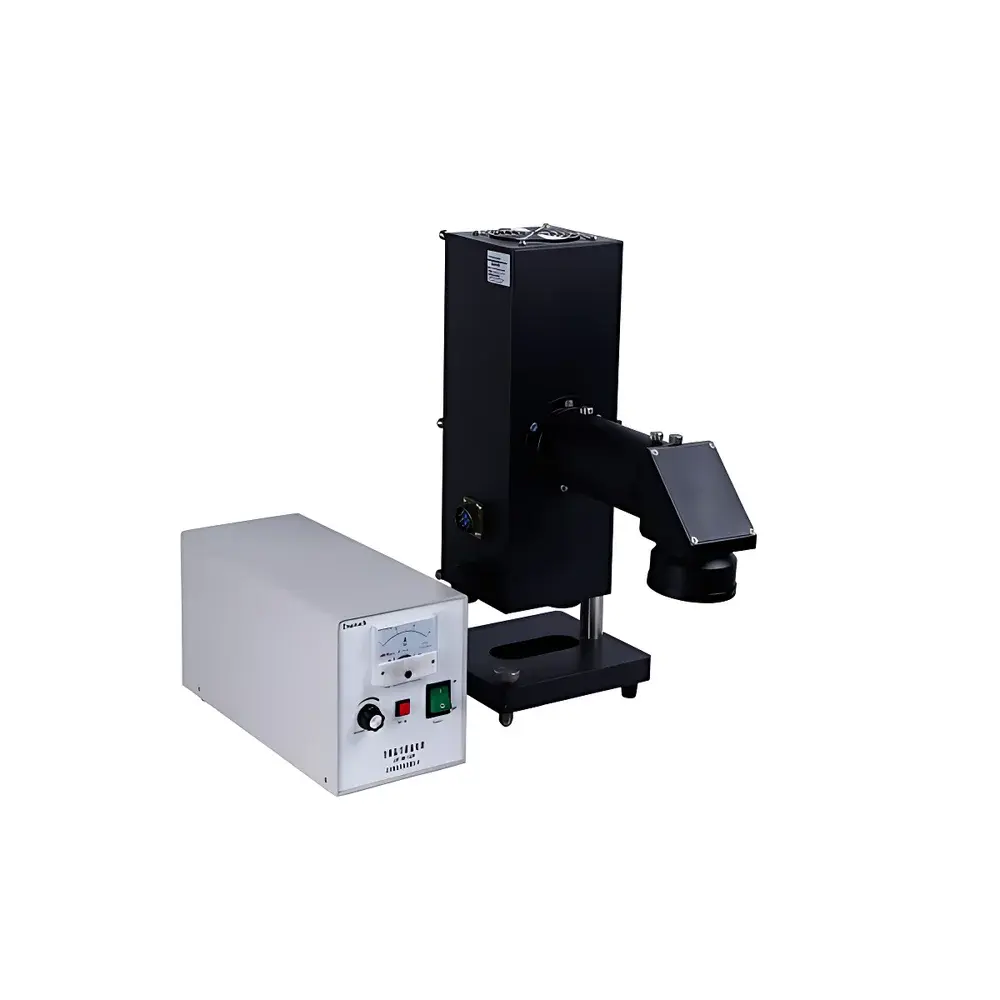
PerfectLight CHF-XM Series 250 W Mercury Arc Lamp System
| Brand | PerfectLight |
|---|---|
| Origin | Beijing, China |
| Manufacturer Type | Authorized Distributor |
| Product Origin | Domestic (China) |
| Model | CHF-XM Series |
| Pricing | Available Upon Request |
| Light Output Modes | Point Source, Collimated Beam, Fiber-Coupled Output |
| Point Source Diameter | 4–6 mm |
| Collimated Beam Diameter | 50 mm |
| Beam Divergence | ≤0.85° (at working distance < 250 mm) |
| Spectral Range | 300–1100 nm |
| Irradiance Uniformity (Φ60 mm) | ≤ ±11% |
| Local Uniformity (2 cm × 2 cm area) | ≤ ±5% |
| Focusing Capability | Adjustable between point source and Φ60 mm collimated output |
Overview
The PerfectLight CHF-XM Series 250 W Mercury Arc Lamp System is a high-stability, broadband ultraviolet–visible–near-infrared (UV-Vis-NIR) light source engineered for quantitative photochemical and photophysical experimentation. Based on a medium-pressure mercury vapor discharge lamp, it delivers intense, spectrally rich emission lines—including strong peaks at 365 nm (i-line), 405 nm (h-line), 436 nm (g-line), 546 nm, and 579 nm—enabling precise excitation across catalytic, electrochemical, and optoelectronic characterization workflows. Unlike broadband halogen or LED sources, the CHF-XM leverages the discrete line spectrum of mercury to support monochromator-coupled quantum yield measurements, action spectrum determination, and wavelength-resolved photocurrent analysis. Its optical architecture is optimized for integration into controlled-environment test stations, including vacuum-sealed PEC cells, glovebox-integrated solar simulators, and multi-instrument optical benches.
Key Features
- Three configurable output modes: adjustable point source (4–6 mm diameter), collimated beam (50 mm diameter, ≤0.85° divergence), and fiber-coupled delivery—enabling seamless adaptation to diverse optical path requirements.
- High spatial uniformity: ≤±5% local irradiance variation over a 2 cm × 2 cm active area—critical for reproducible I-V characterization of perovskite, organic, and silicon-based photovoltaic devices under standardized illumination conditions.
- Optimized collimation optics deliver ≤±11% uniformity across a Φ60 mm field—suitable for calibration-grade irradiance mapping and reference sample illumination in ISO 9050-compliant optical testing setups.
- Modular mechanical design allows direct mounting to monochromators (e.g., Cornerstone 130, Acton SP2500), lock-in amplifiers, and custom-built surface photovoltage spectroscopy (SPS) platforms without realignment.
- Thermally stabilized lamp housing with forced-air cooling ensures ≥1,000 h operational lifetime and <0.5% RMS intensity drift over 4-hour continuous operation—meeting ASTM E927-22 stability criteria for reference light sources.
Sample Compatibility & Compliance
The CHF-XM system is routinely deployed in laboratories conducting ASTM E2583 (quantum yield of photocatalytic hydrogen evolution), ISO 22197-1 (NO removal efficiency), and JIS R 1703-1 (photocatalytic decomposition of acetaldehyde) testing protocols. Its spectral output supports compliance with IEC 60904-9:2020 Class AAA solar simulator equivalence when coupled with appropriate filters and secondary optics. The system operates within GLP-compliant environments; all irradiance calibration records, lamp aging logs, and alignment verification data can be archived in accordance with FDA 21 CFR Part 11–enabled LIMS integrations via optional RS-232/USB control interface.
Software & Data Management
While the CHF-XM operates as a standalone analog light source, its electrical interface supports TTL-triggered on/off sequencing and analog intensity modulation (0–5 V DC) for synchronization with pulsed measurement systems (e.g., transient absorption, time-resolved photoluminescence). Optional PerfectLight Control Suite v3.2 provides instrument logging, scheduled power cycling, and irradiance history tracking—exportable as CSV for traceability audits. All firmware updates and calibration certificates are distributed through secure vendor portal access, ensuring version-controlled compliance documentation.
Applications
- Quantitative quantum efficiency (QE) and incident photon-to-current efficiency (IPCE) mapping in dye-sensitized, perovskite, and tandem solar cells.
- Photoelectrochemical (PEC) water splitting studies—particularly for bias-dependent photocurrent onset potential determination and Faradaic efficiency validation.
- Gas-phase photocatalytic degradation kinetics of VOCs (formaldehyde, toluene), NOx, and SOx under controlled humidity and flow conditions.
- Liquid-phase pollutant mineralization assays (methylene blue, rhodamine B, phenol) aligned with ISO 10678:2010 methodology.
- Wavelength-selective photoinduced electron transfer studies in molecular catalysts and metal–organic frameworks (MOFs).
- In situ operando spectroelectrochemistry using fiber-optic probes coupled to UV-Vis-NIR spectrometers.
FAQ
Is the CHF-XM lamp compatible with standard monochromators?
Yes—the lamp’s collimated output and mechanical flange dimensions conform to common 30 mm and 50 mm optical rail standards (e.g., Thorlabs, Newport), enabling direct coupling to Czerny–Turner monochromators with minimal vignetting.
What safety certifications does the system meet?
The CHF-XM complies with IEC 61000-6-3 (EMC emissions) and IEC 62471 (photobiological safety classification—Risk Group 3 for unfiltered UV output; use of UV-blocking enclosures and interlocks is mandatory).
Can irradiance be calibrated traceably to NIST standards?
Yes—PerfectLight provides optional NIST-traceable calibration reports (SRM 2241, 2242) measured with a calibrated thermopile detector (Ophir 3A-FS) and cosine-corrected head, valid for 12 months from issuance.
What is the recommended replacement interval for the mercury lamp?
Lamp lifetime is rated at ≥1,000 hours at nominal 250 W power; output intensity degrades ~15% by hour 800—users are advised to perform quarterly radiometric verification and replace prior to 900 h for quantitative applications.
Does the system support automated shutter control?
Yes—integrated TTL-compatible shutter driver (optional) enables synchronization with data acquisition hardware (e.g., Keithley 2400, Princeton Instruments ICCD) for dark-current subtraction and pulse-width-modulated illumination protocols.



