
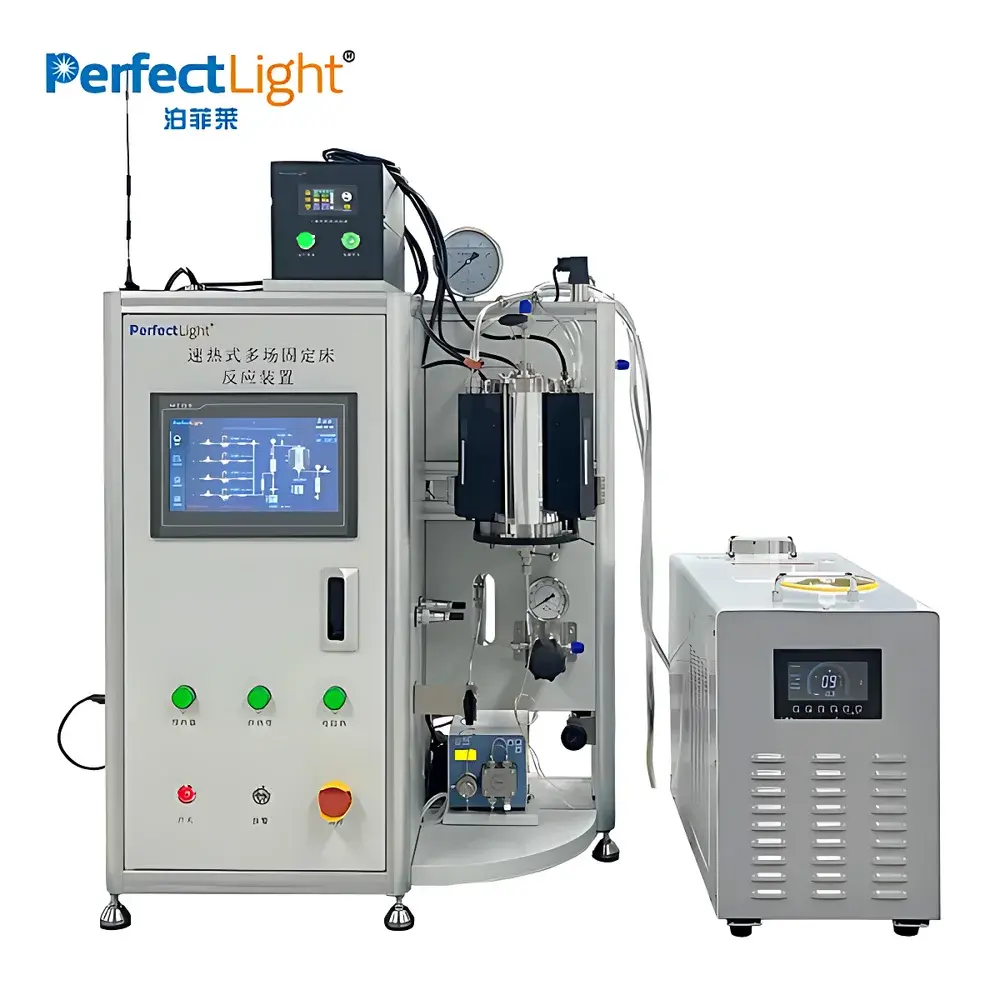
PerfectLight PLR-SCR100A Multi-Field Fixed-Bed Reactor with Rapid Thermal Activation (Light–Heat–Microwave Coupling)
| Brand | PerfectLight |
|---|---|
| Origin | Beijing, China |
| Manufacturer Type | Authorized Distributor |
| Product Category | Domestic Scientific Instrument |
| Model | PLR-SCR100A |
| Pricing | Upon Request |
| Max Operating Pressure | 3 MPa (≤300 °C) / 1 MPa (≤600 °C) |
| Max Temperature | 600 °C |
| Temperature Stability | ±1 °C |
| Pressure Accuracy | ±0.2 % F.S. |
| LED Wavelength Options | 365, 380, 405, 420, 760 nm (customizable) |
| Microwave Output | ~250 W (solid-state, real-time forward/reflected power monitoring) |
| Heating Rate (Joule) | up to 100 °C/min |
| Thermal Equilibration Time | ~15 min |
| Gas Inlets | 3 standard (4 optional), 100 mL/min N₂ calibration flow |
| Liquid Inlet | 0–1 channel, 0.001–2 mL/min |
| Preheater Max Temp | 400 °C |
| Condenser Volume | ≤50 mL, detachable |
| Power Supply | 220 V/10 A, <2.2 kW, grounded |
| Dimensions (W×H×D) | 700 × 800 × 480 mm |
Overview
The PerfectLight PLR-SCR100A is an engineered multi-field fixed-bed catalytic reactor designed for fundamental and applied research in synergistic energy-field catalysis. Unlike conventional single- or dual-field reactors—where thermal, optical, and electromagnetic inputs are mechanically superimposed with poor spatial and temporal coordination—the PLR-SCR100A implements a co-designed, physically integrated architecture for precise, independent, and quantifiable control of resistive heating, monochromatic LED irradiation, and solid-state microwave excitation. Its operational principle centers on concurrent modulation of electronic states (via photon energy matching catalyst bandgaps), reaction kinetics (via rapid, localized thermal activation), and mass transport (via minimized dead volume and optimized gas flow dynamics). The system enables true tri-field coupling (light–heat–microwave) under controlled pressure (up to 3 MPa at ≤300 °C) and temperature (up to 600 °C), making it suitable for mechanistic studies in heterogeneous photocatalysis, microwave-assisted thermocatalysis, and photothermal–microwave hybrid processes.
Key Features
- Tri-Independent Field Control: Light (LED), resistive heat (integrated Joule-heated SiC/Ti carrier), and microwave (250 W solid-state source with real-time forward/reflected power readout) operate as decoupled, programmable subsystems—enabling reproducible single-field baselines and rigorously defined multi-field protocols.
- Optimized Photon Delivery: Triple-circular LED array (PLS-LCC series) with collimating optics delivers uniform, high-flux irradiation (≥3.2 W/cm² at 365 nm, >32 suns equivalent) across catalyst beds (3.14–31.4 cm² active area). Wavelength selection (365–760 nm) permits bandgap-resolved photoactivation without broadband spectral interference.
- Rapid Thermal Response: Internal Joule-heating element embedded within the catalyst support achieves ≥100 °C/min ramp rates and full thermal equilibration in ~15 minutes—reducing experimental cycle time by >3× versus conventional tubular furnaces.
- Vacuum-Insulated & Microwave-Shielded Reactor Core: A fused-quartz fixed-bed tube is enclosed in a high-vacuum jacket (thermal conductivity <1% of ambient air) and coated with IR-reflective layers to minimize radiative loss and enhance thermal reuse. A precision-mesh microwave shield confines field distribution, ensuring operator safety and eliminating cross-talk between energy domains.
- Low-Dead-Volume Flow Architecture: Compact reaction zone (<5 mL void volume), integrated preheater (up to 400 °C), and modular condenser (<50 mL, detachable) enable sub-second gas-phase response times and efficient vapor–liquid handling for continuous-flow or transient kinetic experiments.
Sample Compatibility & Compliance
The PLR-SCR100A supports heterogeneous catalysts in pellet, granule, or monolithic forms (bed height: 10–50 mm; ID: 10–25 mm), including metal oxides, plasmonic nanoparticles, perovskites, and heterojunction semiconductors. It accommodates reactive gases (H₂, CO, NH₃, NOₓ, VOCs), vapors (H₂O, alcohols, ketones), and liquid feeds (via syringe pump interface). All wetted parts comply with ISO 8502-3 surface cleanliness standards; pressure containment meets ASME B31.3 process piping design guidelines. Vacuum-jacket integrity is validated per ASTM E471. For regulated environments, the system supports audit-trail-enabled operation when integrated with compliant LIMS or ELN platforms (21 CFR Part 11-ready via external software layer).
Software & Data Management
The reactor operates via a dedicated embedded controller with local HMI (touchscreen interface) for real-time parameter adjustment (LED intensity %, microwave duty cycle, ramp rate, setpoint hold). All analog sensor outputs (T, P, flow, power) are digitized at 10 Hz and timestamped with microsecond resolution. Raw data export is supported in CSV and HDF5 formats. Optional integration with MATLAB® or Python-based automation frameworks allows script-driven multi-step protocols—including synchronized field sequencing, feedback-controlled light–temperature interlock, and dynamic microwave impedance matching. Data logs include metadata on hardware configuration, calibration history, and environmental conditions—facilitating GLP-compliant reporting and traceability.
Applications
- Mechanistic investigation of photothermal synergy in CO₂ hydrogenation, methane dry reforming, and NH₃ synthesis.
- Time-resolved study of microwave–catalyst coupling effects (e.g., selective hot-spot formation in Ni–Fe alloys or TiO₂–graphene composites).
- Bandgap-engineered photocatalyst screening under monochromatic illumination coupled with controlled thermal bias.
- Accelerated catalyst deactivation/reduction kinetics under combined oxidative/reductive atmospheres.
- Process intensification of industrial off-gas treatment (e.g., low-concentration NOₓ abatement, chlorinated VOC mineralization).
- Development and validation of kinetic models incorporating non-thermal microwave contributions (e.g., altered Arrhenius pre-exponential factors).
FAQ
What distinguishes the PLR-SCR100A from conventional photoreactors or microwave reactors?
It integrates three energy fields within a single, geometrically optimized reaction core—eliminating sequential or externally coupled setups that introduce thermal lag, optical loss, or field misalignment.
Can the LED wavelength be changed during an experiment?
Yes—wavelength selection is hardware-switchable via interchangeable PLS-LCC modules; intensity is independently adjustable from 0–100% without interrupting thermal or microwave operation.
Is the system compatible with in situ spectroscopic characterization?
The quartz reactor body features standardized optical access ports (optional flange kits available for FTIR, Raman, or UV-Vis fiber coupling), enabling operando monitoring under full multi-field conditions.
How is temperature measured and controlled?
A calibrated K-type thermocouple is embedded directly in the catalyst bed; PID control maintains stability within ±1 °C, with secondary IR pyrometry available for non-contact verification.
Does the system meet international safety standards for microwave emission?
Yes—it complies with IEC 61000-4-3 (radiated immunity) and EN 55011 (emission limits for ISM equipment); measured leakage is <0.1 mW/cm² at 5 cm distance, well below ICNIRP occupational exposure thresholds.
Related Products



