
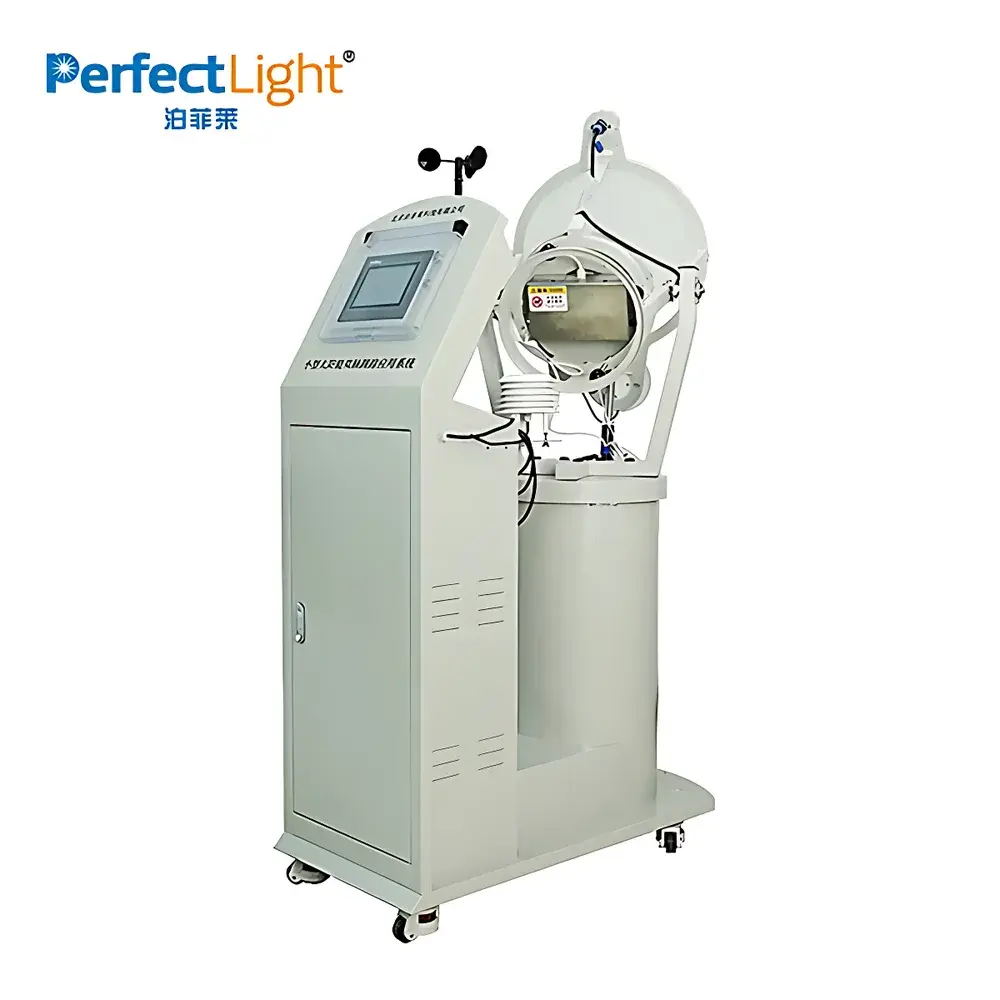
PerfetLight PLS-STAS-I Series Compact Dual-Axis Solar Tracking Application System
| Brand | PerfetLight |
|---|---|
| Origin | Beijing, China |
| Manufacturer Type | Authorized Distributor |
| Origin Category | Domestic (China) |
| Model | PLS-STAS-I Series |
| Price | USD 1 (FOB Inquiry Required) |
| Tracking Method | Hybrid Optical + Astronomical Time-Based Tracking |
| Elevation Range | 0–90° |
| Azimuth Range | −110° to +110° (0° = True South) |
| Optical Tracking Accuracy | < 0.3° |
| Time-Based Tracking Accuracy | < 1.0° |
| Fresnel Lens Area | 0.2 m² |
| Minimum Focal Spot Area | 7 cm² |
| Concentration Ratio | 278× |
| Operating Temperature Range | −25°C to +55°C |
| Ambient Pressure | Atmospheric |
| Gas Collection Capacity | 300 mL / 500 mL gas sampling bags |
| Incident Photon Flux Density Monitoring | ≤10 W/cm² (photochemical irradiance at reaction plane) |
| Environmental Monitoring | Direct/Global Solar Irradiance, Ambient Temperature, Relative Humidity, Barometric Pressure, Wind Speed |
| IP Rating | IP67 |
| Wind Resistance Class | Beaufort Scale Level 6 |
| Safety Features | End-Position Limit Switches, Wind-Induced Auto-Stow Protocol, Rain Detection & Hibernation Mode |
| Control Architecture | Integrated PLC with GPS Geolocation & Real-Time Ephemeris Calculation |
| Data Logging | Timestamped Elevation/Azimuth Angles, Irradiance Values, Environmental Parameters, Derived Solar Positional Metrics |
Overview
The PerfetLight PLS-STAS-I Series Compact Dual-Axis Solar Tracking Application System is an outdoor-integrated experimental platform engineered for quantitative solar-driven photochemical and photovoltaic research under real-world insolation conditions. Unlike conventional laboratory-scale photocatalytic reactors relying on artificial arc lamps or LED simulators, the PLS-STAS-I enables direct utilization of natural sunlight as the excitation source—eliminating spectral mismatch artifacts and enabling field-relevant kinetic and quantum yield assessments. Its core operational principle integrates dual-axis mechanical actuation with hybrid sun-tracking logic: real-time photodiode-based optical feedback supplemented by astronomical ephemeris computation using onboard GPS-synchronized time and geolocation data. This architecture ensures continuous high-fidelity solar vector alignment across variable sky conditions—including partial cloud cover—where pure photovoltaic tracking systems frequently fail due to low signal-to-noise ratios in diffuse-dominant irradiance regimes. The system’s structural design conforms to IEC 61215-2 (photovoltaic module qualification) and ISO 9060:2018 (solar radiometry) referencing practices, supporting traceable irradiance reporting compliant with ASTM G173-03 reference spectra.
Key Features
- Hybrid tracking architecture combining closed-loop optical sensing (four-quadrant photodiodes) with predictive astronomical modeling—ensuring robust operation during transient cloud cover and low-DNI conditions.
- Integrated Fresnel lens concentrator (0.2 m² aperture, 278× geometric concentration ratio) delivering spatially uniform high-flux illumination (≤10 W/cm² photochemical irradiance) onto catalytic or PV test samples.
- Real-time environmental telemetry suite: calibrated pyrheliometer (direct normal irradiance), thermistor-hygrometer-pressure sensor array, and ultrasonic wind anemometer—all synchronized to positional tracking data.
- PLC-based control unit with embedded GPS receiver and ephemeris engine; supports automated stow-on-wind-trigger (Beaufort 6+), rain-induced hibernation, and end-stop mechanical limit protection.
- IP67-rated enclosure housing all electronics and actuation drivers; corrosion-resistant aluminum alloy frame rated for long-term outdoor deployment in temperate and arid climates.
- Modular interface architecture enabling integration with third-party gas chromatographs, electrochemical workstations, or battery management systems via RS485/Modbus RTU or Ethernet TCP/IP protocols.
Sample Compatibility & Compliance
The PLS-STAS-I accommodates standard flat-panel test specimens up to 150 mm × 150 mm (e.g., TiO₂-coated quartz plates, perovskite solar cells, or CPV receiver modules). Reaction vessels include standardized gas-tight quartz reactors compatible with ASTM D3241-21 (aviation fuel oxidation stability testing) and ISO 10678:2010 (photocatalytic air purification evaluation). All irradiance measurements are referenced to NIST-traceable calibration standards. System firmware implements audit-ready logging per GLP requirements: timestamped metadata includes GPS coordinates, UTC time, solar zenith/azimuth angles, DNI/GHI values, ambient parameters, and actuator status codes—fully exportable as CSV or SQLite databases. Optional 21 CFR Part 11-compliant electronic signature and user-role access control modules are available upon request.
Software & Data Management
The system ships with PerfetLight SolarTrack Studio v3.x—a cross-platform desktop application (Windows/macOS/Linux) supporting live telemetry visualization, historical parameter correlation (e.g., CO₂ evolution vs. instantaneous DNI), and automated report generation (PDF/Excel). Raw data streams adhere to CF Standard Names (Climate and Forecast Metadata Conventions) for interoperability with MATLAB, Python (xarray/pandas), or LabVIEW environments. Firmware updates are delivered via secure HTTPS OTA protocol with SHA-256 signature verification. Local storage retains ≥30 days of second-resolution data (angles, irradiance, temperature, wind speed); external USB-C mass storage or network-mounted SMB shares extend archival capacity indefinitely.
Applications
- Photocatalytic Solar Fuel Synthesis: Quantitative evaluation of H₂ evolution, CO₂ reduction, or NOₓ degradation kinetics under natural solar spectrum and variable DNI—enabling comparison against AM1.5G simulator data per ISO 25922:2021.
- Concentrator Photovoltaics (CPV) Screening: Accelerated performance mapping of multi-junction cells under high-flux (>500 suns) outdoor conditions, supporting reliability assessment per IEC 62632-2.
- Hybrid Photoelectrochemical Systems: Co-location of PV panels, electrolyzers, and photocatalytic reactors on a single tracking platform to study energy conversion efficiency trade-offs in integrated solar-to-chemical architectures.
- Solar Thermal Catalysis Validation: Coupling with IR thermography to correlate focal-plane temperature gradients with reaction selectivity in thermally coupled photocatalytic pathways.
FAQ
What is the minimum DNI required for stable optical tracking initiation?
Optical tracking engages autonomously when DNI exceeds 200 W/m²; below this threshold, the system defaults to time-based ephemeris mode with ±1° pointing uncertainty.
Can the system operate during snowfall or heavy fog?
Yes—the IP67-rated enclosure and auto-stow protocol ensure mechanical integrity, though irradiance-dependent experiments are suspended until DNI recovers above 100 W/m².
Is GPS synchronization mandatory for time-based tracking?
GPS provides automatic timezone, latitude/longitude, and leap-second correction; manual coordinate/time entry is supported but reduces long-term pointing accuracy beyond ±0.5°.
How is irradiance measured at the reaction plane?
A secondary calibrated silicon photodiode (NIST-traceable, ±2% uncertainty) mounted adjacent to the focal spot measures incident photon flux density, with software-compensated cosine response correction applied.
Does the system support remote monitoring over cellular networks?
Yes—optional LTE-M module enables encrypted MQTT telemetry transmission to private cloud instances or PerfetLight’s hosted dashboard (GDPR-compliant data residency options available).



