
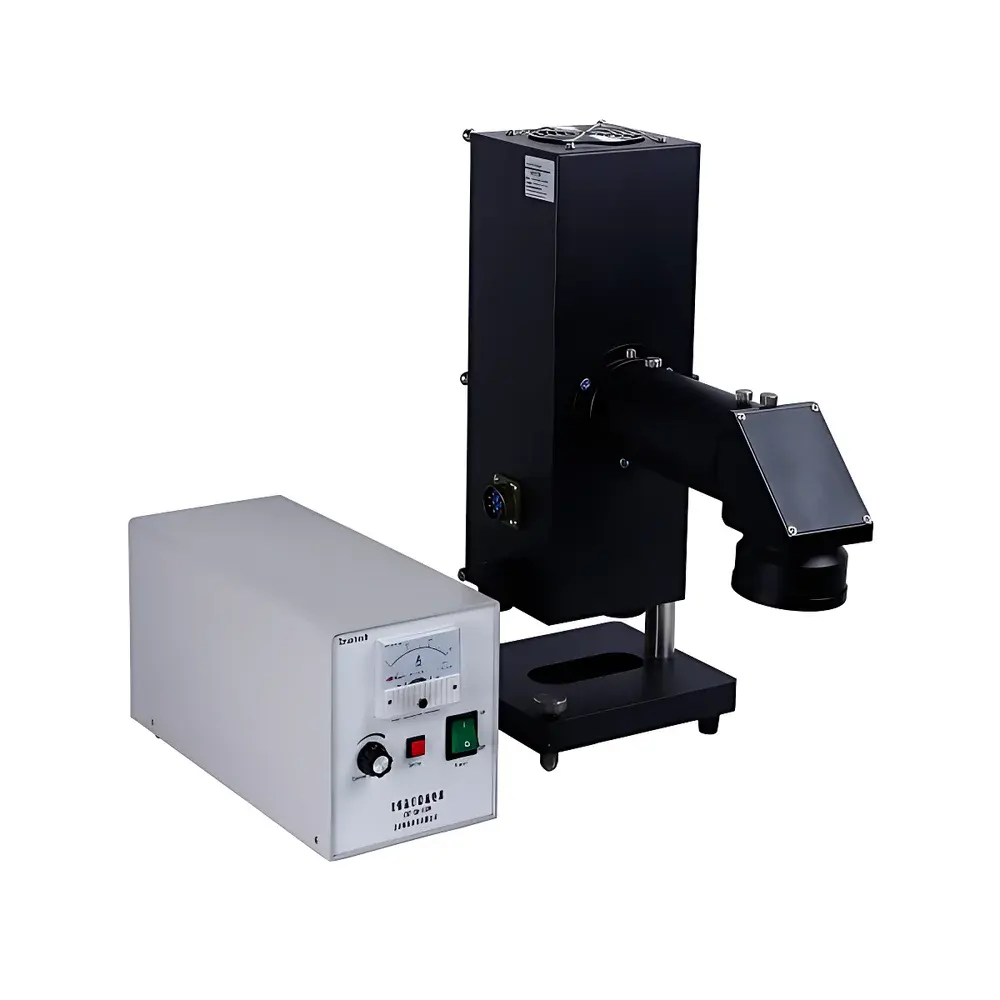
Perfetlight CHF-XM Series Mercury Arc Lamp Light Source
| Brand | Perfetlight |
|---|---|
| Origin | Beijing, China |
| Manufacturer Type | Authorized Distributor |
| Product Category | Domestic |
| Model | CHF-XM |
| Light Source Type | Medium-Pressure Mercury Arc Lamp |
| Illumination Mode | External (Top- or Side-Illumination) |
| Output Modes | Point Source, Collimated Beam, Fiber-Coupled Output |
| Point Source Diameter | 4–6 mm |
| Collimated Beam Diameter | 50 mm (adjustable to Φ60 mm) |
| Beam Divergence | ≤0.85° (at working distance < 250 mm) |
| Spectral Range | 300–1100 nm |
| Spatial Uniformity (Φ60 mm) | ≤ ±11% |
| Local Uniformity (2 cm × 2 cm region) | ≤ ±5% |
| Focus Adjustment | Continuous mechanical zoom for point-source or Φ60 mm collimated output |
| Compliance | Designed for ISO/IEC 17025-compliant optical calibration environments |
Overview
The Perfetlight CHF-XM Series Mercury Arc Lamp Light Source is a precision-engineered, medium-pressure mercury discharge lamp system designed for controlled, reproducible broadband illumination in photophysical and photochemical research laboratories. Operating on the principle of high-intensity arc discharge in mercury vapor, the CHF-XM emits strong line spectra superimposed on a continuous background—particularly intense emission lines at 365 nm (i-line), 405 nm (h-line), 436 nm (g-line), 546 nm, and 579 nm—making it ideal for wavelength-selective excitation, quantum yield determination, and action spectrum studies. Its external illumination architecture enables non-invasive integration into custom optical benches, electrochemical cells, gas-phase reactors, and liquid-phase photoreactors without thermal or mechanical interference with sensitive detection modules. Since its commercial introduction in 2002, the CHF-XM platform has been deployed in over 1,000 academic and industrial laboratories worldwide, primarily supporting standardized photovoltaic characterization, photocatalytic reaction kinetics, and time-resolved surface photovoltage spectroscopy.
Key Features
- Modular optical head design allows rapid reconfiguration between point-source, collimated-beam, and fiber-coupled output modes—enabling seamless adaptation to spectrometer coupling, monochromator input, or spatially resolved irradiation setups.
- Optimized collimation optics deliver a 50 mm (expandable to Φ60 mm) uniform beam with ≤±11% spatial non-uniformity across the full aperture and ≤±5% local variation within a 2 cm × 2 cm test area—meeting the uniformity requirements specified in ASTM E927-22 for Class AAA solar simulators used in PV device validation.
- Mechanical zoom mechanism provides continuous focus adjustment from sub-millimeter point source to wide-field collimated output, eliminating the need for interchangeable lenses or alignment recalibration.
- Thermally stabilized lamp housing with forced-air cooling ensures stable radiometric output (<2% RMS fluctuation over 4 hours) and extends electrode lifetime beyond 1,200 operational hours under standard duty cycles.
- Integrated safety interlocks, UV-blocking quartz envelope, and CE-compliant electrical enclosure meet IEC 61000-6-3 EMC and IEC 62471 photobiological safety standards for Class 3B optical radiation sources.
Sample Compatibility & Compliance
The CHF-XM is routinely integrated with commercially available analytical platforms including lock-in-amplified surface photovoltage spectrometers (SPS), potentiostat-controlled photoelectrochemical (PEC) cells, gas-phase flow reactors for VOC degradation, and liquid-phase stirred-tank photoreactors. Its spectral output (300–1100 nm) aligns with common bandgap sensitivities of TiO₂, g-C₃N₄, BiVO₄, perovskite absorbers, and organic semiconductors. The system supports GLP-compliant experimental workflows: all optical power calibrations are traceable to NIST-traceable silicon photodiodes, and irradiance mapping reports adhere to ISO/IEC 17025 documentation requirements. When paired with calibrated monochromators, the CHF-XM satisfies USP analytical instrument qualification criteria for wavelength accuracy and intensity repeatability in regulated photolysis studies.
Software & Data Management
While the CHF-XM operates as a hardware-stable analog light source without embedded firmware, it is fully compatible with third-party control ecosystems. Analog voltage inputs (0–5 V or 0–10 V) enable intensity modulation via programmable power supplies synchronized with data acquisition systems (e.g., LabVIEW, MATLAB, Python-based PyVISA). Radiometric logs—including real-time lamp current, housing temperature, and external photodiode feedback signals—can be recorded alongside electrochemical or spectroscopic datasets for full experimental traceability. Audit trails generated during photolysis kinetics experiments comply with FDA 21 CFR Part 11 requirements when implemented within validated LIMS or ELN environments.
Applications
- Quantum efficiency mapping of photoelectrodes using monochromated CHF-XM output coupled to potentiostatic biasing and incident photon-to-current efficiency (IPCE) analysis.
- Gas-phase photocatalytic oxidation of formaldehyde, NOₓ, and SO₂ under controlled relative humidity and residence time—aligned with ISO 22197-1 and ISO 22197-2 test protocols.
- Liquid-phase degradation kinetics of methylene blue, rhodamine B, and phenol under simulated UV–vis irradiation—supporting OECD 316 and ISO 18853 standard methodologies.
- Photoelectrochemical water splitting half-reaction quantification (H₂/O₂ evolution) using gas chromatography-coupled evolved gas analysis.
- CO₂ photoreduction product distribution studies (CH₄, CO, C₂H₄) monitored by online FTIR or GC-MS under identical irradiance conditions.
- Photochromic switching kinetics in spiropyran- and diarylethene-based thin films via time-resolved absorption spectroscopy.
FAQ
What is the recommended lamp replacement interval under continuous operation?
Lamp lifetime is rated at ≥1,200 hours at nominal current (±5%); performance monitoring via calibrated photodiode output is advised after 800 hours.
Can the CHF-XM be used with optical choppers for lock-in detection?
Yes—the mechanical stability and low ripple (<0.5%) of the DC-stabilized power supply ensure clean modulation up to 500 Hz without amplitude distortion.
Is ozone generation a concern during extended UV operation?
The fused silica envelope transmits <220 nm radiation minimally; measurable ozone production is negligible below 254 nm output and absent under standard operating conditions.
How is spectral irradiance calibrated for quantum yield measurements?
Users must perform absolute spectral irradiance calibration using a NIST-traceable thermopile or Si photodiode spectroradiometer; Perfetlight provides detailed SOPs aligned with ASTM E275 and ISO 17025 reporting templates.
Does the system support remote operation in inert-atmosphere gloveboxes?
The optical head and power supply are separately housed; feedthrough-compatible versions with KF40 vacuum flanges and purged lamp enclosures are available upon request.





