
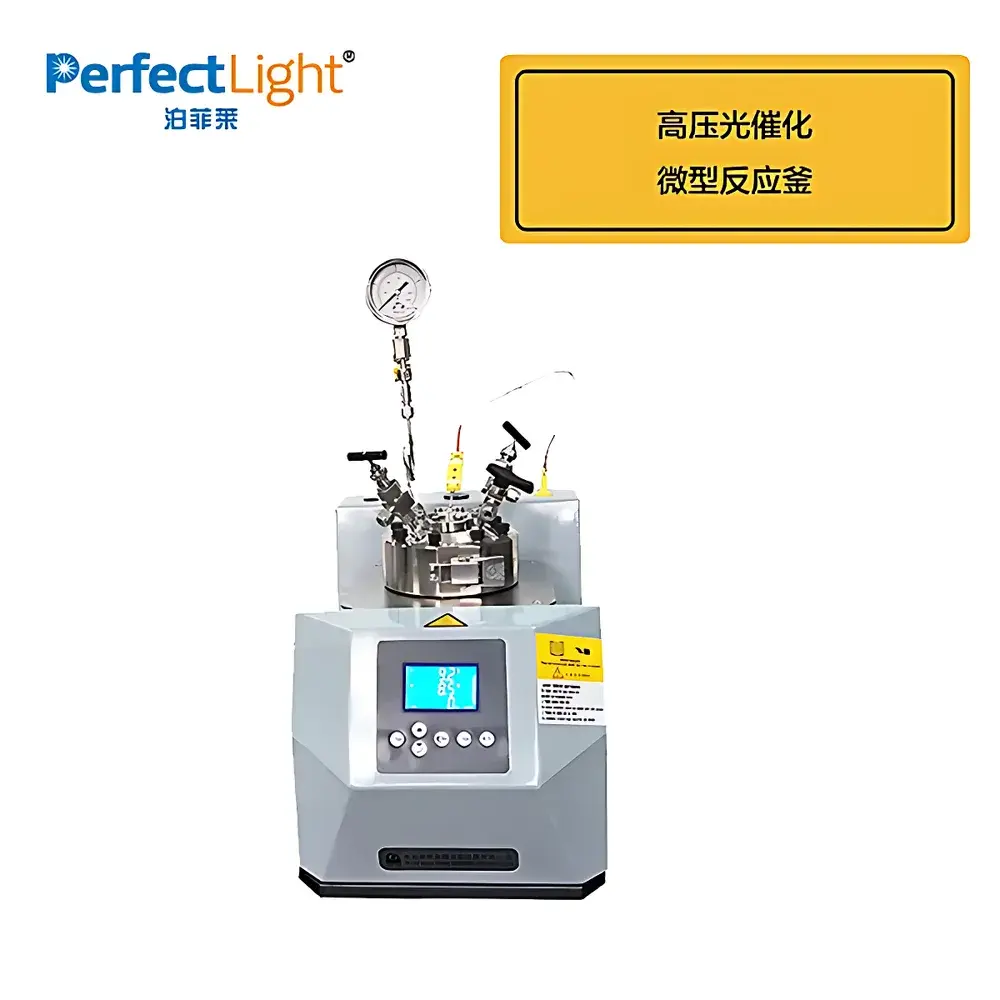
PerfectLight LightChem Series High-Pressure Photochemical Reactor
| Brand | PerfectLight |
|---|---|
| Origin | Beijing, China |
| Model | LightChem Series |
| Reactor Type | Benchtop Micro High-Pressure Photochemical Reactor |
| Effective Volume | 50–500 mL |
| Construction Material | Forged 316L Stainless Steel (weld-free) |
| Operating Pressure | Up to 10 MPa (optional 20 MPa / 30 MPa variants) |
| Operating Temperature | Ambient to 250 °C |
| Heating Method | Integrated Electric Heating Module |
| Stirring | Magnetic or Mechanical Impeller, 0–1200 rpm (infinitely variable) |
| Illumination Modes | Top-, Side-, and Bottom-Irradiation Configurations |
| Optical Window | Round Sapphire Viewport (Φ20 mm or Φ40 mm) |
| Pressure Gauge | 0–16 MPa Bourdon-tube Gauge with Rupture Disc Safety System |
| Temperature Sensing | K-type Thermocouple |
| Valves | Gas Inlet/Outlet Valve, Liquid Sampling Valve, Pressure Relief Valve |
| Control System | MRSC-LightChem Intelligent Controller with Auto-Tuning for Temperature, Speed & Time |
| Safety Features | Overtemperature Alarm, Fault Indication (Audible + Visual), Dual Timer Mode (Hold-Time & Run-Time), Real-time LCD Display (Temp, RPM, Elapsed Time) |
Overview
The PerfectLight LightChem Series High-Pressure Photochemical Reactor is an engineered benchtop platform designed for controlled investigation of photo-driven catalytic reactions under elevated temperature and pressure conditions. Based on Couette-type fluid dynamics and optically optimized irradiation geometry, the reactor enables precise spatiotemporal coupling of photon flux, thermal energy, and reactive mass transport—critical for mechanistic studies in heterogeneous photocatalysis, solar fuel synthesis, and advanced environmental remediation. Its monolithic 316L stainless steel construction—machined from solid forged bar stock without welds—ensures structural integrity at sustained pressures up to 30 MPa and temperatures to 250 °C, satisfying mechanical design requirements aligned with ASME BPVC Section VIII Division 1 and ISO 4775 for pressurized laboratory vessels.
Key Features
- Weld-free monoblock reactor body fabricated from ASTM A479 316L forged bar stock, eliminating crevice corrosion risks and enhancing fatigue resistance under cyclic pressurization.
- Non-flanged, radially compressed sealing architecture with dual O-ring grooves and precision-ground sealing surfaces ensures uniform stress distribution and leak-tight performance at full rated pressure.
- Dedicated catalyst support platform integrated within the reaction chamber promotes homogeneous gas–solid contact and minimizes boundary-layer diffusion limitations during photocatalytic CO₂ reduction or VOC mineralization.
- Modular illumination system with motorized vertical translation stage enables precise alignment of broadband or monochromatic light sources (e.g., Xe, LED, or laser systems) relative to the sapphire viewport—supporting top-, side-, and bottom-irradiation configurations.
- MRSC-LightChem digital controller implements PID auto-tuning for temperature and speed regulation, with programmable ramp-soak profiles, dual independent timers (hold-time for isothermal stabilization and run-time for total experiment duration), and real-time data logging via RS485 interface.
- Integrated safety subsystem includes redundant overtemperature cutoff, rupture disc–protected pressure relief, audible/visual fault alerts, and interlocked lid actuation to prevent operation under incomplete closure.
Sample Compatibility & Compliance
The LightChem reactor accommodates heterogeneous suspensions (e.g., TiO₂, g-C₃N₄, MOFs), slurry-phase catalysts, and gas–liquid–solid triphasic systems. Its sapphire viewport (transmission >85% from 190–5000 nm) permits in situ UV-Vis spectroscopic monitoring and supports external fiber-optic coupling for time-resolved absorption or emission measurements. All wetted components comply with USP Class VI biocompatibility standards. The system meets GLP documentation requirements through MRSC-LightChem’s audit-trail-capable firmware (timestamped parameter changes, alarm logs, and manual override records), and is compatible with 21 CFR Part 11–compliant data archiving when connected to validated LIMS platforms.
Software & Data Management
The MRSC-LightChem controller features a 4.3-inch resistive touchscreen LCD with intuitive menu navigation and multilingual UI (English, Chinese, German). It supports export of CSV-formatted datasets containing synchronized timestamped values for temperature, rotational speed, pressure, and elapsed time. Optional Ethernet/Wi-Fi modules enable remote monitoring and integration into centralized lab automation networks. Firmware updates are performed via USB flash drive with SHA-256 signature verification to ensure traceability and cybersecurity compliance per IEC 62443-3-3.
Applications
- Photocatalytic CO₂ hydrogenation to CH₄, CH₃OH, or C₂H₄ under simulated solar illumination and syngas-relevant pressures (1–10 MPa).
- Advanced oxidation of persistent organic pollutants (e.g., PFAS, pharmaceuticals) in aqueous suspension under UV–vis irradiation and elevated O₂ partial pressure.
- Plasmon-enhanced N₂ fixation using Au/TiO₂ nanocomposites under visible-light excitation and ambient-to-moderate pressures (0.5–5 MPa).
- Photoelectrochemical water splitting kinetics studies with integrated counter/reference electrode ports (optional accessory).
- High-pressure photopolymerization of functional monomers where oxygen inhibition must be suppressed via inert gas pressurization.
FAQ
What pressure ratings are available for the LightChem Series?
Standard configuration is rated to 10 MPa; optional variants certified to 20 MPa and 30 MPa are available upon request with corresponding validation documentation.
Is the sapphire viewport replaceable in the field?
Yes—the viewport assembly is modular and can be replaced using standard Torx tools without requiring recalibration of optical alignment fixtures.
Can the MRSC-LightChem controller interface with third-party data acquisition software?
Yes—via ASCII-based serial protocol (RS485) or Modbus TCP/IP, enabling integration with LabVIEW, MATLAB, or custom Python scripts for automated experiment sequencing.
Does the system support inert atmosphere purging prior to pressurization?
Yes—integrated gas inlet/outlet valves and vacuum-rated seals allow multi-cycle purge-evacuate-fill sequences using N₂, Ar, or synthetic air prior to introducing reactive gases.
What maintenance intervals are recommended for long-term reliability?
Annual verification of pressure transducer calibration, O-ring replacement (every 2 years or after 200 thermal cycles), and thermocouple drift check using NIST-traceable reference sources are advised per manufacturer service bulletin LC-MNT-2023.



