
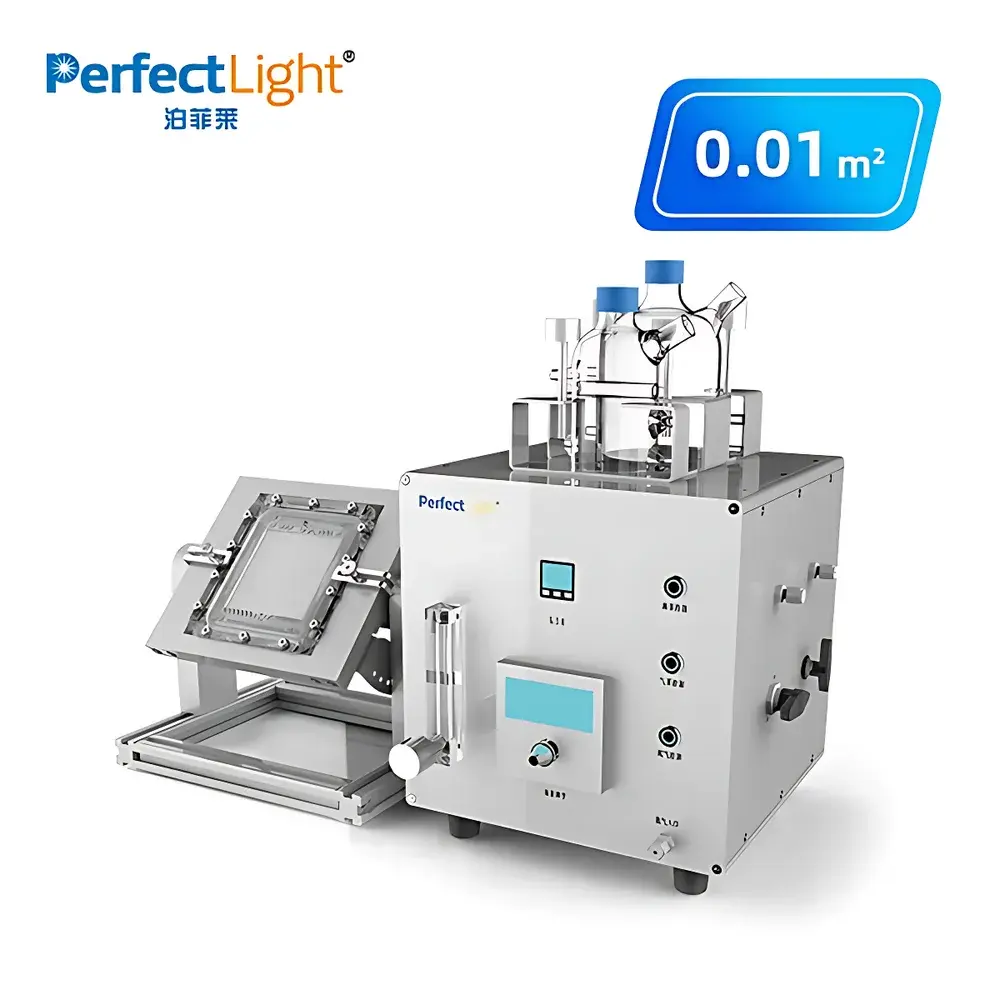
PLR-SPRL Experimental Flat-Plate Photoreactor by PerfectLight
| Brand | PerfectLight |
|---|---|
| Origin | Beijing, China |
| Model | PLR-SPRL |
| Effective Illuminated Area | 10×10 cm² (configurable: 5×5, 15×15, 20×20, 25×25 cm²) |
| Liquid Layer Thickness | 1–5 mm (customizable) |
| Reactor Angle Adjustment | 0–90° continuous |
| Flow Rate (Liquid) | 0–1 L/min |
| Carrier Gas Flow | 4–100 mL/min |
| Operating Temperature | Ambient to 60 °C |
| Operating Pressure | Atmospheric (sealed mode up to 50 kPa) |
| Circulating Gas Pump Flow | 1–1.5 L/min |
| Wetted Materials | PA66, PMMA, PP, Fluoroelastomer |
Overview
The PLR-SPRL Experimental Flat-Plate Photoreactor is an engineered platform designed for controlled, scalable investigation of heterogeneous photocatalytic processes under well-defined irradiation geometry and mass/heat transfer conditions. Unlike conventional batch-type cylindrical photoreactors—where light distribution, boundary layer development, and radial concentration gradients introduce significant scaling uncertainties—the PLR-SPRL employs a planar reaction interface that enables uniform photon flux delivery, reproducible catalyst exposure, and decoupled analysis of interfacial kinetics, diffusion limitations, and thermal management. Its core architecture follows the principles of thin-film photochemistry: reactant solution flows as a laminar film across a flat, optically transparent substrate loaded with photocatalyst (e.g., TiO₂, g-C₃N₄, or MOF-based coatings), while collimated or diffuse UV–vis light irradiates perpendicularly through the top window. This configuration supports first-principles modeling of photon absorption profiles, surface residence time distributions, and local quantum yield estimation—critical parameters for reactor scale-up and process intensification in solar fuel synthesis, environmental remediation, and selective organic transformations.
Key Features
- Modular flat-plate reactor design with interchangeable active areas (5×5 to 25×25 cm²), enabling systematic area-scaling studies while preserving geometric similarity and illumination uniformity.
- Precisely adjustable tilt angle (0–90°) to control liquid film thickness, flow regime (laminar vs. transitional), and gas–liquid interfacial contact time—essential for optimizing photon utilization efficiency and mass transfer coefficients.
- Integrated water-jacketed thermal management system compatible with external chillers or recirculating baths, maintaining isothermal operation (ambient to 60 °C) during exothermic or photo-thermal reactions.
- Dual operational modes: sealed-batch configuration for kinetic profiling and low-conversion screening; continuous-flow mode for steady-state activity assessment, catalyst stability testing, and residence time distribution (RTD) analysis.
- Direct integration capability with GC, HPLC, or online UV-Vis spectrophotometers via standardized Swagelok fittings and a built-in manual sampling valve—enabling real-time product quantification without manual intervention.
- Chemically resistant wetted materials (PA66, PMMA, PP, fluoroelastomer) ensure compatibility with acidic, basic, and organic solvent systems; optional substrate holders accommodate rigid (borosilicate glass, carbon paper) and flexible (nonwoven fabric, carbon cloth) catalyst supports.
Sample Compatibility & Compliance
The PLR-SPRL accommodates a broad spectrum of photocatalyst formats—including slurry-deposited films, sputtered coatings, inkjet-printed layers, and immobilized monoliths—on substrates ranging from conductive carbon-based media to insulating optical glasses. Its open architecture permits in situ characterization (e.g., operando Raman or fluorescence microscopy) when coupled with modular optical access ports. The system complies with standard laboratory safety protocols for low-pressure (<50 kPa) photochemical operations and meets mechanical integrity requirements per ISO 8573-1 (compressed air purity) for carrier gas circuits. While not certified for GMP manufacturing, its design supports GLP-aligned documentation practices—including traceable temperature logging, flow calibration records, and irradiance mapping reports—making it suitable for pre-regulatory process development in academic, governmental, and industrial R&D settings.
Software & Data Management
The PLR-SPRL operates as a hardware-integrated experimental station rather than a closed software ecosystem. All process variables—including liquid flow rate (via calibrated peristaltic or syringe pump), carrier gas flow (mass flow controller), bath temperature (PID-regulated chiller), and incident irradiance (measured independently with NIST-traceable photodiode or thermopile sensor)—are monitored and logged externally using industry-standard DAQ platforms (e.g., LabVIEW, MATLAB Data Acquisition Toolbox, or Python-based PyDAQmx). This architecture ensures full data ownership, audit-trail readiness, and compatibility with electronic lab notebooks (ELNs) such as Benchling or LabArchives. For regulatory applications requiring 21 CFR Part 11 compliance, users may implement third-party validation packages to establish user access controls, electronic signatures, and immutable audit logs for raw acquisition files.
Applications
- Kinetic modeling of photocatalytic CO₂ reduction, H₂ evolution, and NOₓ degradation under controlled photon flux and mass transfer conditions.
- Structure–activity relationship (SAR) studies across catalyst libraries, leveraging rapid area-scaling to isolate intrinsic activity from transport artifacts.
- Optimization of liquid film hydrodynamics for improved quantum efficiency in visible-light-driven oxidation of pharmaceuticals and endocrine disruptors.
- Development of photocatalytic membrane reactors by integrating asymmetric polymer supports or ceramic filters into the flat-plate assembly.
- Validation of computational fluid dynamics (CFD) and radiative transfer models for planar photochemical systems—particularly in predicting local photon flux attenuation and species concentration gradients.
FAQ
Can the PLR-SPRL be used under vacuum or elevated pressure?
No—it is rated for atmospheric operation in continuous-flow mode and sealed-batch operation up to 50 kPa(g); higher pressures require custom engineering and are outside standard specifications.
Is irradiance uniformity across the active area characterized and documented?
Yes; upon request, PerfectLight provides spatial irradiance maps (±3% deviation over central 80% area) measured using a calibrated imaging radiometer at specified wavelengths (e.g., 365 nm, 405 nm, or broadband AM1.5G).
What calibration standards are recommended for quantitative product analysis?
Internal standard methods with deuterated analogues (e.g., d₈-toluene for aromatic oxidation) or certified reference materials (CRM) from NIST or LGC are advised; GC/FID or GC/MS calibration curves must be established separately for each analyte.
Does the system support automated dosing or pH control?
Not natively—but auxiliary modules (e.g., syringe pump-controlled reagent addition or inline pH probe with feedback loop) can be integrated via ¼″-28 UNF threaded ports and standard 0–10 V analog I/O interfaces.
Are replacement parts such as gaskets, windows, or substrate holders available separately?
Yes; all consumables and wear components—including fluorocarbon O-rings, fused silica viewports, and stainless-steel substrate frames—are stocked and supplied with full material certifications (RoHS, REACH).



