
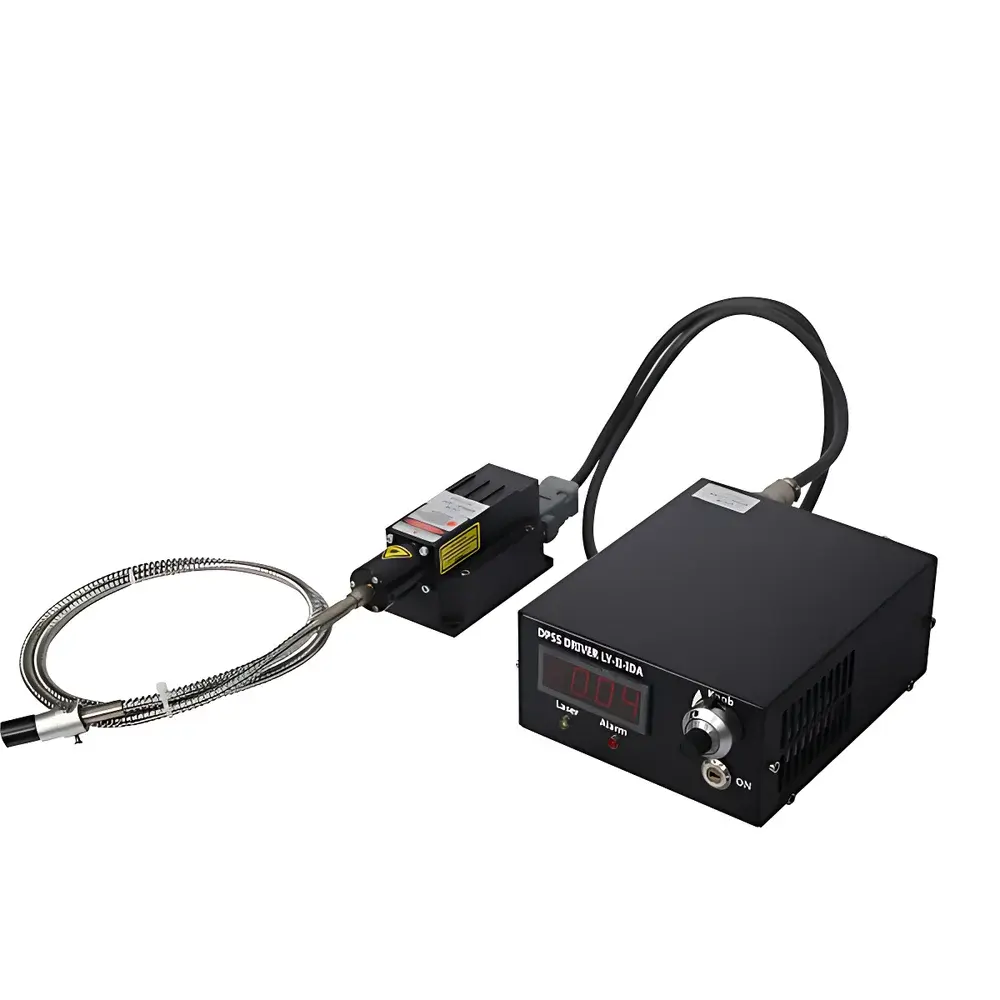
PLS-LD Laboratory Laser Light Source
| Brand | PerfectLight (PoPhilai) |
|---|---|
| Origin | Beijing, China |
| Model | LD Light Source |
| Light Source Type | Monochromatic Diode Laser |
| Illumination Mode | External Irradiation |
| Output Power | >100 mW (wavelength-dependent) |
| Spectral Bandwidth (FWHM) | <2.5 nm |
| Beam Divergence | ≤60° (with fiber + collimating lens), ≤1.2 mrad (collimated beam) |
| Collimated Beam Aperture | 40 mm |
| Available Wavelengths | 405 nm, 447 nm, 473 nm, 532 nm, 635 nm, 671 nm |
| Output Options | Free-space direct output or fiber-coupled (optional kit) |
| Warm-up Time | <8 min |
| Modulation Support | TTL and Analog, up to 20 kHz |
Overview
The PLS-LD Laboratory Laser Light Source is a precision-engineered monochromatic illumination system designed for quantitative photochemical and optoelectrochemical research. Unlike broadband sources such as xenon or mercury arc lamps—whose spectral output requires filtering and suffers from inherent intensity instability and broad FWHM—the PLS-LD employs high-reliability semiconductor diode lasers to deliver narrowband, high-spectral-purity irradiation. Its core operating principle relies on stimulated emission within a solid-state gain medium, enabling diffraction-limited beam quality, exceptional wavelength stability (<±0.1 nm drift after thermal equilibrium), and reproducible photon flux delivery. This makes it particularly suitable for experiments demanding strict photonic control: quantum yield determination, action spectrum analysis, and time-resolved photocurrent measurements in photoelectrochemical cells (PEC). The system is engineered for integration into glovebox-contained photocatalytic reactors, electrochemical workstations, and custom optical benches where spatial coherence, temporal stability, and spectral fidelity are non-negotiable.
Key Features
- Monochromatic output with FWHM <2.5 nm—significantly narrower than filtered arc lamps or high-CRI LEDs—ensuring minimal spectral contamination in wavelength-resolved studies.
- Thermally stabilized laser diode platform with active temperature regulation (±0.05 °C) and low-noise constant-current drivers, guaranteeing power stability better than ±1.5% over 8-hour continuous operation.
- Two standardized irradiation modes: collimated beam (40 mm clear aperture, divergence ≤1.2 mrad) for uniform planar irradiation; and fiber-coupled output (SMA905 interface, optional coupling kit) for flexible light delivery into confined or sealed reaction chambers.
- Multi-wavelength configurability: six discrete emission wavelengths (405–671 nm) cover key absorption bands of common photocatalysts (e.g., TiO₂, g-C₃N₄, perovskites, porphyrins) and enable systematic investigation of wavelength-dependent reaction kinetics.
- Real-time intensity modulation support via TTL (0–5 V) and analog (0–5 V) inputs, enabling synchronized triggering with lock-in amplifiers, potentiostats, or data acquisition systems at frequencies up to 20 kHz—critical for phase-sensitive photocurrent detection and transient absorption setups.
- Short warm-up time (<8 minutes to full spectral and power stability) minimizes experimental downtime and improves throughput in multi-wavelength comparative studies.
Sample Compatibility & Compliance
The PLS-LD is compatible with standard quartz and fused-silica optical windows, borosilicate reaction vessels, and optically transparent electrochemical cells (e.g., three-electrode PEC cells with ITO- or FTO-coated substrates). Its external irradiation geometry allows seamless integration with commercial photochemical reactors (e.g., Topochem, Newport, or custom-built systems) without requiring internal lamp replacement. All electrical components comply with IEC 61010-1 safety standards for laboratory equipment. While the system itself does not carry CE or FDA certification, its optical output parameters—including radiometric power calibration traceable to NIM (National Institute of Metrology, China)—support GLP-compliant documentation when used in conjunction with calibrated photodiode sensors (e.g., Thorlabs S120VC) and NIST-traceable reference standards. For regulated environments (e.g., ISO 17025-accredited labs), users may implement audit-ready log files via the optional analog monitoring output.
Software & Data Management
The PLS-LD operates as a standalone hardware module with no proprietary software dependency. Power level, modulation mode, and status indicators are controlled via front-panel buttons and LED feedback. For automated workflows, the analog and TTL interfaces enable full integration with LabVIEW, Python (PyVISA), MATLAB, or electrochemical software suites (e.g., CHI, Gamry Framework). Users can script ramp sequences, synchronize laser pulses with potentiostat voltage steps, or log real-time power drift using external DAQ devices. All operational parameters—including cumulative runtime, thermal history, and modulation duty cycles—are accessible via RS-232 serial command set (ASCII protocol), supporting metadata embedding in raw experimental datasets for FAIR (Findable, Accessible, Interoperable, Reusable) data practices.
Applications
- Quantum Yield Measurement: Enables absolute actinometry using chemical actinometers (e.g., potassium ferrioxalate) under rigorously defined monochromatic irradiance—essential for reporting ΦH₂, ΦO₂, or ΦCO in peer-reviewed photochemistry literature.
- Photoelectrochemical Characterization: Provides stable, wavelength-specific excitation for incident photon-to-current efficiency (IPCE) mapping and Mott–Schottky analysis of semiconductor photoanodes/cathodes.
- Wavelength-Dependent Reaction Kinetics: Supports mechanistic studies of photocatalytic H₂ evolution, CO₂ reduction, and organic pollutant degradation across the visible spectrum.
- Photoredox Catalysis Screening: Delivers precise photon flux for evaluating Ru/Ir-based or organic photocatalysts in synthetic chemistry protocols under controlled irradiation conditions.
- Optical Sensor Calibration: Serves as a stable reference source for calibrating spectroradiometers, integrating spheres, and quantum sensors in metrology labs.
FAQ
Is the PLS-LD compliant with ISO/IEC 17025 requirements for accredited testing laboratories?
While the unit itself is not third-party certified, its traceable power output, thermal stability profile, and digital logging capability support compliance when paired with validated measurement chains and documented uncertainty budgets.
Can the laser output be calibrated against NIST-traceable standards?
Yes—PerfectLight provides factory calibration reports referenced to NIM standards; end-users may perform in-house recalibration using NIST-traceable thermopile or photodiode sensors.
What safety class does the PLS-LD fall under?
Depending on selected wavelength and output power, models operate within Class 3B (e.g., 532 nm @ >5 mW) or Class 4 (e.g., 405 nm @ >500 mW); appropriate laser safety eyewear and interlock integration are mandatory per ANSI Z136.1.
Is remote computer control supported out of the box?
Yes—RS-232 interface enables bidirectional communication for power setting, status query, and error reporting without additional hardware.
Does the system support pulsed operation with variable duty cycle?
Yes—TTL input accepts square-wave signals up to 20 kHz; analog input permits continuous linear power adjustment from 10% to 100% of maximum rated output.





