
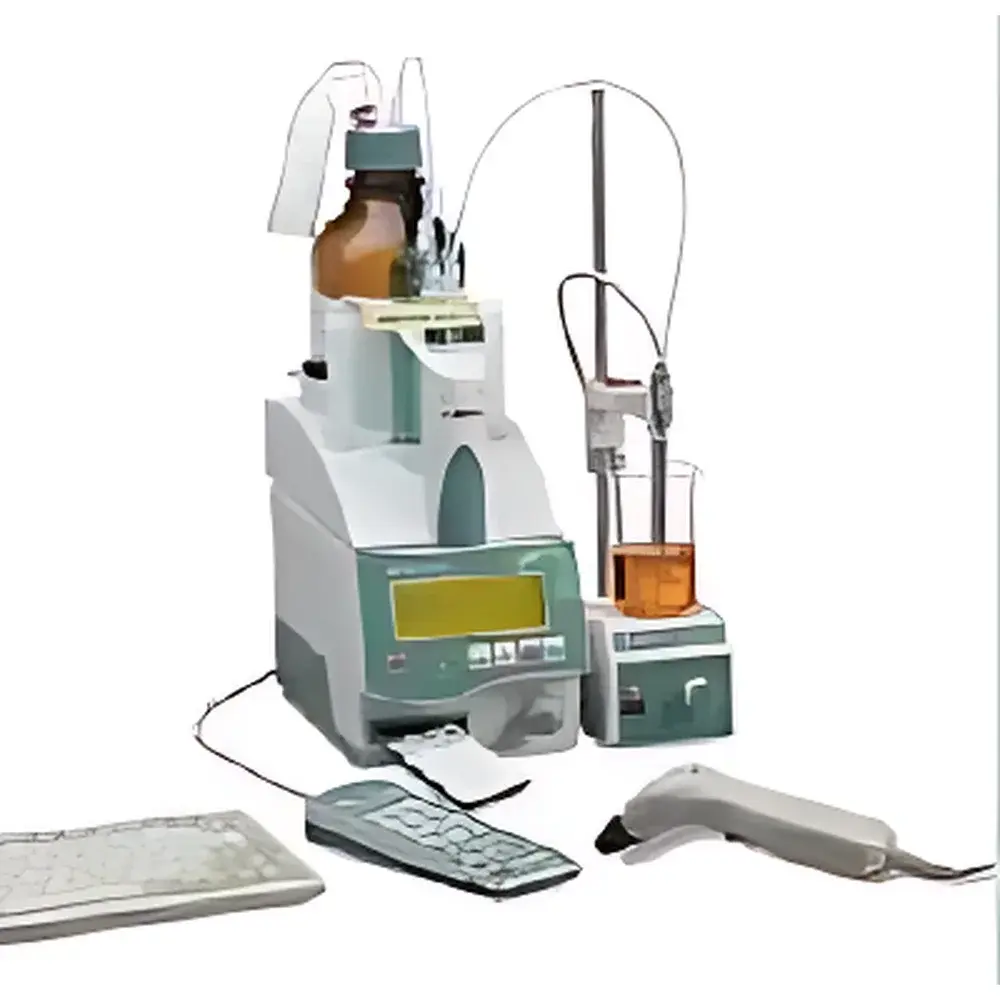
Metrohm 798 Professional Automatic Potentiometric Titrator
| Origin | Switzerland |
|---|---|
| Titration Volume Options | 1, 2, 5, 10, 20, or 50 mL |
| pH Range | 0 to ±20.00 |
| Potential Range | ±2000 mV |
| Current Range | ±200.0 µA |
| Temperature Range | −150.0 to +450.0 °C |
| Titration Resolution | 1/10,000 of burette volume |
| Absolute Accuracy (10 mL burette) | ±0.02 mL |
| Relative Accuracy (10 mL burette) | ±0.2% |
| Input Impedance | >10¹³ Ω |
| Polarization Current | ±127 µA |
| Polarization Potential | ±1270 mV (10 mV steps) |
| Electrode Inputs | 2 high-impedance measuring, 1 reference, 1 polarization, 1 temperature sensor |
| Method Storage Capacity | 100 methods |
| Dimensions (W×H×D) | 150 × 450 × 275 mm |
Overview
The Metrohm 798 Professional Automatic Potentiometric Titrator is a high-precision, modular electrochemical analysis platform engineered for rigorous routine and research-grade potentiometric titrations. Based on the proven Metrohm Titrando architecture, it implements classical potentiometric endpoint detection—measuring potential changes across a redox, acid–base, precipitation, or complexometric reaction—as a function of titrant addition. Its design emphasizes signal integrity, thermal stability, and reproducible fluid handling, making it suitable for applications demanding compliance with ISO 8655 (burette accuracy), ASTM E2087 (potentiometric titration practice), and pharmacopeial monographs (e.g., USP , EP 2.2.20). Unlike entry-level titrators, the 798 Professional integrates dual high-impedance electrometer channels, active temperature compensation (±15 µV/K drift correction), and a dedicated differential amplifier stage optimized for low-conductivity non-aqueous media—critical for Karl Fischer coulometric and volumetric water determination per ISO 13733 and ASTM D6304.
Key Features
- Real-time graphical display of titration curves on a high-contrast LCD screen, supporting simultaneous visualization of potential (mV), pH, derivative (dE/dV), and temperature vs. titrant volume
- Modular burette system with six interchangeable volumes (1, 2, 5, 10, 20, or 50 mL), each calibrated to ISO 8655 Class A tolerances and delivering ±0.02 mL absolute accuracy at 10 mL
- TIP (Titration Intelligent Programming) software engine enabling up to 30 sequential titration steps—including conditional branching, multi-equivalence point detection, and dynamic dosing control—within a single method
- Dual independent high-impedance input channels (>10¹³ Ω) for simultaneous monitoring of two working electrodes, supporting redox pair analysis and dual-sensor validation protocols
- Integrated polarization module (±127 µA current, ±1270 mV potential in 10 mV increments) for controlled potential electrolysis, amperometric titrations, and electrode conditioning
- Expandable method library storing up to 100 user-defined titration procedures; supports external SD card for archival of validated methods and historical calibration records
Sample Compatibility & Compliance
The 798 Professional accommodates diverse sample matrices—from aqueous buffers and organic solvents (e.g., methanol, chloroform, DMF) to viscous oils, crude petroleum fractions, and solid suspensions via automated sample homogenization add-ons. Its low-noise electrometer and differential amplification stage ensure stable baseline performance in non-aqueous systems with conductivities as low as 1 µS/cm. The instrument meets essential regulatory requirements for quality-controlled environments: full audit trail capability (user login, method execution, result export), electronic signature support aligned with FDA 21 CFR Part 11 Annex 11 principles, and GLP/GMP-compliant data integrity through encrypted local storage and time-stamped event logging. It is routinely deployed in laboratories accredited to ISO/IEC 17025 for testing in pharmaceutical raw material release, fuel sulfur content (ASTM D7042), and wastewater chloride quantification (EPA 325-B).
Software & Data Management
Operation is managed via Metrohm’s tiamo™ software (v3.x or later), which provides method development, instrument control, real-time data acquisition, and automated report generation. All titration data—including raw potential values, first/second derivatives, equivalence point calculations, and statistical summaries—are stored in vendor-neutral .csv and .pdf formats. The system supports direct integration with LIMS via OPC UA or ODBC drivers, and includes built-in validation tools for IQ/OQ documentation. Raw signal files retain full resolution (16-bit ADC sampling at 10 Hz), enabling post-acquisition reprocessing using alternative endpoint algorithms (e.g., Gran plot, inflection point, or least-squares fitting) without re-running samples.
Applications
- Pharmaceutical QC: assay of active pharmaceutical ingredients (APIs), residual solvent analysis, and Karl Fischer water determination in lyophilized powders and injectables
- Petrochemical testing: total acid number (TAN) and total base number (TBN) per ASTM D664 and D2896; chloride ion quantification in jet fuel (ASTM D3229)
- Environmental analysis: cyanide speciation (ISO 6703), fluoride in drinking water (ISO 10359), and sulfide titration in anaerobic digester sludge
- Food & beverage: titratable acidity in wines and dairy products (AOAC 942.15), free fatty acids in edible oils (ISO 660), and preservative (sorbate/benzoate) quantification
- Academic research: mechanistic studies of proton-coupled electron transfer (PCET) reactions and kinetic profiling of slow-step titrations using programmable pause intervals
FAQ
Does the 798 Professional support both volumetric and coulometric Karl Fischer titration?
Yes—it operates in volumetric mode natively; coulometric KF requires optional integration of a Metrohm Coulometer Module (e.g., 851 Coulotherm) and compatible generator anode cell.
Can I import legacy methods from older Metrohm titrators (e.g., Titrino or 756)
tiamo™ includes backward-compatible method converters for Titrino (.met) and 756 (.tdf) files, preserving all titration parameters, dosing logic, and endpoint criteria.
Is temperature compensation mandatory during pH titrations?
While not mandatory, the integrated Pt1000 sensor input enables automatic Nernst equation correction per IUPAC recommendations, improving accuracy to ±0.002 pH units across −10 to 100 °C.
What validation documentation is provided with the instrument?
Each unit ships with Factory Calibration Certificate (traceable to METAS), IQ/OQ protocol templates, and a complete set of metrological verification procedures compliant with ISO/IEC 17025 Clause 6.5.
How is electrode drift monitored during extended batch analyses?
The system logs open-circuit potential (OCP) before each titration and triggers configurable alerts if drift exceeds user-defined thresholds (e.g., >2 mV/30 min), ensuring measurement consistency across multi-hour sequences.
Related Products





