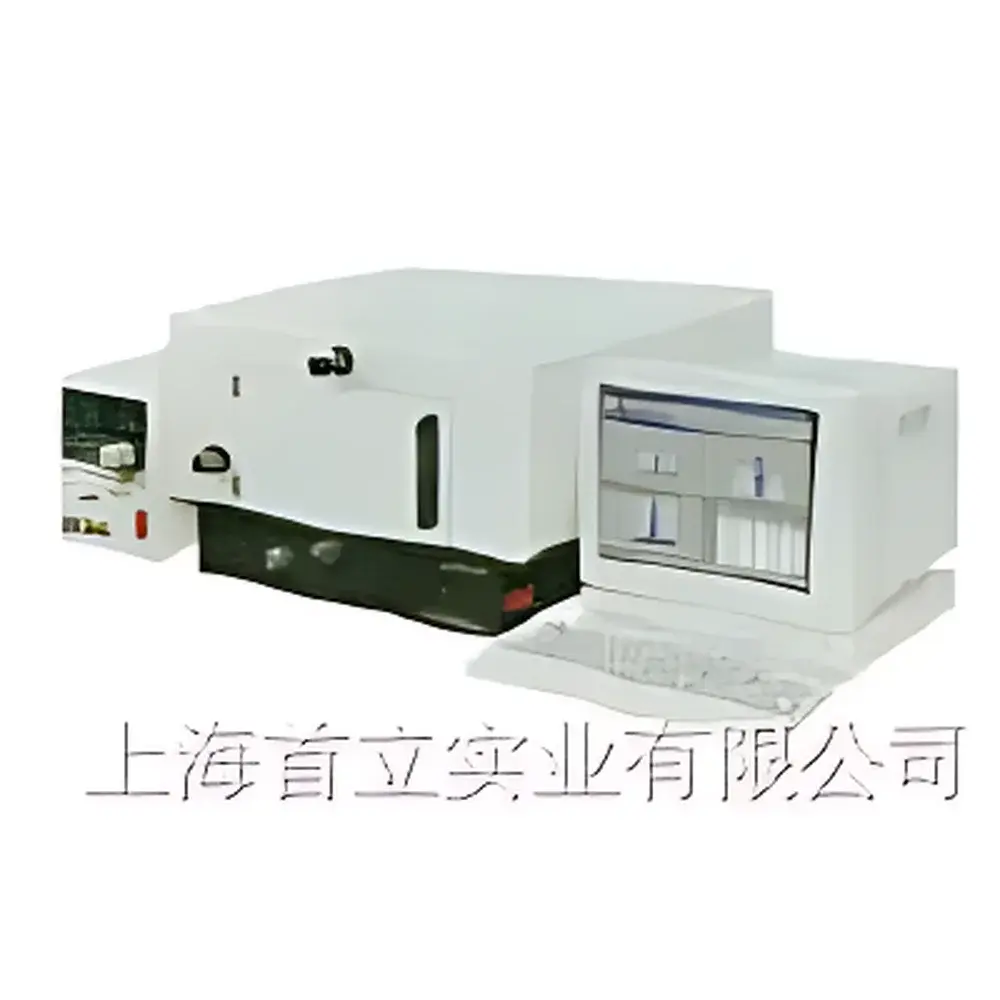
LED-5000 LED Luminous Intensity Distribution Measurement System
| Origin | Japan |
|---|---|
| Manufacturer Type | Authorized Distributor |
| Origin Category | Imported |
| Model | LED-5000 |
| Quotation | Upon Request |
| Luminous Intensity Measurement Angle Range | ±90° |
| Angular Resolution | 1° or 2° selectable |
| Angular Accuracy | ≤ ±0.25° |
| Photodetector | Silicon Photodiode |
| Spectral Response Range | 320–1100 nm |
| Test Distance | 100 mm |
| Aperture Diameter | 3.6 mm |
| Cap Diameter | Standardized for collimated beam alignment |
| Sensitivity Adjustment | Automatic |
| PC Interface | RS-232C serial port |
| Dimensions (W×D×H) | 500 × 440 × 430 mm |
| Constant Current/Voltage Source Output | 0–100 mA / 0–10 V |
| Current Setting Accuracy | ±0.1 mA, Temp. Coefficient: 200 ppm/℃ |
| Software Compatibility | Windows OS (7/10/11) |
| Data Export Format | CSV |
Overview
The LED-5000 LED Luminous Intensity Distribution Measurement System is a precision goniophotometric instrument engineered for quantitative characterization of spatial luminous intensity distribution (LID) of light-emitting diodes under controlled electrical and thermal conditions. Based on the fundamental principle of goniophotometry—measuring photometric quantities as a function of solid angle—the system rotates the detector around a fixed LED sample mounted at the origin of a spherical coordinate system, enabling full hemispherical (±90° in elevation, 360° in azimuth) acquisition of candela (cd) values per angular increment. Designed in accordance with CIE S 025/E:2015 and IES LM-79-19 measurement protocols, the LED-5000 supports traceable, repeatable evaluation of key photometric performance indicators including total luminous flux (lumens), beam angle, peak intensity direction, and candela distribution curves—critical parameters for optical design validation, regulatory compliance, and quality assurance in LED manufacturing and lighting R&D.
Key Features
- High-accuracy goniometric stage with angular resolution configurable to 1° or 2°, achieving angular positioning repeatability better than ±0.05° and absolute accuracy ≤ ±0.25° over the full ±90° vertical range.
- Calibrated silicon photodiode detector with spectral responsivity covering 320–1100 nm, enabling broadband measurement of visible, near-UV, and near-IR LED emissions without spectral correction artifacts.
- Integrated constant-current/constant-voltage source (0–100 mA / 0–10 V) featuring digital current setting resolution of 0.1 mA and temperature-stable output (200 ppm/℃ drift), eliminating external driver dependency and ensuring stable bias conditions during measurement.
- XYZ-adjustable sample stage with micrometer-driven translation (±5 mm range, 10 µm resolution), allowing precise alignment of the LED die center to the goniometer’s rotational axis—essential for minimizing cosine error and spatial averaging effects.
- Automatic sensitivity gain control and real-time signal normalization, compensating for wide dynamic range (typically >10⁴ cd) across high-brightness and low-flux emitters without manual range switching.
- RS-232C interface compliant with standard SCPI command syntax, supporting automated test sequences, synchronization with external environmental chambers, and integration into factory metrology networks.
Sample Compatibility & Compliance
The LED-5000 accommodates standard through-hole (T-1¾, T-1, etc.) and surface-mount (SMD2835, SMD3030, SMD5050, COB packages) LED devices, provided mechanical mounting fixtures are used to secure the sample at the designated 100 mm test distance from the aperture plane. The 3.6 mm diameter entrance aperture ensures minimal vignetting while maintaining adequate field-of-view for typical LED emission profiles. All photometric measurements conform to international standards including CIE Publication No. 127:2007 (Measurement of LEDs), IEC 62031 (LED modules safety), and ISO/IEC 17025 requirements for accredited calibration laboratories. The system architecture supports GLP-compliant operation via software audit trails, user access levels, and timestamped raw data logging—facilitating FDA 21 CFR Part 11 readiness when paired with validated Windows-based control software.
Software & Data Management
The bundled Windows-compatible application provides full instrument control, real-time visualization, and post-processing functionality. Users configure measurement sequences—including angular step size, dwell time, current/voltage setpoints, and averaging iterations—via an intuitive graphical interface. Acquired luminous intensity data are displayed simultaneously as polar plots, Cartesian graphs, and tabular listings; all visualizations support logarithmic scaling, interpolation, and comparative overlay of multiple datasets. Raw measurement records include metadata such as timestamp, ambient temperature, drive current, detector gain, and calibration certificate ID. Export options include native .csv format for import into Excel, MATLAB, or optical simulation tools (e.g., LightTools, TracePro), as well as .png/.svg vector graphics for technical documentation. Software updates and firmware patches are distributed via secure HTTPS portal with version-controlled release notes.
Applications
- Characterization of directional emission patterns for automotive headlamp LEDs, display backlight units, and architectural accent lighting modules.
- Verification of beam shaping optics (lenses, reflectors, diffusers) by comparing measured LID against ray-tracing simulations.
- Quality control screening in LED packaging lines—detecting die misalignment, phosphor coating non-uniformity, or encapsulant voids that manifest as asymmetry or hotspots in intensity distribution.
- Development and validation of photometric models for energy-efficient lighting products seeking ENERGY STAR, DLC, or CE marking.
- Academic research in solid-state lighting physics, including studies of far-field radiation patterns, Lambertian deviation analysis, and thermal roll-off effects on angular color uniformity.
FAQ
Is the LED-5000 compatible with high-power COB LEDs requiring active thermal management?
Yes—while the base system does not include an integrated heatsink or thermoelectric cooler, it supports external thermal control interfaces via analog voltage input (0–10 V) for synchronized temperature monitoring and closed-loop bias adjustment during extended measurements.
Does the system provide NIST-traceable calibration certificates?
Calibration is performed using reference standards traceable to NMIJ/AIST (Japan) or PTB (Germany); optional ISO/IEC 17025-accredited calibration certificates with uncertainty budgets are available upon request.
Can the software generate IESNA LM-63 photometric files?
Native export to IES (.ies) and EULUMDAT (.ldt) formats is supported through optional licensed modules, enabling direct import into lighting design software such as AGi32 and Dialux.
What is the minimum measurable luminous intensity?
With automatic gain optimization and low-noise amplification, the effective lower limit is approximately 0.01 cd at 1° resolution, assuming optimal signal-to-noise ratio and stable thermal conditions.
Are replacement apertures or custom collimation tubes available?
Standard accessories include interchangeable apertures (2.0 mm, 5.0 mm) and calibrated diffusers for extended dynamic range; OEM-specific collimators can be commissioned under NDA with lead times of 8–12 weeks.