
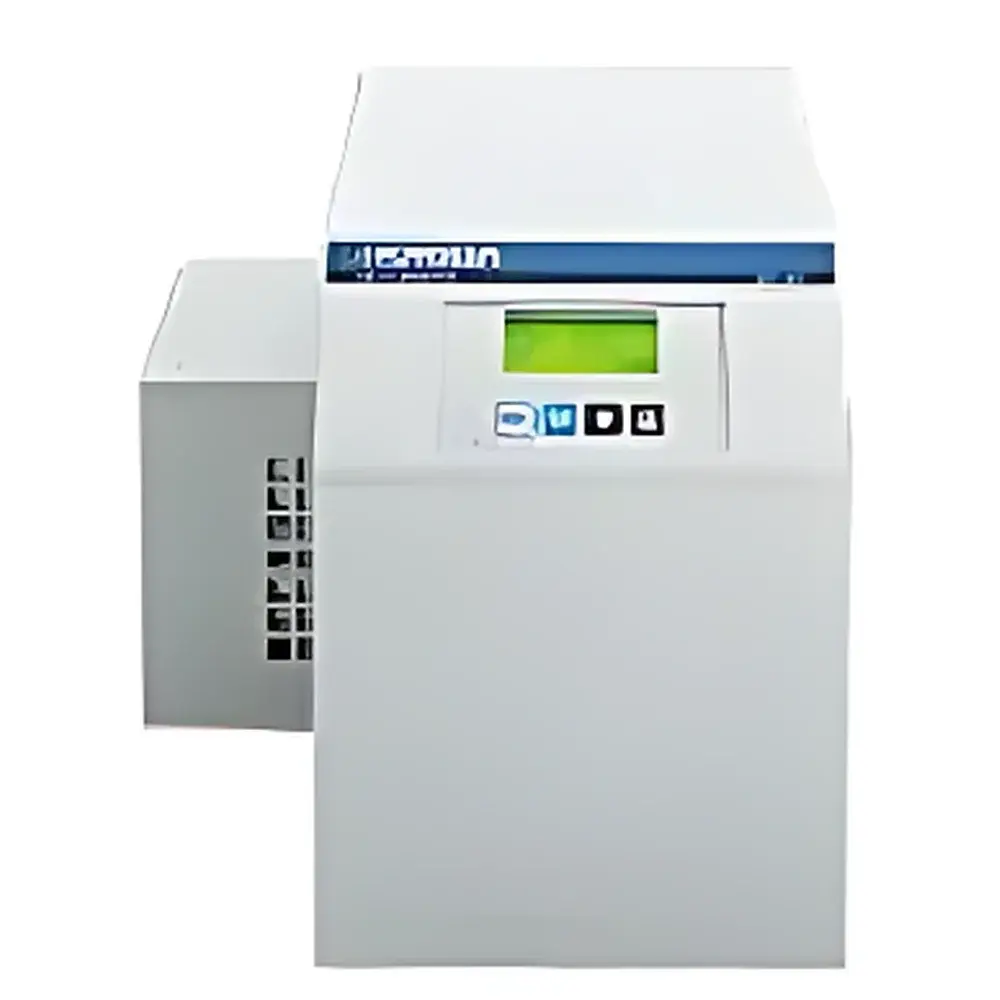
Horiba CS-131 SC-1 Concentration Analyzer for Semiconductor Wet Cleaning Processes
| Origin | Japan |
|---|---|
| Type | Imported Instrument |
| Model | CS-131 / CS-131C (with integrated cooler) |
| Measurement Principle | UV-Vis Absorption Spectrophotometry |
| Analyte | SC-1 solution (NH₃ / H₂O₂ / H₂O) |
| Response Time | ≈2 s (excluding fluid exchange & cooling time) |
| NH₃ Range Options | 0.00–1.00%, 0.00–3.00%, or 0.00–5.00% w/w |
| H₂O₂ Range Options | 0.00–5.00%, 0.00–7.00%, or 0.00–10.00% w/w |
| H₂O Range | 85.0–100.0% w/w |
| Repeatability | NH₃ ±0.15–±0.25%, H₂O₂ ±0.3%, H₂O ±1.5% |
| Operating Temp. | CS-131: 20–30°C |
| CS-131C | 20–80°C |
| Flow Rate | CS-131: 20–60 mL/min |
| CS-131C | 20–40 mL/min |
| Pressure | 0.10–0.20 MPa |
| Power Supply | DC 24 V ±10%, 2 A |
| Output Interfaces | RS-232C, 4–20 mA (dual-channel), open-collector digital outputs, opto-isolated parallel inputs |
| Dimensions (W×D×H) | CS-131: 205 × 329 × 269 mm |
| CS-131C | 291 × 329 × 269 mm |
| Weight | CS-131: ~11 kg |
| CS-131C | ~12 kg |
| Tubing | 3 mm OD / 2 mm ID (Nippon Pillar Super fittings) |
Overview
The Horiba CS-131 SC-1 Concentration Analyzer is an in-line, real-time process monitoring instrument engineered for semiconductor front-end manufacturing, specifically designed to quantify the active components—ammonia (NH₃), hydrogen peroxide (H₂O₂), and water—in Standard Clean-1 (SC-1) solutions used during wafer surface cleaning. Unlike conventional titration or conductivity-based methods, the CS-131 employs UV-Vis absorption spectrophotometry coupled with temperature-compensated multivariate analysis to resolve overlapping spectral signatures of NH₃ and H₂O₂ in aqueous matrixes. This optical methodology enables continuous, non-invasive, and reagent-free measurement without sample dilution or chemical consumption. Its ≈2-second cycle time supports closed-loop concentration control in both batch and single-wafer cleaning tools, ensuring adherence to stringent process windows defined by ITRS and SEMI standards. The analyzer operates within Class 100 cleanroom environments and is built to withstand aggressive chemistries typical of advanced node fabrication (≤7 nm), including high-purity SC-1 formulations used in gate-last and EUV mask cleaning processes.
Key Features
- Real-time dual-component quantification: Simultaneous determination of NH₃ and H₂O₂ concentrations with configurable range options to match process-specific requirements (e.g., 0.00–5.00% NH₃ and 0.00–10.00% H₂O₂).
- Integrated thermal management: The CS-131C variant incorporates a built-in Peltier cooler enabling stable operation across a broad sample temperature range (20–80°C), eliminating external chiller dependency and reducing system footprint.
- Robust bubble mitigation architecture: A dedicated degassing chamber precedes the flow cell, followed by solenoid-valve-controlled purge cycles to minimize optical path disturbance from microbubbles—critical for reliable measurement in high-temperature, low-surface-tension SC-1 streams.
- Compact mechanical design: With a base area reduced to ~67% of legacy models (e.g., CS-220 series), the CS-131 facilitates direct integration into space-constrained wet bench manifolds and OEM cleaning equipment.
- Functional safety compliance: Powered by SELV-rated DC 24 V supply and equipped with an embedded liquid leak sensor that triggers automatic chemical shutoff upon detection—supporting ISO 13849-1 PL d and SEMI S2-0216 electrical safety requirements.
- Zero-reference calibration: Uses ambient air as optical reference, eliminating need for deionized water blanks or daily recalibration routines—reducing operator intervention and maintenance overhead.
Sample Compatibility & Compliance
The CS-131 is validated for use with SC-1 solutions meeting SEMI C1–C10 purity specifications and is compatible with standard quartz or sapphire flow cells rated for 0.10–0.20 MPa operating pressure. It maintains measurement integrity under variable flow conditions (20–60 mL/min for CS-131; 20–40 mL/min for CS-131C) and tolerates trace metallic contaminants common in reclaimed chemistries. All wetted materials—including fluidic pathways, seals, and optical windows—are selected for resistance to NH₃-induced stress corrosion cracking and H₂O₂ oxidation (e.g., PFA-lined stainless steel, fused silica optics). The analyzer conforms to SEMI E10-0217 (Specification for Process Equipment Safety) and supports audit-ready data logging compliant with FDA 21 CFR Part 11 when paired with Horiba’s optional secure software package. It does not require periodic verification against NIST-traceable standards due to its self-referencing optical architecture and factory-installed multivariate calibration models.
Software & Data Management
The CS-131 delivers analog (4–20 mA) and digital (RS-232C) outputs for seamless integration into factory automation systems (SECS/GEM, OPC UA). Concentration values, alarm states (low-low, low, high, high-high), device health status, and leak detection signals are transmitted in ASCII format with configurable polling intervals. Optional Horiba ProcessLink™ software provides time-series visualization, trend analysis, and automated report generation aligned with ISO/IEC 17025 documentation requirements. All parameter changes—including alarm thresholds and output scaling—are logged with user ID and timestamp, satisfying GLP/GMP electronic record retention mandates. No proprietary drivers or OS-specific dependencies are required; communication protocols are fully documented in the publicly available Horiba Technical Interface Manual (TIM-SC131 Rev. 4.2).
Applications
Primary deployment includes real-time feedback control of NH₃/H₂O₂ replenishment in immersion and spray-type SC-1 cleaning modules for 200 mm and 300 mm silicon wafers. It supports yield-critical applications such as post-etch residue removal, pre-gate oxide cleaning, and EUV photomask defect mitigation. Secondary use cases extend to concentration monitoring in SC-2 (HCl/H₂O₂/H₂O) and dilute HF chemistries when configured with alternate calibration models. The analyzer is widely adopted in foundry, memory, and logic fabs certified to ISO 9001:2015 and IATF 16949, where consistent SC-1 composition directly correlates with particle removal efficiency (PRE), metallic contamination control (as measured by TXRF), and oxide etch rate uniformity (±0.8% 3σ across 300 mm wafers).
FAQ
Does the CS-131 require daily calibration or reference standards?
No. The system uses air as the optical reference and relies on factory-derived multivariate calibration models. Routine verification is performed via system suitability checks using certified SC-1 reference solutions (available as Horiba part #REF-SC1-KIT), recommended quarterly or after major maintenance.
Can the CS-131 operate continuously in a 24/7 fab environment?
Yes. Designed for unattended operation with MTBF >15,000 hours, it features redundant thermal protection, sealed electronics, and fail-safe leak detection—all validated per SEMI E10 reliability testing protocols.
Is the CS-131 compatible with Industry 4.0 data infrastructure?
Yes. RS-232C output supports Modbus RTU mapping, and optional Ethernet gateway modules enable MQTT/HTTP(S) publishing to cloud-based MES or APC platforms without middleware.
What maintenance is required beyond routine tubing replacement?
Annual inspection of optical windows for deposition buildup and validation of temperature sensor accuracy using a NIST-traceable dry-block calibrator (±0.1°C tolerance). No lamp replacement is needed—the UV-Vis source has a rated lifetime of >10,000 hours.
How does the CS-131 handle drift caused by aging of H₂O₂ in recirculated baths?
The multivariate algorithm explicitly accounts for H₂O₂ decomposition kinetics by incorporating real-time temperature and spectral baseline correction—enabling accurate quantification even in static bath configurations with turnover times exceeding 48 hours.





