
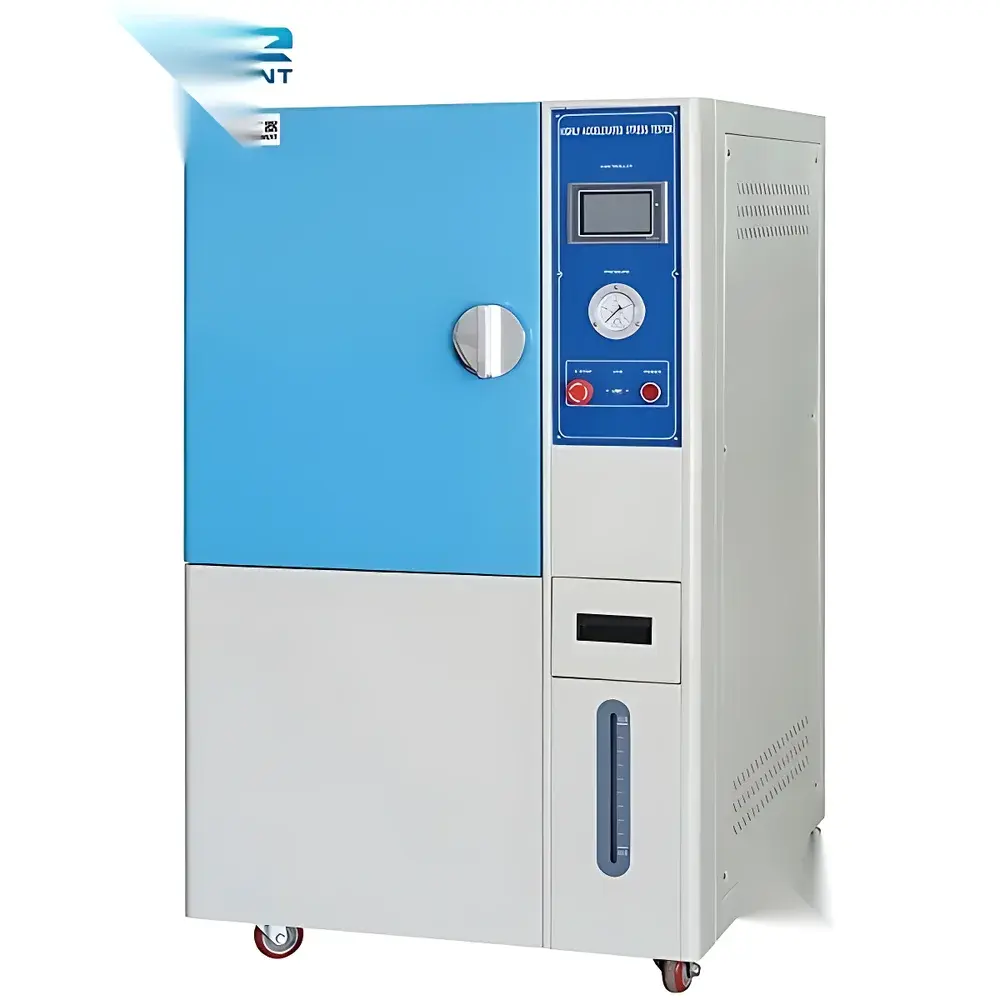
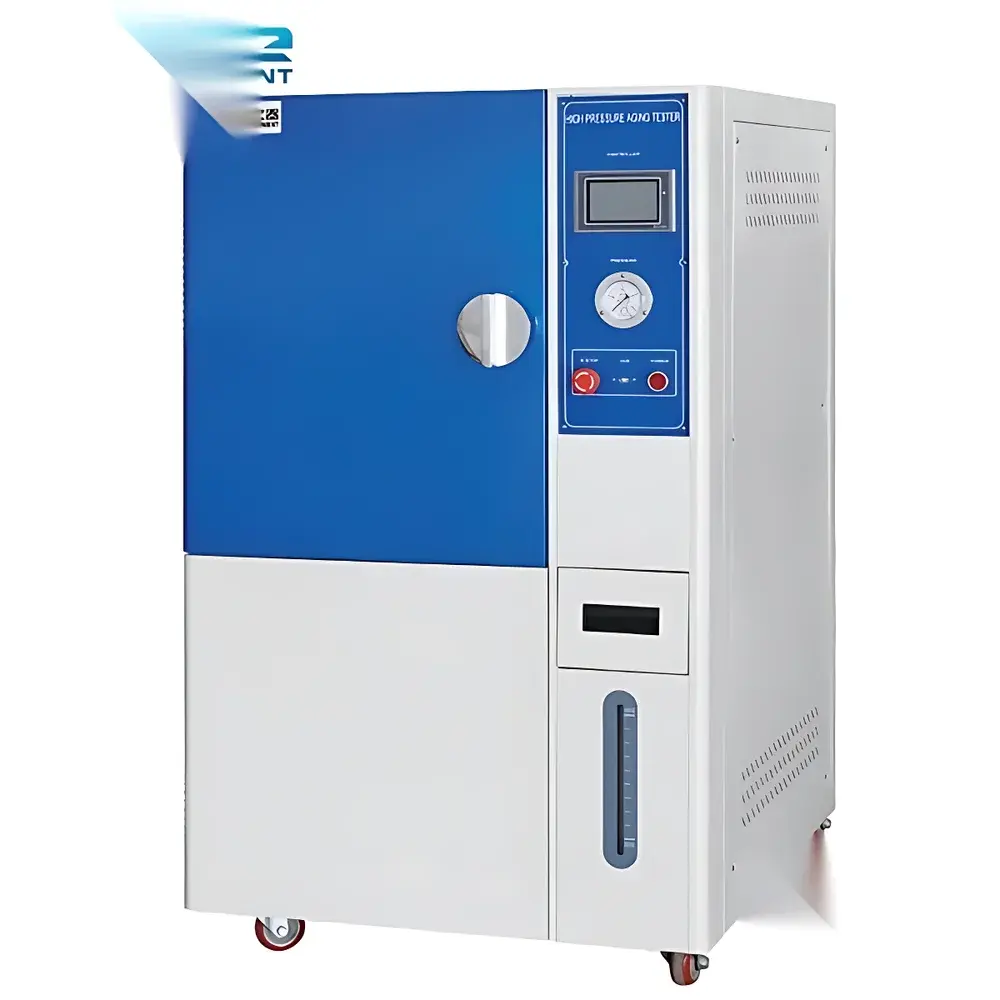
OK-PTC Series PCT Pressure Cooker Test Chamber – High-Temperature, High-Pressure, 100% RH Steam Aging Chamber
| Brand | OK-PTC |
|---|---|
| Model Options | OK-PTC-25 (Ø250 × 450 mm), OK-PTC-35 (Ø350 × 500 mm) |
| Temperature Range | RT + 10°C to 132°C |
| Humidity Range | 100% RH (saturated steam environment) |
| Pressure Range | 0.0–2.8 kg/cm²(g) (relative gauge pressure) |
| max vessel design pressure | 4.0 kg/cm²(g) |
| Temperature Uniformity | ±1.5°C |
| Temperature Control Accuracy | ±0.5°C |
| Temperature Resolution | 0.1°C |
| Heating Method | Stainless Steel U-shaped Electric Steam Generator |
| Humidification Water Supply | Integrated 10 L Stainless Steel RO-Filtered Auto-Replenishment Tank |
| Cooling & Load Regulation | Air-Cooled Multi-Stage Automatic Capacity Control System |
| Evaporator | Taiwan Zhongli Finned-Tube Type |
| Expansion Valve | Danfoss Automatic Capacity-Controlled Valve |
| Safety Systems | Dual-Limit Overpressure Cut-off, Vacuum-Assisted Air Purge (≤1 µm particulate filtration), Interlocked Door with Pressure-Activated Sealing Mechanism |
| Power Supply | AC 220 V, 1-phase, 50/60 Hz, 15 A, 4 kW |
| Dry-Out Function | Programmable Post-Test Desiccation Cycle |
| Warranty | 12 months comprehensive system coverage (excludes force majeure and misuse) |
Overview
The OK-PTC Series PCT (Pressure Cooker Test) Chamber is an engineered environmental stress test system designed for accelerated reliability evaluation of electronic components, PCB assemblies, plastic enclosures, and moisture-sensitive devices under combined high-temperature, high-pressure, and saturated steam (100% RH) conditions. Operating on the principle of pressurized saturated steam aging—where elevated partial pressure of water vapor significantly accelerates hydrolytic degradation mechanisms—the chamber replicates years of field exposure in days or weeks. Unlike conventional humidity chambers, the OK-PTC achieves thermodynamic equilibrium between temperature, pressure, and relative humidity via precise steam saturation control, enabling reproducible IPC-J-STD-020, JEDEC JESD22-A102, and MIL-STD-202H Method 108 compliant testing. Its cylindrical horizontal chamber geometry minimizes condensate pooling and ensures uniform thermal-moisture exposure while enhancing operator safety through passive mechanical door sealing.
Key Features
- Pressure-Actuated Self-Sealing Door: Utilizes internal gauge pressure to enhance gasket compression against the chamber wall—eliminating reliance on external latches or hydraulic clamps and extending gasket service life by up to 3× versus traditional compression seals.
- Vacuum-Assisted Air Purge: Pre-test evacuation removes ambient air and replaces it with filtered intake air (≤1 µm particulate retention), ensuring low-oxygen, contaminant-controlled steam environments critical for oxidation-sensitive materials.
- Multi-Stage Thermal Load Management: Integrates air-cooled condensation, finned-tube evaporators (Zhongli, Taiwan), and Danfoss thermostatic expansion valves to maintain stable saturation conditions across dynamic pressure ramping profiles.
- Continuous Operation Support: RO-filtered auto-replenishment system with 10 L integrated stainless steel reservoir enables uninterrupted 100-hour test cycles; optional full automation available upon request.
- Fail-Safe Protection Architecture: Dual independent overpressure limit switches, real-time vacuum integrity monitoring, and automatic depressurization at test completion comply with ASME BPVC Section VIII Div. 1 pressure equipment safety requirements.
- Programmable Dry-Out Sequence: Post-test desiccation cycle removes residual moisture from samples and chamber interior, mitigating post-test corrosion and enabling rapid turnaround.
Sample Compatibility & Compliance
The OK-PTC accommodates a broad range of sample geometries—including stacked PCBs, molded connectors, wafer-level packages, and encapsulated sensors—within its horizontally oriented cylindrical cavity. Its design supports standard IPC, JEDEC, and automotive AEC-Q200 test protocols requiring controlled steam aging at 121°C/2 atm (100% RH), 132°C/3 atm (100% RH), or custom pressure-temperature setpoints. All control logic and data logging functions adhere to GLP/GMP documentation standards, with optional audit trail configuration supporting FDA 21 CFR Part 11 compliance. Mechanical interlocks, pressure-rated viewports, and redundant safety cut-offs ensure conformity with ISO 13857 (safety distances) and IEC 61000-6-2/6-4 EMC immunity/emission requirements.
Software & Data Management
Equipped with a programmable touch-panel controller supporting up to 99 multi-step test profiles, the OK-PTC logs time-stamped temperature, pressure, and operational status data at user-defined intervals (minimum 1-second resolution). Raw data exports in CSV format are compatible with statistical process control (SPC) platforms and laboratory information management systems (LIMS). Optional Ethernet interface enables remote monitoring, alarm notification via SMTP/SNMP, and integration into centralized test fleet management dashboards. Firmware updates preserve calibration traceability and include version-controlled change logs per ISO/IEC 17025 clause 5.9.2.
Applications
- Moisture sensitivity level (MSL) classification per IPC-J-STD-020
- Plastic package delamination screening (popcorn effect)
- Die attach adhesion validation under thermal-hygric stress
- Conformal coating integrity assessment
- Automotive electronics qualification per AEC-Q100 stress test conditions
- Medical device polymer stability evaluation under sterilization-relevant steam exposure
- Qualification of solder mask and underfill materials for lead-free reflow compatibility
FAQ
What pressure rating does the chamber vessel meet?
The OK-PTC series is constructed to ASME BPVC Section VIII Div. 1 requirements with a maximum allowable working pressure (MAWP) of 4.0 kg/cm²(g), certified for continuous operation up to 2.8 kg/cm²(g) during standard test cycles.
Is the chamber suitable for testing non-electronic materials such as elastomers or adhesives?
Yes—its saturated steam environment and pressure-controlled thermal profile are applicable to polymer crosslinking studies, adhesive hydrolysis kinetics, and sealant aging per ASTM D570 and ISO 62 protocols.
How is calibration traceability maintained?
Each unit ships with NIST-traceable calibration certificates for primary temperature and pressure transducers, validated annually using third-party accredited instrumentation per ISO/IEC 17025.
Can the system be integrated into an existing factory MES or SCADA network?
Standard Modbus TCP and optional OPC UA interfaces support bi-directional communication with enterprise manufacturing execution systems, enabling automated job dispatch, parameter synchronization, and electronic batch record generation.
What maintenance intervals are recommended for long-term reliability?
Quarterly inspection of steam generator electrodes, annual replacement of RO membrane and gasket sets, and biannual verification of pressure relief valve setpoints are advised—documented in the included preventive maintenance log template.



