
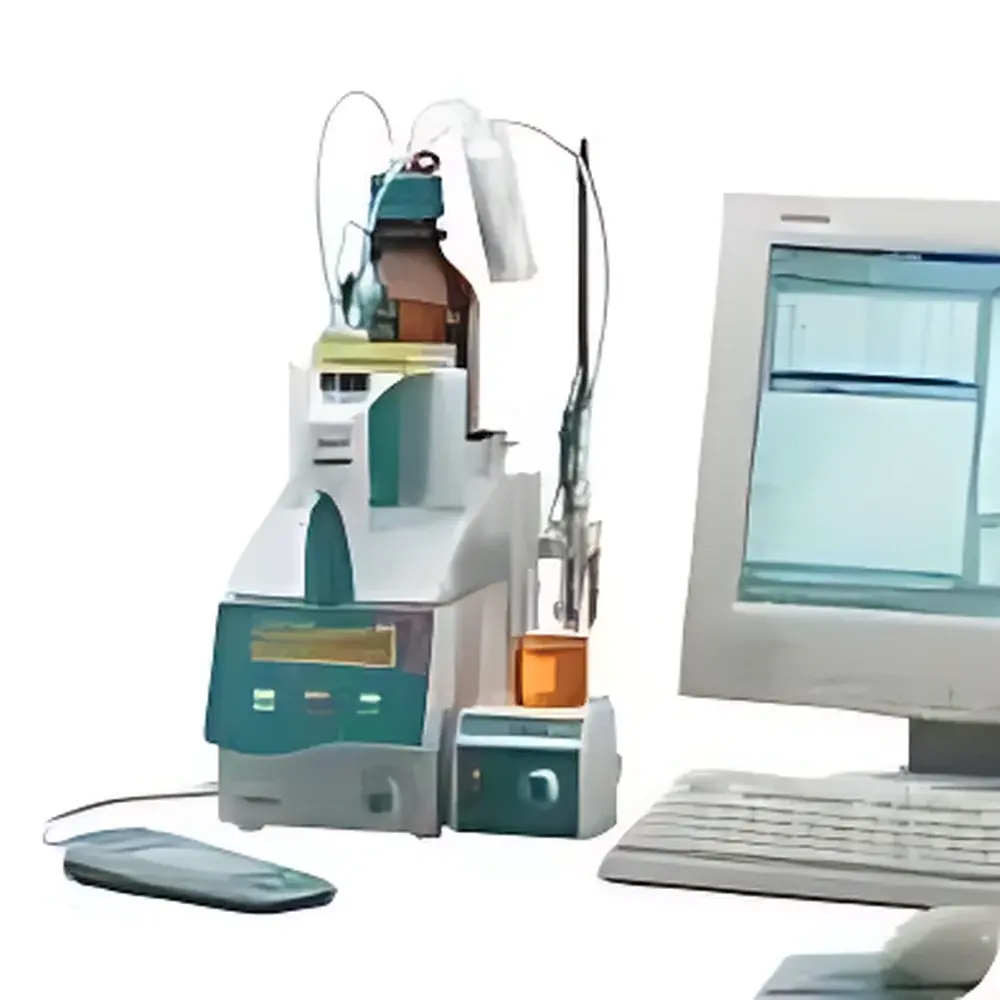
Metrohm 794 Standard Automatic Potentiometric Titrator
| Origin | Switzerland |
|---|---|
| Manufacturer Type | Authorized Distributor |
| Origin Category | Imported |
| Model | 794 Standard |
| Price | Upon Request |
| pH Range | 0 to ±20.00 |
| Potential Range | 0 to ±2000 mV |
| Current Range | 0 to ±200.0 µA |
| Temperature Range | −150.0 to +450.0 °C |
| Burette Volumes | 1, 5, 10, 20, or 50 mL |
| Burette Resolution | 1/10000 of selected volume |
| Absolute Accuracy (10 mL burette) | ±0.02 mL |
| Relative Accuracy (10 mL burette) | ±0.2% |
| Input Impedance | >10¹³ Ω |
| Polarization Current | 0 to ±127 µA |
| Polarization Potential | 0 to ±1270 mV (10 mV steps) |
| Electrode Inputs | 2 high-impedance measuring electrodes, 1 reference electrode, 1 polarization electrode, 1 temperature sensor |
| Method Storage Capacity | 100 methods |
| Dimensions (W×H×D) | 150 × 450 × 275 mm |
Overview
The Metrohm 794 Standard Automatic Potentiometric Titrator is a precision-engineered electrochemical analysis platform designed for routine and advanced potentiometric titrations in regulated and research-intensive laboratory environments. Operating on the fundamental principle of potentiometric endpoint detection—where the potential difference between a working and reference electrode changes sharply at the equivalence point—the instrument delivers high reproducibility and traceable quantification across acid-base, redox, precipitation, and complexometric titrations. Developed by Metrohm AG (Herisau, Switzerland), this fourth-generation titrator inherits the architectural rigor of the Titrando series while optimizing for robustness, method flexibility, and compliance-ready operation. Its modular hardware design supports both aqueous and non-aqueous matrices—including low-conductivity solvents—via integrated differential amplification and active polarization control, enabling accurate titration of weak acids, organometallics, and highly viscous samples without signal drift or junction potential interference.
Key Features
- Full support for standardized titration modes: Direct Endpoint Titration (DET), Metrohm Evaluation Titration (MET), and Setpoint Titration (SET), all configurable via intuitive method templates.
- TIP (Titration Intelligent Programming) allows up to nine sequential titration steps within a single method—enabling multi-stage analyses such as back-titration followed by blank correction and sample dilution compensation.
- Dual high-impedance input channels (>10¹³ Ω) ensure stable signal acquisition from glass pH, ion-selective, and redox electrodes—even under high-resistance conditions typical of non-aqueous media.
- Integrated polarization module provides programmable current (0–±127 µA) and potential (0–±1270 mV, 10 mV resolution) control for controlled-potential coulometric titrations and electrode conditioning protocols.
- Thermal compensation with real-time temperature monitoring (−150.0 to +450.0 °C) minimizes thermal drift in electrode potential and enables precise thermometric endpoint detection where applicable.
- Burette system offers five interchangeable volumes (1, 5, 10, 20, 50 mL) with 1/10000 volumetric resolution and certified accuracy of ±0.02 mL (10 mL burette), meeting ISO 8655-3 requirements for piston burettes.
Sample Compatibility & Compliance
The 794 Standard accommodates diverse sample matrices including aqueous solutions, alcoholic extracts, acetonitrile-based formulations, and chlorinated hydrocarbon solvents. Its differential amplifier architecture mitigates noise and baseline instability in low-conductivity systems—critical for pharmaceutical assay of APIs in anhydrous methanol or quality control of lubricants per ASTM D974. The instrument supports GLP/GMP-aligned workflows through secure user management, audit-trail-enabled method editing, and electronic signature compatibility (when paired with Metrohm’s tiamo™ software and compliant IT infrastructure). All electrical safety and electromagnetic compatibility conform to IEC 61010-1 and EN 61326-1 standards. While not inherently 21 CFR Part 11–certified, its data integrity framework—including immutable raw signal logging, version-controlled method archives, and timestamped event logs—facilitates validation against FDA and EMA regulatory expectations.
Software & Data Management
Operation is managed via Metrohm’s tiamo™ software (v3.x or later), which provides a validated, Windows-based interface for method development, real-time titration monitoring, and post-run evaluation. Raw potential vs. volume curves are stored in vendor-neutral .csv and proprietary .tmd formats, supporting third-party statistical analysis. The system stores up to 100 fully parameterized methods locally—with optional networked storage via shared drives or LIMS integration using OPC UA or ODBC connectors. All measurement events—including electrode calibration records, burette zeroing, and environmental temperature readings—are time-stamped and logged with operator ID, satisfying traceability requirements for ISO/IEC 17025 accreditation. Data export includes full metadata: method name, sample ID, analyst, date/time, ambient conditions, and instrument configuration.
Applications
This titrator is routinely deployed in QC laboratories for pharmacopeial assays (e.g., USP acid value determination in excipients), water hardness testing (EDTA complexometry per ISO 6059), chloride quantification in crude oil (ASTM D4294), and peroxide value analysis in edible oils (AOAC 965.33). In R&D settings, it supports kinetic titration studies, stability-indicating methods for degradation product quantification, and titration curve modeling for pKa determination of novel compounds. Educational institutions utilize its transparent signal acquisition and stepwise TIP programming to teach fundamental electrochemical concepts—from Nernst equation derivation to junction potential correction—and to train students in method validation per ICH Q2(R2).
FAQ
Does the 794 Standard support automatic electrode calibration?
Yes—it supports automated calibration routines for pH, redox, and ion-selective electrodes using up to three standard solutions per calibration curve, with slope and offset verification per ISO 7027.
Can it perform Karl Fischer titration?
No—Karl Fischer requires coulometric or volumetric moisture-specific hardware; the 794 Standard is optimized for potentiometric endpoints only.
Is remote operation possible?
Yes—via tiamo™ Remote Access over secured LAN or VPN, allowing supervised method execution and real-time monitoring from secondary workstations.
What electrode types are compatible?
All Metrohm-compatible electrodes with BNC or S7 connections, including combination pH electrodes, Pt ring electrodes, Ag/AgCl reference electrodes, and specialized sensors for sulfide, cyanide, or fluoride determination.
How is method validation documented?
Each method file contains embedded validation parameters (linearity range, LOD/LOQ estimates, repeatability criteria), and tiamo™ generates validation reports compliant with ISO 17025 clause 7.2.2 upon request.




